 In this article, we delve into the ongoing transformation in Argentina under President Javier Milei’s libertarian policies, as observed by Joel Bowman, founder of Notes from the End of the World.
Bowman’s previous update highlighted a remarkable shift away from an overbearing government towards individual freedom, showcasing the potential for economic revitalization alongside personal liberty. In his latest piece, Capitalism: The Enemy of Poverty, he uncovers significant developments reflecting this dual benefit.
If you haven’t yet, make sure to visit Bowman’s website and subscribe to his newsletter to stay updated with his insightful analyses as they unfold.
Enjoy!
MN Gordon
P.S. We have no financial ties with Bowman and do not profit from sharing his work. We simply believe in the value of his insights and wish to extend them to our audience.
—
Capitalism: The Enemy of Poverty
Free markets, free minds, and free people…
By Joel Bowman, founder of Notes from the End of the World
“Slowly, an international alliance has been forming among nations that… want to be free and believe in liberty.”
~ Javier Milei, at the WEF Congress of Vampire Demons in Davos, 2025
If you’re someone who prefers to avoid good news, today’s Note may not suit your taste.
However, with inflation under control, the fiscal deficit eliminated, public spending drastically cut, millions lifted out of extreme poverty, and the fastest growing economy in South America…
… it’s time for a brief update on the current situation back home in Argentina.
For newcomers, we are witnessing a significant transformation that many believed was impossible: a libertarian experiment unfolding in an unexpected locale. For over 75 years, mismanagement by the Argentine government led the country into turmoil.
With destructive price controls, heavy market intervention, burdensome regulatory measures, high trade tariffs, capital constraints, excessive money printing, and an ever-growing mountain of debt… the nation faced a grim reality of economic misfortune and despair.
All possible solutions were attempted, yet mistakes were repeated with relentless fervor. The intertwining of extensive state control and political misdeeds generated a chaotic web of disincentives, making it nearly impossible for citizens to navigate the pervasive corruption and indoctrination.
An Immoveable Feast
At the dawn of the century, public expenditure in Argentina consumed over a quarter of the nation’s economic output, based on the government’s own (often questionable) GDP figures. By 2010, that figure had soared to over a third. Fast forward to 2020, and this number grotesquely increased to 41.6%.
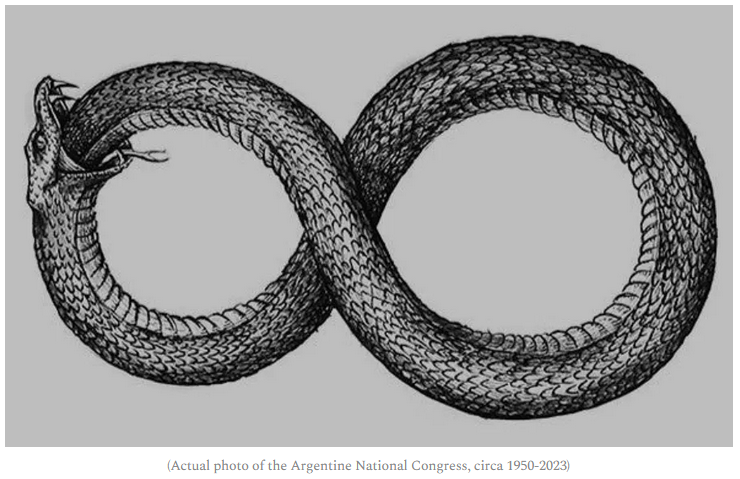
Like the mythological Ouroboros, the hungry State was consuming itself, alongside the lives of the beleaguered Argentine populace.
With many lives decimated by pervasive inflation and the creeping expansion of the welfare state, the once prosperous, resource-rich nation appeared to be heading towards a dire future. For Argentines hoping for a brighter tomorrow, escaping the cycle of poverty through democratic means seemed nearly impossible, given the stranglehold of the political elite, state media, and corporate interests all feasting at the public trough.
Now, after approximately a year and a half of this “libertarian experiment,” preliminary results are emerging.
When Milei took office in December 2023, he famously declared, “No hay plata.” (There is no money.)
He initiated a battle against the primary foe, Inflation, wielding his knowledge as a trained economist steeped in both Keynesian and Austrian economic theories to implement reforms aimed at curbing government spending and dismantling bureaucratic excess.
Milei introduced a series of controversial concepts, including advocating for private ownership of production means, believing that free individuals should set prices instead of state intervention, and insisting that parties in a contract should negotiate terms without interference from self-proclaimed experts.
He boldly took these ideas to the global stage, proclaiming:
“Free-market capitalism is the only tool we have to end hunger, poverty, and destitution across the entire planet,” he told a stunned audience at the World Economic Forum in Davos, January 2024.
“The State is a criminal and violent organization, as it is financed through a coercive source of income called taxes,” he mentioned at a conference hosted by the Cato Institute and Libertad y Progreso, April 2024. “As Hayek said, ‘every time the State intervenes, it creates a worse outcome.’”
Again, at the G20 Vampire Summit, November 2024, he reiterated: “I’ll say it again: the only thing that works to lift billions out of poverty is free-market capitalism… I’ll keep repeating it as many times as necessary, because history is entirely on my side.”
So how did these radical ideas fare?
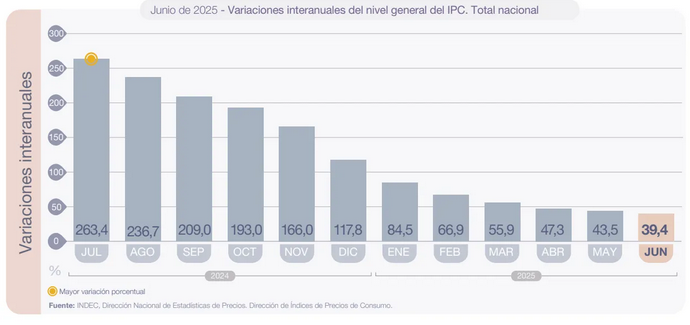
Currently, wholesale inflation rates suggest a positive trend, being recorded as negative monthly inflation—indicative of a phenomenon usually absent from today’s economic landscape: declining prices.
This development, while causing headaches for bureaucrats, is a breath of fresh air for everyday citizens at the lower end of the economic spectrum. Unsurprisingly, reports show a significant decrease in poverty levels in Argentina—an outcome that proponents of state intervention are reluctant to acknowledge and report.
The Nowcast Poverty Estimate from Universidad Torcuato Di Tella (UTDT) highlights a notable drop in poverty across the Pampas, plummeting from 55.5% in the first half of 2024 to 31.6% in the first half of 2025. This marks the lowest poverty rate since 2018, indicating that over 11 million people have escaped the grips of extreme poverty.
Recently, Unicef revealed that chronic child poverty in Argentina has reached its lowest level in nearly a decade. What does this translate to in terms of precious lives? As reported by the local paper, La Derecha Diario:
Child poverty decreased: 2.4 million children will no longer be poor in 2025
Chronic child poverty stood at 12%, the lowest rate since 2016.
Continued improvements are anticipated in 2025, with projections indicating a 19% drop in child poverty between the first half of 2024 and the first half of 2025, resulting in better living conditions for 2.4 million children.
Readers of these Notes will recognize that the downward trends in inflation and poverty are interconnected. The following graphs illustrate the correlation between monthly consumer price inflation (top) and the Nowcast Poverty Estimate (bottom).
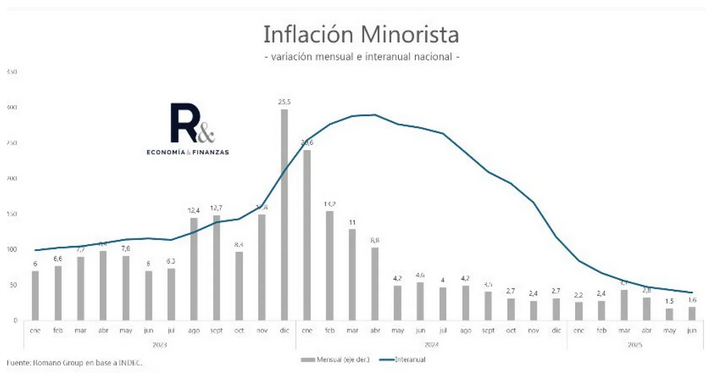
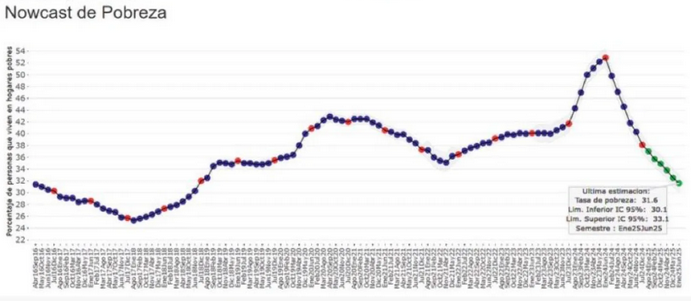
Imagine that: lower prices positively impacting poor people in the real world!
As a result, not only are these young individuals being lifted out of poverty, but they are also entering an economy grounded in liberty and opportunities associated with free market capitalism.
It is, therefore, no coincidence that Argentina, now the freest economy in South America, is also its fastest growing economy.
At the southernmost tip of the continent, prospects look brighter than ever, bringing encouraging news for those who wish to embrace it.
Stay tuned for more Notes from the End of the World…
Cheers,
Joel Bowman
founder of Notes from the End of the World
Return from Capitalism: The Enemy of Poverty to Economic Prism

