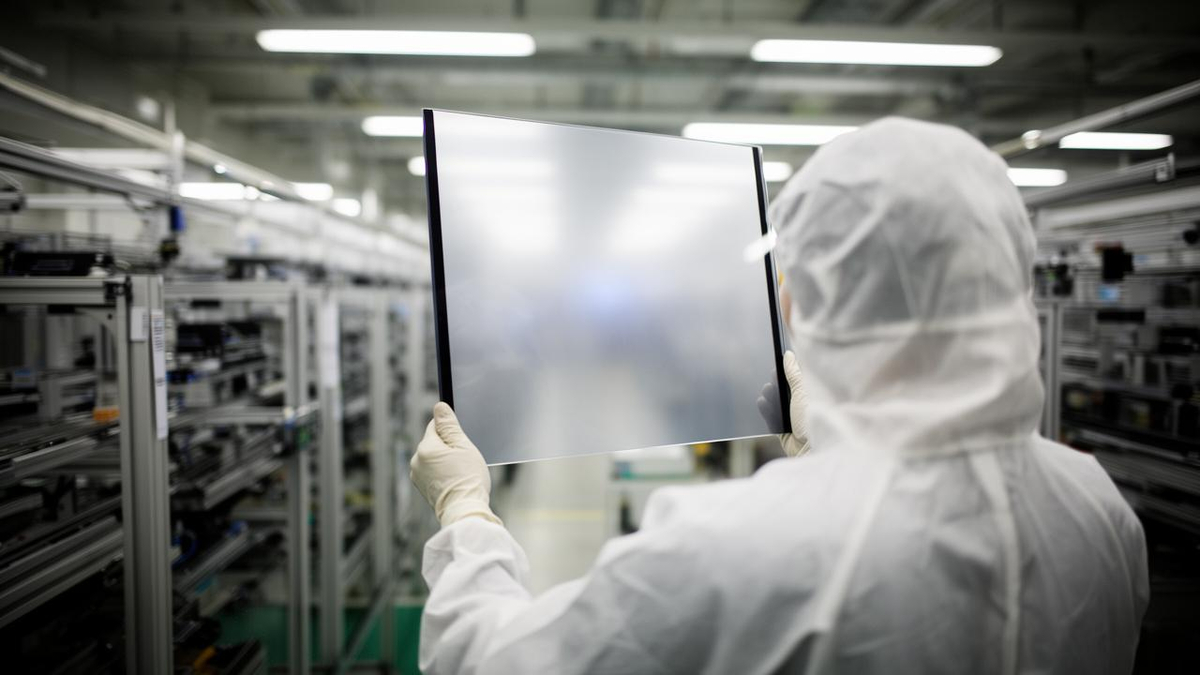
Chinese display manufacturers are rapidly gaining ground in the global automotive panel market, now holding nearly two-thirds of the share in shipments. Currently focused on LCD technology, forecasts predict that their cost competitiveness in OLED will significantly increase after 2028, intensifying competition for South Korean manufacturers.
According to a report from Omdia on September 7, Chinese companies are expected to reach a 65.2% share of global automotive display shipments in the latter half of this year, up from 59.0% earlier in the same year. This figure has sharply risen from just 28.1% in 2019 and 56.6% last year, more than doubling within six years.
This growth can be attributed to South Korean firms scaling back their LCD operations. As Samsung Display and LG Display shut down their low-margin LCD factories and redirected focus away from LCD, automakers had little choice but to source panels from Chinese suppliers.
China’s advantage stems from its establishment of advanced production lines for larger LCD panels a decade ago, unlike South Korean manufacturers, who halted expansion at the 8th generation. China is poised to maintain its focus on large LCD production for the foreseeable future.
However, the concern extends beyond LCD. Projections suggest that once China’s new 8th-generation OLED fabs meet smartphone and IT demand, existing 6th-generation OLED lines could shift to automotive uses. With most of this older equipment expected to be fully depreciated by 2028, lower costs could lead to even more competitive panel pricing in the automotive OLED market.
Investment in OLED production in China is accelerating, with significant projects like BOE’s B16 and TCL CSOT’s T8 underway. Research from Counterpoint forecasts a 74% year-on-year increase in OLED capital expenditure, with a major focus on 8.7-generation IT OLED.
By 2029, China’s OLED capacity is projected to exceed South Korea’s, a rapid rise from under 1% of the global market just a decade ago. This growth is heavily supported by substantial government assistance, covering 50-70% of display maker investment costs through various forms of financial aid.
In contrast, South Korea’s government measures to support the display industry have stagnated. The proposed 2026 tax reform excludes display technologies from production incentives, limiting support to certain key sectors. Furthermore, a pending legislative proposal for display industry support remains stuck in the National Assembly.
An industry representative stressed the importance of reinforcing OLED production capabilities for national industrial security, highlighting its expanding applications beyond just consumer electronics.
Omdia’s Senior Research Director, Stacy Wu, noted that China’s lead in automotive displays is critical, as the need for consistent production capacity throughout the vehicle lifecycle becomes essential for automakers and suppliers. With the automotive display market evolving amid trends like electrification and autonomous driving, if China employs its LCD base to pursue a pricing strategy in OLEDs, South Korean manufacturers may face significant profitability challenges in this competitive landscape.