Imperialism has often led to devastating consequences, and this remains evident today in the U.S.’s attempts to cling to its global dominance. Sanctions, warfare—whether direct or via proxies—genocides, and the spread of class struggles all contribute to widespread destruction.
In many respects, U.S. imperialism mirrors previous colonial endeavors. However, there is a crucial distinction: our awareness of climate change. The challenge of reducing emissions has always loomed large before humanity, yet global responses have been sluggish. It is indeed a cruel irony that as the reality of global warming becomes increasingly unmistakable, we find ourselves in a hyper-capitalist era driven by a nation committed to unbridled growth.
The U.S.’s aggressive tactics in the face of its crumbling empire are only exacerbating an already dire scenario.
Recent developments serve as a stark reminder that the preoccupations of powerful factions in Washington, focused on destabilization efforts today, are ensuring tomorrow’s global instability.
The planet has just officially crossed a critical climate tipping point with the catastrophic decline of global reefs, with more potential tipping points looming. Alarmingly, the Atlantic Ocean’s circulation is currently at its weakest state in a millennium and evidence is mounting that it may be nearing collapse.
Under more favorable circumstances, this alarming news would dominate global headlines, leading to unprecedented collaboration to keep fossil fuels buried and to rethink our economic and social frameworks.
Regrettably, the trend is heading in the opposite direction. Climate tipping points receive casual mention—if at all—before being swept aside by the latest nuclear threats in the New Cold War, potential conflicts in Venezuela and Colombia, and U.S.-Israeli initiatives to reshape the Middle East through calamity. It is no coincidence that the countries and regions targeted by Washington are known to contain the largest reserves of oil and gas, as the U.S. doubles down on a grim future characterized by fossil fuel dependency, climate upheaval, and entrenched class disparities guarded by rigorous state control.
The trajectory favored by economic elites not only blocks effective responses to climate change but may also lead them to leverage these crises as tools in their imperial toolbox.
In recent years, it has become increasingly challenging to keep pace with a barrage of news filled with schemes, frauds, absurdities, and violence running parallel with climatic changes. At times, I find myself losing sight of broader trends while trying to navigate Washington’s increasingly chaotic global maneuvers.
In an effort to step back from all this chaos, let’s take a moment to consider the overarching narrative—the planet’s destruction in pursuit of control.
Rogue Empire
On October 18, Maxim Musikhin, Director of the Legal Department of the Russian Foreign Ministry, provided an interview with TASS to discuss the International Court of Justice’s recent advisory opinion on countries’ responsibilities regarding climate change. Musikhin brings attention to an often-overlooked issue amid the flurry of war maps and geopolitical interests: the impact of one unnamed nation’s illegal unilateral coercive measures (sanctions) on the global community’s ability to tackle the planet’s most pressing threat:
In the context of the obligation to cooperate, we drew the Court’s attention to the problem of illegal unilateral coercive measures (sanctions). We noted that such measures do not allow the world community to effectively respond to the challenges associated with adverse effects of climate changes. Unilateral coercive measures not only fail to contribute to the achievement of the UNFCCC and the Paris Agreement goals, but also, in fact, cause damage to the environment, as well as violate the very obligation to cooperate, for which the States introducing them must bear responsibility under international law.
It is not my intention to suggest that Russia would emerge as a climate savior without U.S. intervention, but the point remains valid: the expectation for meaningful climate action is unrealistic when a major global power is acting recklessly and out of control. What recourse does Russia have when faced with unprecedented sanctions and attempts at disruption? Naturally, it will resort to whatever means are necessary for survival—even if that entails leaning on fossil fuels for economic stability. The same could be observed in Iran, Venezuela, and other nations facing similar pressures.
Instead of incentivizing these countries to keep fossil fuels untapped, the U.S. is forcing their hand through economic warfare, pushing them to extract resources that contribute to global warming.
Climate Change as Wild Card in the Global Great Game
As international rivalries intensify, climate change is becoming yet another bullet point in the geopolitical chess match.
Recently, China made headlines for achieving a significant advancement in “supply chain efficiency” when the containership Istanbul Bridge completed the 7,500 nautical mile journey from China to the UK via the Arctic Northern Sea Route (NSR) in just 20 days. This development elicits concern in Washington, as the NSR offers fewer opportunities for sabotage compared to other trade routes, traversing only Russian waters en route to Europe.
Consequently, think tanks and analysts are producing extensive reports on strategies for the New Cold War landscape. Yet, the fact that the NSR’s viability is bolstered by climate change—specifically melting ice—is typically shunted to the sidelines.
Shouldn’t this be the focal point instead? Why is there less concern about which countries emerge victorious when the very reality of the route in use signals that we are all facing losses?
Ultimately, this could prove inconsequential in the context of logistical battles. China may well be a dominant force in engineering, technology, and manufacturing, but under current trends, the UK and Europe may devolve into impoverished, climate-impacted regions not worth the effort of navigating new trade pathways.
War Kills the Environment Too
In September, the UN released its second assessment of environmental damage from Israel’s escalation in Gaza and the broader U.S.-backed turmoil across West Asia. The report reveals extensive harm to air quality, soil, and water, with recovery appearing unlikely.
This devastation intensifies the survival crisis for populations residing in some of the planet’s most challenging environments. As noted by Countercurrents:
The Middle Eastern region, characterized by its long coastlines and vast deserts, is especially susceptible to climate change and its associated extreme weather patterns. Recent severe droughts and disasters have gone largely unacknowledged due to the obsession with conflict. Sandstorms pose a significant threat, along with increasing desertification. Water scarcity is already a pressing issue in many countries, potentially worsening land sink and subsidence problems. The heat will continue to escalate over time, and access to effective air-conditioning will not always be guaranteed. Furthermore, varying natural disasters such as cyclones and coastal floods can threaten vital resources.
With upcoming wars being fueled by U.S.-Israeli interests, exacerbated by a ruling elite that predominantly supports these actions, the situation is expected to worsen.
Embracing the Heat
A growing number of indicators suggest that U.S. geopolitics not only detracts from the urgent need to confront climate change but that accelerationists in Washington may be welcoming it as an ally in their unending destabilization strategies.
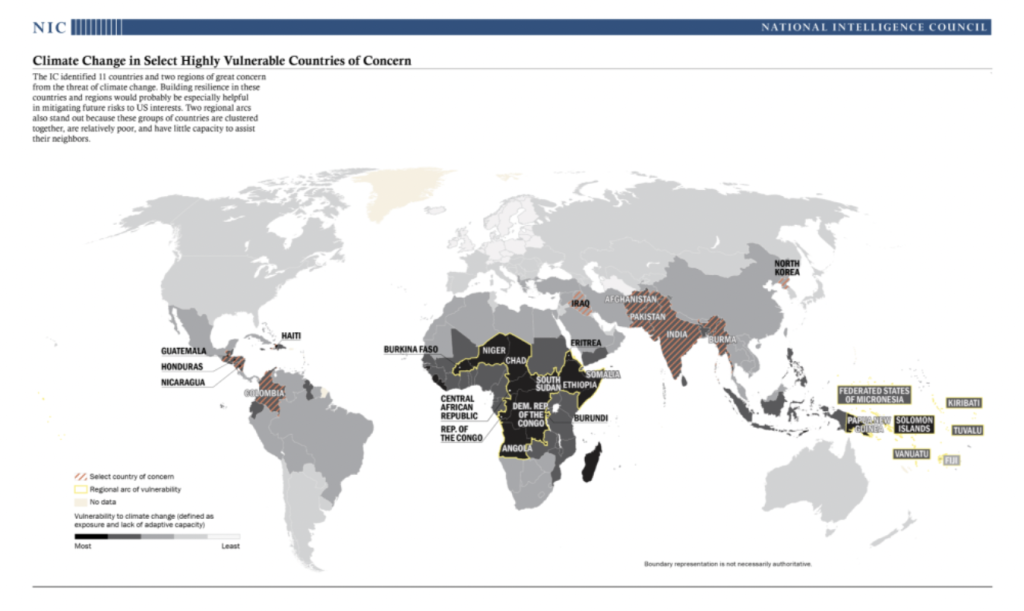
Known for their shortsightedness, D.C.’s intelligence community seems to believe that climate change could function as an asset for U.S. regime change efforts. The prevailing thought appears to be that even if the world consumes its dwindling fresh water, it may produce advantages. The National Intelligence Council forecasts that countries like Iran and China will be disproportionately affected compared to the U.S., presenting further “opportunities.”
…we judge that transboundary tensions probably will increase over shared surface and groundwater basins as increased weather variability exacerbates preexisting or triggers new water insecurity in many parts of the world. Forecasted climate change effects on local and regional weather—including loss of glaciers and more frequent and extreme droughts and floods—will make water management, resource allocation, and service provision more complex and difficult, and probably more contentious. Although scientific forecasts are not precise enough to pinpoint likely flashpoints, we assess that several areas are at high risk.
Those familiar with U.S. imperial strategy will recognize echoes of longstanding divide-and-rule tactics. With climate change on the rise, the U.S. won’t even need to exert significant effort or expenses for destabilization or the assembly of proxy regimes. And, conveniently, numerous target nations coincide with regions likely to be central in climate-related struggles.

The NIC narratives continue, detailing how countries like China and Iran will increasingly grapple with climate change.
Iran probably will face more frequent droughts, intense heat waves, and expanding desertification that, combined with poor water management, will lower food production and increase import costs during the coming decades, increasing the risk of instability, localized conflict, and displacement.
Such conditions can set the stage for further U.S. and proxy exploitation, resulting in significant human suffering. Notably, the Institute for the Study of War, led by the Kagan family, has developed a particular interest in Iran’s water resources.
The American Institute for the Study of War (ISW) has published a detailed map of Tehran’s water supply. pic.twitter.com/CRgg67qM35
— Soureh 🇮🇷🇵🇸 (@Soureh_design2) October 1, 2025
The NIS also provides insights concerning China:
More variable precipitation is likely to widen China’s south-north water disparity, challenging its ability to irrigate agricultural areas in its water-deficient northeast and further drive its dam construction on rivers upstream from neighboring countries. However, it is likely to have the financial and technological resources to compete successfully in markets for solar and other clean energies and limit the damage from climate impacts, such as more intense cyclones and river flooding.
And so, the U.S. accelerates forward!
She’s an icon
She’s a legend
And she is the moment✨ pic.twitter.com/MDkIj71JZf— U.S. Department of Energy (@ENERGY) July 31, 2025
Ultimately, the extent of chaos brought about by future climate tipping points remains uncertain.
The U.S. is currently fortunate to possess a wealth of fresh water (as does its neighbor, the “51st state” to the north)—for now. However, the other detrimental effects of global warming will also impact America and induce destabilization.
The challenge lies in the belief held by the economic elite in the U.S. that their wealth will always afford them solutions. They seem to welcome a future in which they can orchestrate a contractor-based empire, sustaining power through an oversight of weapon systems, AI data hubs, and mercenaries. Quinn Slobodian provides a helpful overview of this mindset:
Right-wing accelerationists envision a world where existing sovereignty dissolves into a “patchwork” of private entities, ideally ruled by what could be termed technomonarchies. Examples like autocratic polities such as Dubai serve as rough prototypes for how nations could be dismantled into “a global spiderweb of tens, if not hundreds of thousands of sovereign and independent mini-countries, each governed by their own joint-stock corporation without regard to the residents’ opinions.” These would constitute decentralized archipelagos: fortified nodes in a circuitry still connected through finance, commerce, and communication. Imagine the year 1000 in Central Europe, albeit with vertical take-off and landing taxis and Starlink internet.
Although the U.S. lacks the hard power or economic leverage necessary to maintain a global empire, these nihilists believe they can wreak enough havoc to establish control over a dystopian landscape from their affluent havens. Unfortunately, they are intent on imposing their delusions on all of us.
