Understanding the current landscape of artificial intelligence (AI) reveals paradoxical trends that are impacting employment and corporate behavior. While large language models, often identified with “generative AI,” seem to be experiencing a slowdown in growth, notable companies like Amazon, UPS, and Walmart are announcing significant job cuts, attributing these layoffs to AI implementation. What is driving this seemingly contradictory situation?
The crux of the issue lies in the fact that AI may not be delivering stellar results in terms of accuracy and reliability. Yet, it appears “good enough” for corporate executives who leverage it to tighten their grip on white-collar positions, all aimed at securing bonuses and satisfying shareholders. Even if the anticipated AI bubble bursts and reveals its shortcomings, the current pace of layoffs could irreparably damage the career prospects for college-educated workers, particularly recent graduates. This change threatens the social contract traditionally upheld by governments and management classes to ensure adequate employment and safety nets. Additionally, it could dismantle the prosperous framework established by Henry Ford, wherein stable, well-paying jobs allowed workers to purchase new consumer goods and contribute to economic growth—eventually fostering the development of suburban homes and class mobility. The erosion of this framework will further endanger the prospects of the middle class and destabilize society, especially as safety nets continue to deteriorate.
Corporate America is undergoing a transformation, but motivations are varied. Many executives seize on the current AI enthusiasm in the market, presenting traditional efficiency strategies as new and innovative AI approaches. Although reports indicate that 95% of corporate AI pilots fail, there is an increasing trend of large corporations reducing white-collar staffing, particularly for entry-level roles.
So, is this scenario indicative of AI functioning as a tool for class warfare rather than a genuine technological advancement?
The Corporate AI Firing Frenzy
Before delving deeper into the consequences, let’s examine the magnitude of this trend. Historically, company leaders would avoid advertising workforce reductions, but now they are openly celebrating layoffs as successes. This strategic shift has been documented in numerous reports, such as one from the Wall Street Journal in June 2025, where it affirms the new mindset among CEOs:
In today’s rapidly evolving business landscape, leaders are increasingly lauding layoffs as achievements rather than a last resort. Companies are using staff reductions as deliberate tactics to enhance profitability and demonstrate their AI readiness to investors.
As reported by the Wall Street Journal by Chip Cutter on June 27th, 2025.
CEOs Are Shrinking Their Workforces—and They Couldn’t Be Prouder
Major companies are shrinking, and their CEOs are eager to share this information. Gone are the days when workforce reductions indicated trouble; now, executives are eager to showcase their commitment to embracing AI while aiming for leaner operations.
For instance, Wells Fargo’s CEO recently highlighted that their workforce has consistently shrunk for twenty consecutive quarters, praising attrition as a beneficial strategy. Similarly, Loomis and Union Pacific have noted that they are managing growth while simultaneously cutting employee numbers, which further illustrates this new corporate mentality.
The shift aligns with a cooling labor market where the balance of power is tilting towards employers, prompting a reconsideration of how to effectively run their businesses. Many are inspired by startups that achieve significant revenues with minimal staff, seeing extensive workforces as more of a liability than an asset. The message is clear: companies aim to embrace AI advancements while reducing their human resource reliance.
A recent Wall Street Journal analysis provides an overview of notable layoffs within major corporations, such as Amazon’s reported cuts of 14,000 jobs and UPS’s reduction of its management positions.
Amazon revealed plans to eliminate approximately 10% of its white-collar workforce as part of a larger strategy. Other companies like UPS and Target have also announced substantial layoffs, with thousands of office workers in the U.S. facing an increasingly stagnant job market.
The prospect of a new, lean employment normal in the U.S. looms as employers tighten their belts, leaving fewer opportunities for both experienced and new workers who had relied on traditional white-collar roles. Factors like decreasing hiring confidence and the rising pressure from investors to operate efficiently amplify this trend.
While this corporate restructuring may feel familiar, the scale of the current transformations is unprecedented, largely driven by technological advancements in AI. The seismic shifts began in the 1980s with efforts to streamline corporate structures, but the renewed push to embrace AI is reshaping the workforce landscape in ways previously unseen.
Signs of Weakening AI Demand
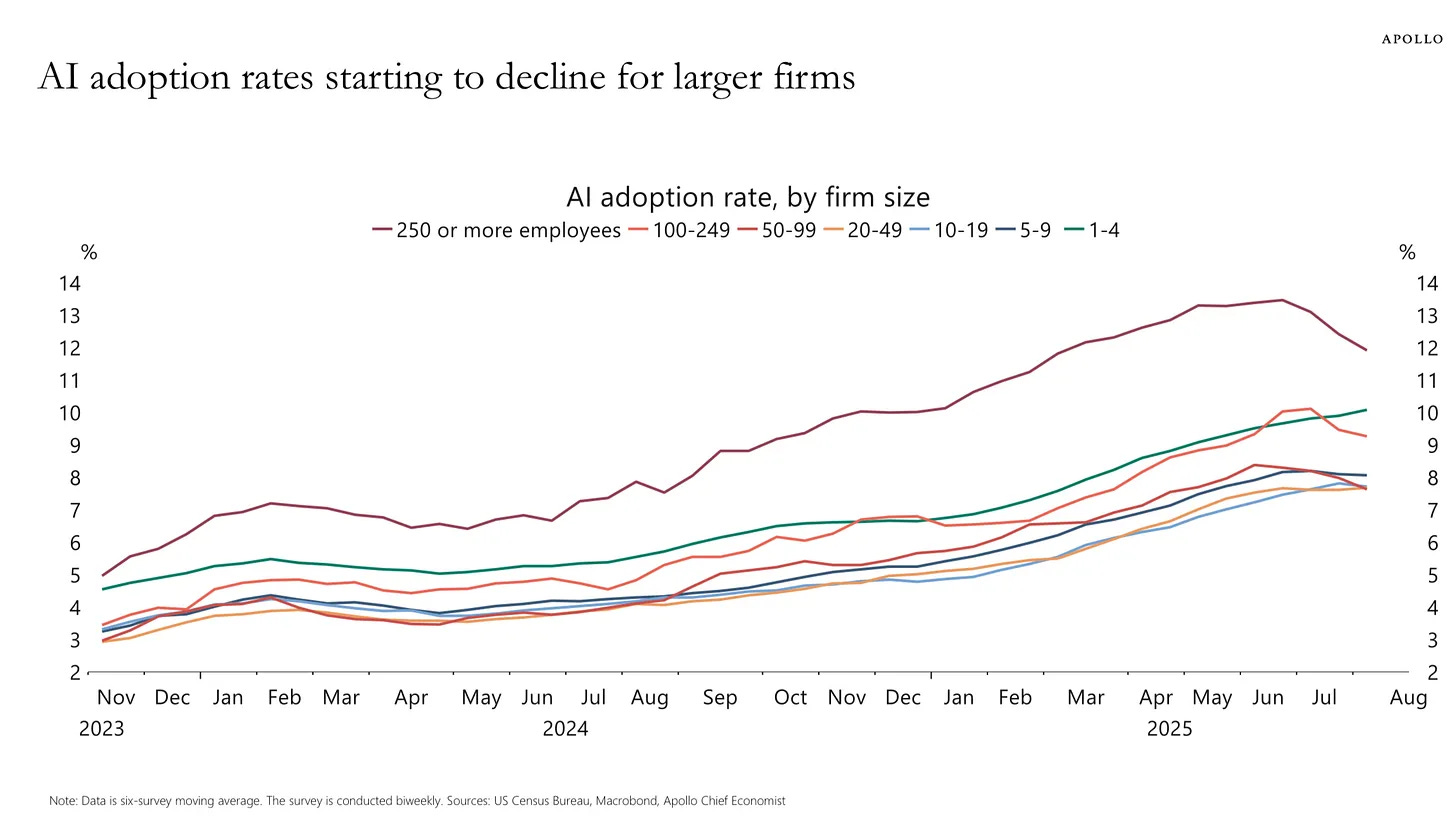
Despite the fervor surrounding AI technology, indicators suggest a decline in its demand, hinting at performance shortfalls. Noteworthy studies have shown that the use of generative AI among American workers has decreased recently.
Hartley, Jolevski, Melo, and Moore have been tracking GenAI use for Americans at work since December 2024.
They report that GenAI usage fell to 36.7% of respondents in September 2025 from 45.6% in June.
Furthermore, tech-related applications such as ChatGPT are experiencing reduced growth in download and daily usage. Despite these signs, faith in AI persists among corporate leadership, often overlooking service quality deterioration that accompanies reduced human labor.
What Happens as the Gutting of the Middle Class Accelerates?
Critics might argue that office workers are facing the consequences of choices made over previous decades, including outsourcing and offshoring. However, many of these strategic decisions, aimed at increasing executive pay and power, have produced a fragile workforce landscape where stability is increasingly rare.
The economic rationale for the AI boom holds that new technology will enhance overall prosperity. However, history shows us that major economic shifts often lead to a divergence in fortune—producing winners and losers. Income growth in the U.S. has stagnated, especially for younger workers slogging through economic challenges and high living costs.
Real income growth for workers aged 25 to 54 has reached near-decade lows, reflecting a distressed labor market. Even as inflation erodes wage gains, many individuals find themselves in precarious financial situations.
As the middle class shrinks, the broader societal implications are profound. Young individuals burdened with student debt despite uncertain job prospects seek refuge in parental support or struggle against mounting financial obligations. This shift in household dynamics and career aspirations could reshape higher education trends and ultimately erode societal stability.
The potential for unrest looms large if the middle class continues to suffer from shrinking opportunities and declining wages. History demonstrates that economic shifts can spark significant social movements, yet the current climate does not seem conducive to organized resistance.
In conclusion, while the complexities surrounding AI and employment continue to unravel, a deeper understanding reveals a society poised on the edge of drastic change. The impacts on the middle class signal not only economic distress but also threaten the social fabric as we know it. As the landscape evolves, vigilance, adaptation, and perhaps a reevaluation of values will be crucial in navigating the future.