“There will be no progress in negotiations with the United States if Marco Rubio is included in the delegation.” Luiz Inácio Lula da Silva
Recent developments suggest that relations between the US and Brazil could be mending, at least temporarily, until the next tariff-related controversy emerges. Brazilian President Luiz Inácio Lula da Silva reportedly engaged in a “highly constructive meeting” with President Trump at the 47th ASEAN summit in Kuala Lumpur earlier this week. During their discussions, Lula presented Trump with a document advocating against US tariff increases on Brazilian goods, while also recognizing America’s right to impose such measures.
Moreover, the US is in urgent need of a new source for rare earth minerals, with Brazil being the world’s second-largest supplier, following China. This underscores the US government’s, military’s, and corporate interest in these resources, overshadowing the political affiliations of Trump’s recently incarcerated ally, Jair Bolsonaro, and Lula’s calls for de-dollarisation.
However, for negotiations to advance between Brazil and the US, Lula has identified a significant obstacle requiring resolution: US Secretary of State Marco Rubio.
“As an experienced president, I understand that if you wish for a successful deal, you cannot have someone with ill intentions at the negotiating table; otherwise, it will lead nowhere.”
Brazilian President Luiz Inácio Lula da Silva remarked in an interview that negotiations with the USA will not progress if Secretary of State Marco Rubio is part of the negotiating group.
Rubio, a staunch critic of Lula, opposes governments allied with him in Venezuela, Cuba, etc. pic.twitter.com/2NROd5L9Er
— Sprinter Press News (@SprinterPress) October 28, 2025
While Lula has not explicitly named Rubio in the previous statement, he did reportedly do so during another portion of his press conference. According to Infobae, he stated:
“Progress in negotiations with the United States will be impossible as long as Marco Rubio represents the team. He is against our allies in Venezuela, Cuba, and Argentina.”
Lula has also aimed to assume a mediating role in the Caribbean, as the Trump administration has intensified threats and actions against Venezuela and Colombia, while broadening its maritime military engagements.
This approach seems peculiar, especially as one party is clearly engaging in hostilities without indication of retreat. It’s noteworthy that Lula’s relationship with Nicolás Maduro’s government has deteriorated since the summer of 2023 when he single-handedly prevented Venezuela from joining BRICS.
Nonetheless, any attempt to avert further US escalations in the Caribbean is commendable—not just for peace in Latin America but also for stability in the US.
The Soufan Group, an international political and security think tank, has echoed warnings about potential backlash from the US military action against well-armed drug cartels, many of which operate in urban centers across the United States.
The attempt to eradicate these cartels could lead the US into yet another chaotic, shortsighted, misguided conflict, the aftershocks of which would likely resonate closer to home. Instead, it is essential to pursue strategies that are “reasoned, legal, ethical, and moral, grounded in realistic success expectations.”
However, the likelihood of achieving this under the current leadership of Trump, Hegseth, and Rubio appears slim—especially with Secretary of War Pete Hegseth purportedly urging US military officials to sign non-disclosure agreements in anticipation of potential disclosures regarding future war crimes.
Prioritizing Strategic Minerals
Despite the obstacles posed by Rubio, Lula’s resistance in both public and private spheres seems to be gaining some traction. Argentine geopolitical analyst Bernabé Malacalza remarked in an interview (in Spanish) with Diario Red:
“Lula’s assertiveness has effectively sidelined Marco Rubio from negotiations, as he was notably absent from the table during the initial meeting, thanks to Lula’s firmness.”
The recent thaw in relations between the Trump administration and Lula’s government appears primarily driven by strategic interests, particularly the ongoing conflict with China over rare earth mineral control.
“A significant factor is the restrictions China has imposed on rare earths. Brazil’s abundant reserves make it highly appealing to the US.”
“With China dominating 60% of rare earths and 90% of refining capabilities, the US is more than willing to invest in Brazil. What we are witnessing is the early stages of negotiation.”
Nonetheless, Lula insists that negotiations cannot involve Rubio. He is not alone in voicing objections, as Colombian President Gustavo Petro has criticized Rubio’s role in exacerbating tensions across the Caribbean:
“Marco Rubio has emerged as a factional hindrance to peaceful relations between the US and Latin America.”
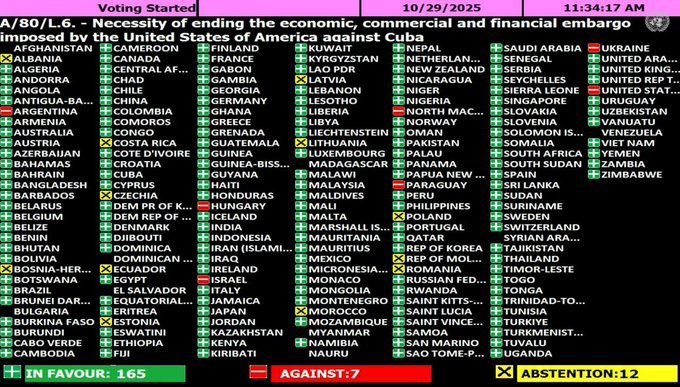
Petro also noted the growing isolation of the US at the UN, referencing the overwhelming vote of 165 countries in favor of ending the blockade against Cuba, with only seven—including the US and its closest allies—opposing it.
Petro is correct in asserting that the US faces significant isolation on this matter, a trend that has persisted for decades. However, it is important to recognize that more countries voted against or abstained from this year’s resolution compared to past years. The dissenting nations were the US, Israel, Ukraine, Argentina, Paraguay, Hungary, and North Macedonia, while the abstaining countries included the three Baltic states, Ecuador, Costa Rica, Czechia, Poland, and Morocco.
The Empire Strikes Back
Petro’s outspoken critiques of US foreign policy have led to the cancellation of all US aid to Colombia that was ostensibly designated to combat drug trafficking. Further, the US Treasury has added Petro to the list of individuals sanctioned by the Office of Foreign Assets Control (OFAC), informally known as the “Clinton List”—a registry for entities associated with drug trafficking, prohibiting transactions with the US financial system.
Tensions between Bogotá and Washington intensified in September when Petro condemned US policies in Latin America and the Israeli government’s actions in Gaza at the UN General Assembly. He even called for establishing an international task force to halt the violence in Gaza. In response, the Trump administration removed Colombia from its list of reliable partners in drug enforcement and revoked Petro’s US visa.
The implications of Petro’s inclusion on the “Clinton List” are already being felt. Recently, companies operating at Madrid’s Barajas airport refused to refuel the aircraft carrying the Colombian president to Saudi Arabia for fear of violating OFAC regulations. Ultimately, the presidential plane was redirected to a Spanish military base for refueling before continuing its journey.
The extent to which Rubio influenced these punitive actions is uncertain. What remains clear is his fervent commitment to undermining the Communist regime in Cuba, along with allied governments in Venezuela and Nicaragua. Just recently, he tweeted in praise of the United States and the Cuban Democratic Revolutionary Front’s failed Bay of Pigs “invasion”:
“Sixty-four years ago, the brave patriots of Brigade 2506 undertook a noble mission at the Bay of Pigs in pursuit of freedom for Cuba. Today, we honor those who sacrificed their lives seeking liberty from Castro’s rule.”
— Secretary Marco Rubio (@SecRubio) April 17, 2025
One of Rubio’s initial actions as Secretary of State was reinstating Cuba’s designation as a state sponsor of terrorism. The Biden administration kept this designation until just before leaving office, resulting in minimal changes in overall policy.
Sanctioning Cuban Doctors and Nurses
However, considerable changes have occurred in the realm of sanctions. Rubio’s State Department has imposed increasingly stringent sanctions on Cuba, aggravating the electricity shortages that are creating significant hardships for its citizens.
In a move that exemplifies the lowest point for US foreign policy, the Trump administration has sought to obstruct some of the world’s most impoverished nations from benefiting from the medical assistance—often provided free of charge—afforded by Cuban medical missions. As noted in a previous post from March 18, Caribbean Countries Blast US Plans to Sanction Cuban Medical Missions Around the World:
On February 25, Rubio’s State Department announced visa restrictions targeting both Cuban government officials and those globally found to be “complicit” in the island’s medical assistance efforts. These sanctions could extend to family members of current and former officials and include trade restrictions for involved countries.
The US government effectively accuses Cuba of utilizing forced labor, likening overseas Cuban medical personnel to slaves. If successful, these sanctions could devastate an already fragile Cuban economy—excluded from the US-dominated financial system for years—and impose additional hardship on various nations relying on Cuban medical aid amid looming debt crises.
Among those affected is Jamaica, which Rubio recently visited. In a press conference with Prime Minister Andrew Holness, Rubio attempted to denounce Cuba’s medical efforts. Moments later, Holness countered Rubio’s claims by stating that Cuban healthcare professionals had been “incredibly helpful,” filling the significant gap left by Jamaican medical personnel emigrating to other nations.
¡QUEDO EN 4 BLOQUES!
🇯🇲 Marco Rubio visited Jamaica to speak ill of Cuban doctors, only for Prime Minister Holness to set the record straight.
🗣️ “Cuban doctors in Jamaica have been enormously helpful to us.” pic.twitter.com/YnVGcqlFq7
— Adelso Carvajal (@adelso_car) October 29, 2025
The Most Powerful Secretary of State Since Kissinger?
From the outset, Trump’s appointment of Rubio as Secretary of State—and his concurrent role overseeing national security—positions Rubio among the most influential secretaries of state since Henry Kissinger. In an article cross-posted here, Medea Benjamin and Nicholas Davies cautioned that “Rubio’s disdain for his ancestral homeland, Cuba, has manifested in a broader hostility toward the rest of Latin America.”
“He aligns himself with far-right politicians like Jair Bolsonaro in Brazil and Javier Milei in Argentina, while he harshly criticizes progressive leaders like Lula in Brazil and former Mexican President López Obrador, whom he labeled an ‘apologist for tyranny’ for supporting other leftist governments.”
In regard to Venezuela, he has supported severe sanctions and advocated for coup attempts against Nicolás Maduro’s government. Rubio was a primary architect of Trump’s ill-fated initiative recognizing opposition leader Juan Guaido as president in 2019 and has promoted sanctions and attempts at regime change in Nicaragua.
In March 2023, Rubio urged President Biden to impose sanctions on Bolivia for holding accountable leaders responsible for the 2019 US-supported coup that resulted in the killings of at least 21 individuals.
Rubio’s appointment has also been a setback for hopes of peace in Ukraine and the Middle East.
In Latin America, Rubio’s focus isn’t limited to attacking leftist governments; he is also pressuring judiciary systems in the region to absolve former right-wing leaders facing serious criminal charges, including Bolsonaro, who recently received a 27-year prison sentence for attempting to overthrow the Lula government. This prosecution played a role in Trump’s decision to impose a 50% tariff on Brazilian exports.
Rubio’s response was:
“The political persecutions led by sanctioned human rights abuser Alexandre de Moraes continue. He and others on Brazil’s supreme court have unjustly ruled against former President Jair Bolsonaro. The United States will respond accordingly to this witch hunt.”
— Secretary Marco Rubio (@SecRubio) September 11, 2025
In a recent panel discussion on CNN Brazil, former Brazilian ambassador to the US, Rubens Barbosa (1999-2004), noted that the diplomatic pressure to release Bolsonaro originated not from the White House but rather directly from Rubio himself. The urgency is highlighted by the fact that the US now requires a new supply of rare earth minerals from Brazil, making Bolsonaro’s imprisonment less of a priority.
Even more contentious is Rubio’s intervention in Colombia’s legal system to safeguard former President Alvaro Uribe Vélez, recently convicted for fraud and witness tampering and sentenced to 12 years under house arrest—marking the first instance in Colombian history where a former head of state faced criminal conviction.
In July, Rubio described the ruling against Uribe as a “political assault” conducted by “radicalized” judges. In response, 17 members of Congress signed a letter urging Rubio to cease interference in the Uribe case, arguing that it undermines the rule of law, sovereignty, and judicial independence.
“Uribe’s sole crime has been his relentless defense of his homeland. The exploitation of Colombia’s judiciary by radical judges sets a dangerous precedent.”
— Secretary Marco Rubio (@SecRubio) July 28, 2025
Ultimately, Rubio’s maneuvers bore fruit; the Supreme Court in Bogotá overturned Uribe’s conviction, exonerating him of all bribery and fraud allegations.
A Genuine Narco-President
Uribe stands as Colombia’s preeminent political figure—he was historically the first president to gain re-election in over a century after reforming the constitution to allow it. His documented ties to drug trafficking remain concerning. According to a 1991 report by the US Defense Intelligence Agency, later declassified in 2004, Uribe was a “close personal friend of Pablo Escobar,” “collaborating at high government levels” with the Medellín cartel.
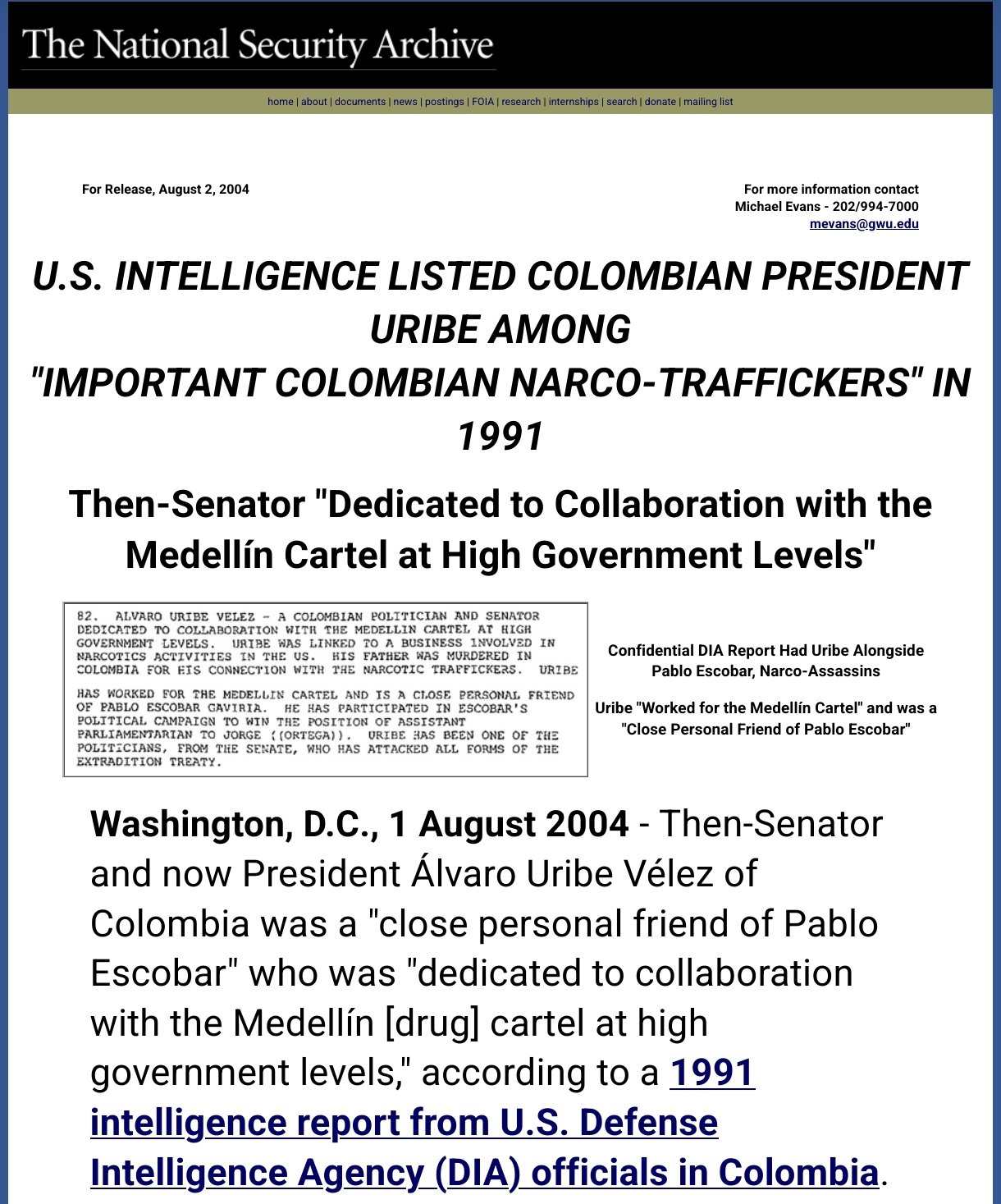
Uribe has been not only alleged to collaborate with the Medellín cartel, but also to cultivate illegal paramilitary groups associated with extensive human rights violations over the past three decades. As noted by the US National Security Archive:
“Testimonies from former employees of ‘La Carolina’ ranch in Yarumal indicate a close relationship between Uribe’s family—particularly with his brother, Santiago Uribe—and the leader of the ‘Doce Apóstoles’ (Twelve Apostles), a death squad targeting petty criminals, drug users, and supposed supporters of insurgent groups like the FARC and ELN.”
“Historically, Uribe has been viewed as a supporter of state-sponsored civil militia groups during his time as governor of Antioquia and as president, further empowering paramilitary forces known as the United Self-defense Forces of Colombia (AUC) responsible for most abuses in recent decades.”
Same Old, Same Old
In conclusion, the US government faces a glaring contradiction: it imposes sanctions against Colombia’s current president and his family based on unfounded allegations of drug trafficking, while simultaneously working to liberate a former president suspected of actual ties to drug trafficking and who has associations with paramilitary death squads.
This dynamic illustrates the nature of US foreign policy under Rubio’s stewardship—a continuity of historical patterns in interactions with Latin America that have persisted since the early 20th century. As John Mearsheimer summarizes in a recent interview with Judge Napolitano, this interventionist legacy is unlikely to change, especially with figures like Rubio at the helm:
“Since the early 20th century, the United States has resisted any left-leaning governments in Latin America. Whenever a leftist regime emerges, US intervention is nearly always the outcome.”
“This narrative predates Rubio, though he indeed intensifies the situation. His aversion to the Cuban regime leads him to also harshly oppose similar governments in Venezuela and elsewhere.”
Ultimately, the US’s relations in Latin America will continue to be shaped by ongoing historical paradigms and the actions of interested local leaders. Some dynamics, it seems, will never change.