Seeking Solitude in an Unforgiving Land
 Modern economists often sound alarm bells over economic uncertainties. The world presents us with myriad puzzles, leading experts to fret over aspects such as population growth versus limited farmland. They frequently envision a grim scenario where divergence leads to chaos.
However, it is beyond the full grasp of any one individual to piece together every part of this puzzle, especially when the elements and numbers are perpetually in flux. Markets exist to facilitate real-time corrections and modifications, preventing disarray from taking hold.
Under normal circumstances, markets function effectively. Yet there are moments, particularly when governments interfere with an economy or its currency, when calamity ensues. In those times, it’s prudent to seek refuge away from the chaos.
Today, we find ourselves at the outskirts of civilization. Here in Joshua Tree, located in Southern California’s High Desert, we are on a quest for a rare and sought-after treasure. This commodity is in scarce supply yet increasingly essential in our daily lives. Perhaps it is in short supply and highly desired in yours too.
What we pursue is not gold or riches but rather silence—a resource we seldom acquire enough of. We find ourselves yearning for more.
Silence undoubtedly plays a crucial role in fostering the ability to think, reflect, and understand the complexities of our world. It is a vital prerequisite for clear insight. Without it, the tumult and distractions make it nearly impossible to rise above the noise and anticipate what lies ahead.
Yet silence is not our only goal in this remote expanse. We are also in search of perspective and a tangible awareness of life’s resilience in such a harsh environment. We aim to observe how organisms adapt to survival against the odds and to grasp where to navigate when the moment arrives to escape the turmoil.
The ominous signs developing just over the horizon have been accumulating for around 80 years. With over $60 trillion in combined public and private debt resting upon a nominal GDP of roughly $20 trillion, it begs the question: How can GDP support this massive debt while simultaneously being supported by it?
Over an extended timeframe, what seems impossible may be sustained through escalating debt issuance. However, ultimately, a colossal pyramid of debt erected upon a shaky foundation will collapse. It’s an undeniable truth.
This leads us inexorably toward a complete financial breakdown and a widespread reckoning of debt that will resonate through the economy for decades. There is no way to avert it.
Thus, we must learn to find joy amid the chaos. Even in the most challenging situations, we can recognize things to be grateful for… if we take the time to appreciate our blessings.
Experiencing Beauty in a Harsh Environment
Each sunrise at Joshua Tree National Park is an epitome of perfection. As night gives way to day, the myriad stars fade, and the desert landscape transforms into a magical scene. From the Cholla Cactus Garden, the sun rises over the eastern horizon like a radiant orb.
The sky transitions through a stunning spectrum of colors from purple to pink, then orange, and finally yellow. As dawn breaks, the winds awaken, sending clouds swirling across the vast sky like a mesmerizing kaleidoscope. Our words fail to capture this splendor, and our eyes cannot cling to it for too long.
Yet, this enchantment is fleeting. The vibrant hues soon diminish, replaced by the relentless desert sun, making the surroundings feel akin to walking through a giant oven.
At the intersection of the high Mojave Desert and the low Colorado Desert, the rugged terrain thrives in its own imperfect way. Massive boulders, sharp mountains, barren cacti, abandoned mining pits, and vast desert valleys comprise this unique setting.
Fringe-toed lizards scurry across the loose sand, utilizing their webbed feet. Ground squirrels stand upright like Homo erectus, fixating on you with a gaze that seems frozen in time. Indeed, this is truly a strange land.
Escaping the Everyday
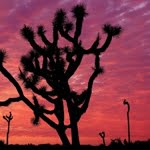
The eponymous Joshua Tree, uniquely scattered throughout the landscape, captures attention and admiration, growing more intriguing with time. At first glance, it may appear as a curious mutation—neither clearly a cactus nor a tree.
However, the distinction is inconsequential. Each Joshua Tree is shaped by the intense desert winds, creating its own peculiar character. What does that signify?
When Mormon pioneers first encountered these unusual trees, they imagined them resembling the biblical Joshua, with their outstretched limbs akin to raised arms. They named the trees in honor of this vision.
The Cahuilla Indians, who inhabited this region long before western settlers arrived, utilized the fibers of the Joshua Tree to create sandals and nets. They fashioned branches into quail traps. Tales of their past resonate through the petroglyphs engraved on the rocks, which to our untrained eyes may resemble the scrawls of a child.
The Cahuilla’s survival in these harsh conditions appears to stem from their resourcefulness. While many perceived a desolate wasteland, they recognized a land filled with potential. Archaeologist Charlotte Hunter identified 121 plant species employed for sustenance, healing, or as materials for crafting.
While Joshua Tree may serve as an appropriate refuge when seeking to escape reality, it is not a viable long-term haven. Only the most resilient of desert inhabitants can endure here for an extended period. Nevertheless, the abundance of silence makes this place worth the visit for anyone in need.
Warm regards,
MN Gordon
for Economic Prism