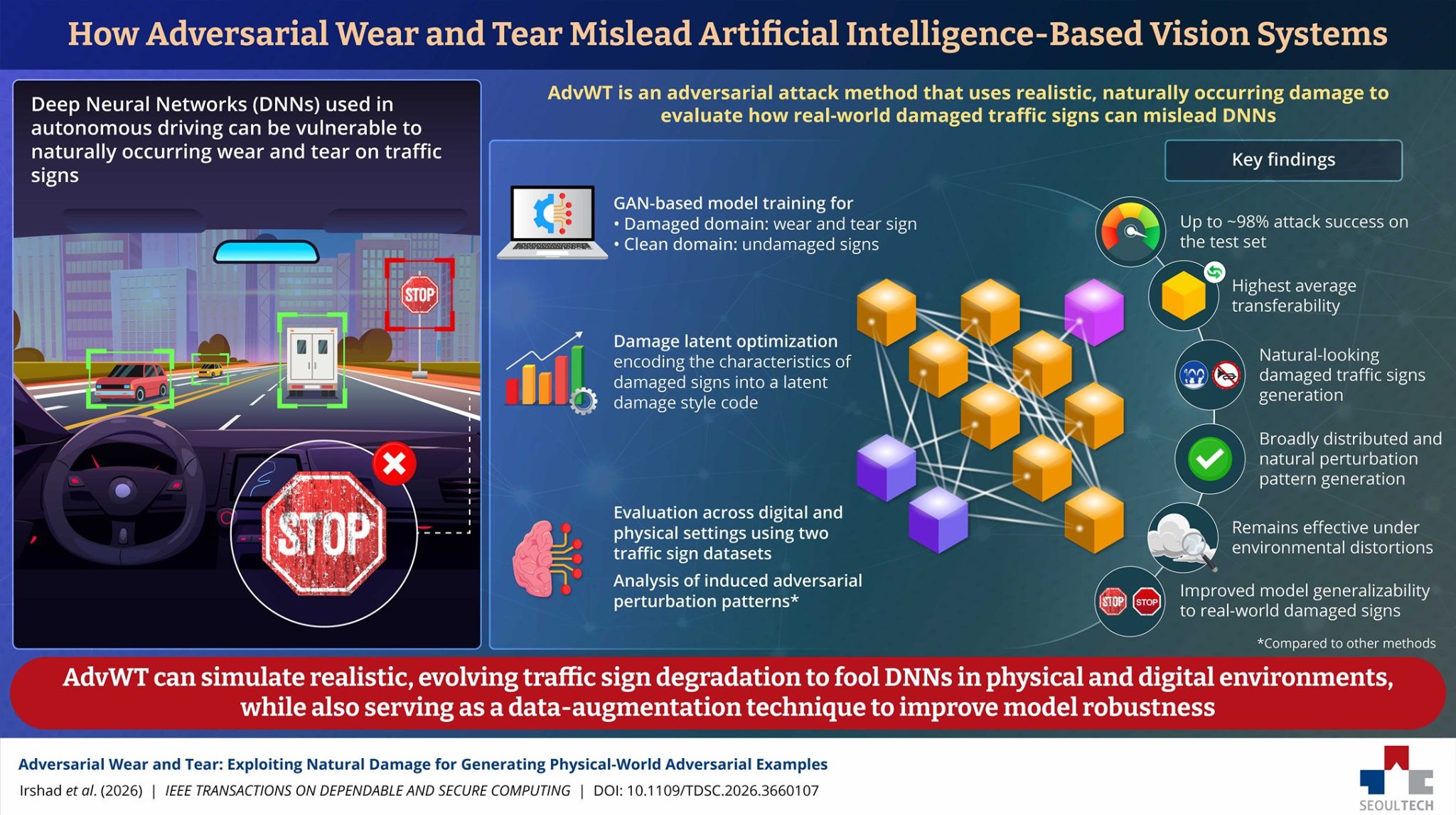
The AdvWT framework, developed by researchers from Seoul National University of Science and Technology and Kyung Hee University, addresses vulnerabilities in AI-based vision systems, particularly in traffic sign recognition. By leveraging naturally occurring wear and tear, AdvWT generates images of traffic signs that mimic real-world damage, which can mislead deep neural networks (DNNs).
This framework, utilizing a generative model built on StarGAN-v2, produces a variety of realistically degraded signs while maintaining their original meaning. Testing has shown impressive results: it achieved high success rates in misclassifying signs across different AI architectures, including both CNNs like ResNet-18 and MobileNet, as well as transformer models.
Moreover, the researchers validated the effectiveness of these adversarially modified signs in real-world conditions by printing and photographing them, confirming that the misleading effects persist despite physical alterations. Interestingly, AdvWT also has applications in restoring damaged signs, hinting at a dual-purpose utility in both testing and enhancement of AI recognition systems.
This work underlines the necessity of building robust AI systems that can endure real-world challenges and emphasizes the importance of continuous improvement in understanding and addressing AI failures in critical applications like autonomous driving, healthcare, and finance.