 The world increasingly finds itself at odds, with each day bringing new divisions. From contentious elections to growing censorship on social media platforms, the signs of a brewing crisis are right before us.
Observing from our vantage point over San Pedro Bay—the primary entry point for Chinese goods into the USA—the unfolding economic challenges become strikingly clear, even to the untrained eye.
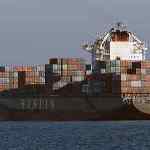
In response to the incessant growth of international trade, ports have expanded berths and deepened channels to accommodate enormous vessels like the CMA CGM Benjamin Franklin. This colossal container ship towers over 20 stories tall, spans the width of a 12-lane highway, and stretches longer than four football fields, providing enough space for 90 million pairs of shoes labeled ‘Made in China.’
The consequences of such enormous ships will serve as historical markers for future generations examining how the political economy went astray. For instance, the Port of Long Beach is currently constructing the Gerald Desmond Bridge replacement at a staggering cost of $1.5 billion. This new structure, with towers soaring to 515 feet, will stand as the second tallest cable-stayed bridge in the U.S.
This bridge replacement aims to facilitate greater clearance for mega container ships entering the Port’s Inner Harbor. The new bridge deck, upon completion, will not only surpass the previous structure in height but also resemble a futuristic highway linking land to sky. We look forward to driving across it upon its anticipated completion in late 2019.
Episodes of Global Trade Contraction
The advocates of the bridge seem to operate under the belief that global trade will continue to expand indefinitely. Consequently, an increasing amount of space is deemed necessary for next-generation container ships, backed by 50 years of data supporting this viewpoint. However, historical trends suggest that what exists currently is not guaranteed to continue.
In reality, global trade has been on a continuous rise for so long that only the oldest generations may recall an era when it didn’t. Notably, there have been lengthy periods of contraction in global trade, particularly throughout the first half of the 20th century. From the beginning of World War I until the 1960s, global trade as a fraction of total economic activity experienced a significant decline—a nearly 50-year downturn. Could we be on the verge of another such contraction?
Extrapolating from economic history can sometimes lead to shortsightedness. Currently, the potential for a geopolitical shock that could reverse the global trade expansion, sustained since the 1960s, appears to be at its highest since the onset of World War I.
We may be on the cusp of a new, prolonged contraction in global trade, fueled by a politically charged trade war aimed at addressing the substantial trade deficit the U.S. holds with China. The expectation is that trade tariffs will somehow restore manufacturing jobs to America’s rustbelt, allowing for the long-desired achievement of full employment. However, skepticism remains about whether a trade war can truly accomplish this goal—time will soon tell.
How the Global Trade Contraction Begins
This week, President Trump initiated Round 2 of his contentious trade war with China. On Tuesday, U.S. Trade Representative Robert Lighthizer announced a 25 percent tariff on $16 billion worth of Chinese goods, effective August 23. This entails 279 categories, including tractors and various industrial products.
Uncertainties surround Mr. Lighthizer’s intentions—perhaps he anticipated that it would prompt China to engage in new trade negotiations. However, in response, China swiftly enacted a matching 25 percent tariff on $16 billion worth of U.S. goods, set to take effect the same day. The irony is palpable.
In simple terms, a trade war inevitably leads to a contraction in trade. Reduced trade activities translate to fewer imports and exports, ultimately resulting in smaller container ships, which, in turn, necessitate lower bridges.
In summary, a trade war signals a contracting economy, leading to fewer choices and diminished global wealth. As this conflict unfolds, we can expect a variety of unusual and dysfunctional scenarios.
Currently, for instance, the cargo ship Peak Pegasus is stranded off the coast of China with 70,000 tons of soybeans. At a cost of $12,500 per day, the ship is biding its time, attempting to avoid incurring a 25 percent tariff upon unloading in China. This is a clear illustration of how the global trade contraction takes root.
However, how the global trade contraction concludes remains a different matter entirely. Once ignited, like a wildfire, the effects are difficult to contain, leading to inevitable devastation before any resolution can emerge.
Sincerely,
MN Gordon
for Economic Prism
Return from How the Global Trade Contraction Begins to Economic Prism

