 The slow expansion of government often goes unnoticed on a daily basis. A new law emerges here, a regulation is added there, and an additional fee gets imposed—all in the name of benevolence.
However, over the span of a decade, or even a century, these seemingly minor governmental additions can completely alter the landscape, much like an invasive species invading a natural habitat. The citizens then bear the cost of this proliferating bureaucracy.
While expanding government is relatively easy, rolling it back is quite another matter. Rarely do we see governments willingly reduce their size and influence. Yet, this is precisely what’s unfolding in Argentina.
Joel Bowman, the founder and author of Notes from the End of the World, is closely monitoring what he describes as the Greatest Political Experiment of Our Age. Today, we check in with Mr. Bowman from his vantage point in Villa la Angostura, where he offers his unique insights.
From this tranquil setting, Bowman explores the concept of Invasive Species and shares the latest updates on Javier Milei’s ambitious campaign to purge the administrative state of its excesses. So far, the results appear to be positively impacting personal freedoms and economic growth.
If you find his observations intriguing, we encourage you to visit Bowman’s website and subscribe to his newsletter for real-time updates on his findings.
Happy reading!
MN Gordon
P.S. We do not have any financial ties to Bowman and do not benefit from sharing his work; we simply appreciate his insightful perspectives and believe you will too.
—
Invasive Species
Trimming Big Government down to size…
By Joel Bowman, founder of Notes from the End of the World
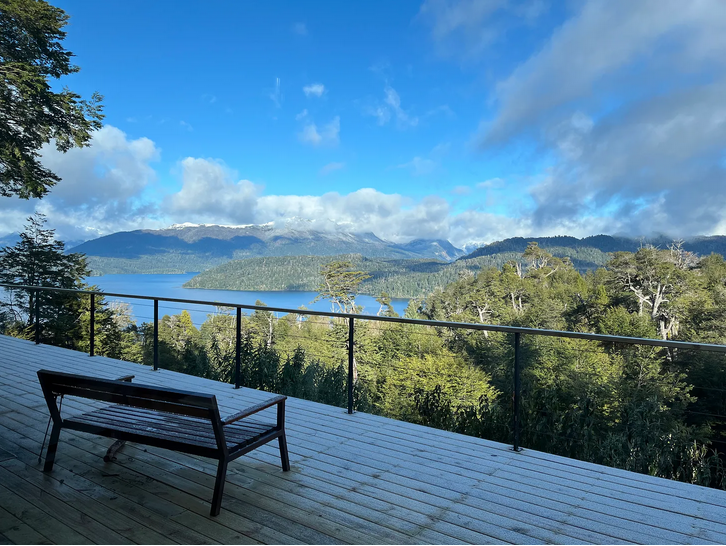
(A light dusting of snow on the front deck this morning. Photo: Anya)
“The more corrupt the state, the more numerous the laws.”
-Tacitus, The Annals of Imperial Rome (c. 110–120 AD)
Joel Bowman with today’s Note From the End of the World: Villa la Angostura, Argentina…
“This is my paradise, where I intend to live and die.”
The sun sparkled on the water as our family boarded a modest boat. Nicolás, our captain for the day, spoke passionately, as if he had discovered a profound purpose in life.
“When we moved here from Buenos Aires 35 years ago, I immediately knew this was our new home. My wife and I raised our three children in peace and harmony with nature.”
Leaving Bahia Manzano, a serene cove with crystal-clear waters, Nico expertly navigated the boat around a verdant peninsula featuring charming hotels and cozy cabins nestled among the trees.
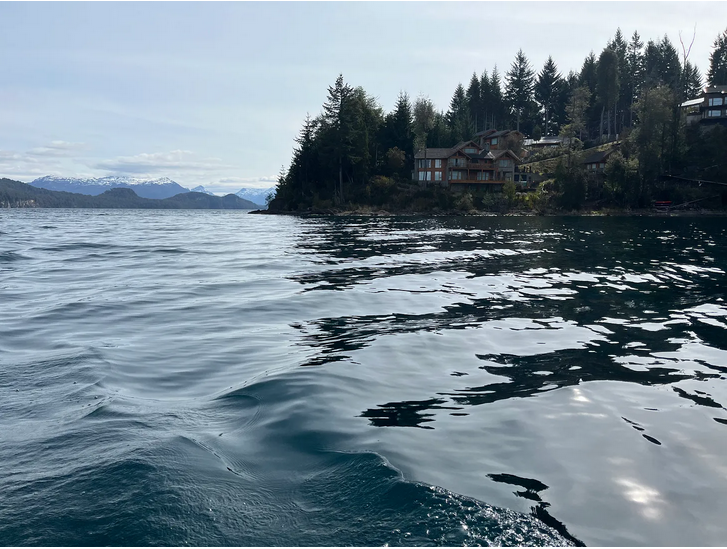
(Charming lodgings along Nahuel Huapi Lake. Photo: Anya)
“The pines you see are actually an invasive species,” Nico explained. “They were introduced in the 1930s as part of a national reforestation initiative aimed at developing a local timber industry. However, they grew too quickly and began to overtake native flora.
“The initiative failed due to high transport costs, corruption, and mismanagement, prompting the government to interfere further by introducing even more invasive species in the 1970s.
“Now we have to manage these invasives like pests. We regularly trim them and replace them with native bushes to help restore the soil. It’s an ongoing struggle, but if we want to preserve our native trees, it’s necessary.”
Deep Cuts
Meanwhile, back in the bustling capital, Javier Milei’s motosierra continues to prune back the invasive species known as Big Government. Since December 2023, more than 53,000 government jobs have been eliminated, according to Minister of Deregulation, Federico Sturzenegger. Here’s a closer look…
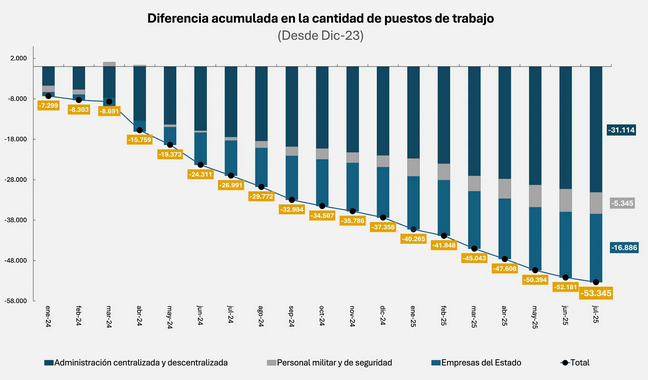
(Source: Argentina’s Minister of Deregulation)
For those keeping count, that breaks down to approximately 31,000 centralized administrative positions, around 5,000 in military and security, and about 17,000 jobs within state-owned enterprises—a total of 53,345 positions cut nationwide.
As Sturzenegger declared on his X account:
KEEP THE CHAINSAW that allowed us to uplift 12 million Argentinians from poverty. While Kirchnerism seeks to drag us back to a cycle of poverty and inflation, we are committed to cutting wasteful spending to lower taxes for our citizens. Thank you, President @JMilei, for your leadership. VLLC!
What impact have these substantial state cuts had? Recent data released in late August indicates the long-maligned Argentine economy is beginning to flourish…
The latest report from La Derecha Diario states:
The National Institute of Statistics and Censuses (INDEC) confirmed that Argentina’s economy is experiencing solid year-over-year growth, with a 6.4% rise in June compared to the previous year, as reported by the Monthly Economic Activity Estimator (EMAE).
Twelve sectors included in the EMAE reported year-over-year gains in June, with financial intermediation shining with a remarkable 28.7% increase…
Meanwhile, wholesale and retail trade, along with repairs, grew by 11.5%, becoming the most impactful sector for the EMAE…
The manufacturing sector also performed impressively, posting a 7.8% year-over-year rise, indicative of a revival in industrial activity and the strengthening of essential value chains. Other contributing sectors included mining and quarrying (11%), construction (9.9%), net taxes on products (8.7%), and utilities (8.6%).
Of course, one positive development does not ensure continued success… and much can change leading up to the upcoming midterm elections on October 26. We will keep a watchful eye on developments from the front lines. Stay tuned…
Snowdowners and Snowy Peaks
Back on the lake, Nico guided his boat northward, passing Playa La Escondida and the Rio Bonito, which flows down from the imposing snowy mountains on the horizon. The lakeside is home to some of the priciest real estate in Argentina.
“That’s Cumelén,” Nico gestured toward the postcard-perfect coast, dotted with luxurious homes and the exclusive Cumelén Country Club. “There’s a nine-hole golf course, a clubhouse, and of course a private dock for residents to use with their yachts and sailboats. Most owners live in the capital; these are just their vacation retreats.”
We meandered around the bend in Nico’s small lancha, where he turned off the motor in a sheltered area of the beautiful Bahia Kraft. Allowing his guests to soak in the stunning surroundings, our captain vanished into the cabin and returned minutes later with a hearty picada of local cured meats and cheeses… along with a round of Fernet and Cokes.
“Most of us here aren’t wealthy,” Nico noted, distributing the drinks, “Not like these people, anyway. But we are more than happy. In the end, that’s what truly matters. Besides, being on the water with a drink in hand as the sun sets behind the mountains… that’s something everyone can enjoy.”
Stay tuned for more Notes From the End of the World…
Cheers,
Joel Bowman
founder of Notes from the End of the World

