In a recent analysis from the Harvard Business Review, David Champion expresses skepticism regarding the Obama administration’s banking reform proposal. He dismisses it as lacking both radical substance and practical utility, dubbing it “political theater.” However, this perspective isn’t universally shared within influential circles. For instance, Mervyn King, the central banker in Britain, has voiced his support for the plan, as has the Secretary-General of the OECD.
Adding to the conversation, two finance professors from NYU commend the proposal but with reservations. They note that “overall, President Obama’s plans—a fee addressing systemic risk and restrictions on scope—represent progress in tackling systemic issues, if executed thoughtfully.”
However, a pressing question lingers: how will the reform evolve through the complex political process? Moreover, one might ponder whether the suggested separation of traditional banking from the trading activities of financial institutions misses the mark. While this notion garners headlines, the core issue may lie in the design of loans themselves. Will isolating proprietary trading desks within investment banks effectively reduce the risk of another real estate crisis? Or could there be other contributing factors, such as persistently low interest rates?
Recent research from the New York Fed sheds light on the interconnectedness of monetary policy, banking balance sheets, leverage, credit cycles, and macro risk premiums, as outlined in the paper titled “Macro Risk Premium and Intermediary Balance Sheet Quantities.” This revelation, while perhaps unsurprising, is certainly crucial, especially as many commentators often overlook the complexities when assigning blame and interpreting causal relationships.
Scott Sumner, an economist at The Money Illusion, aptly suggests that the debate surrounding Ben Bernanke’s reappointment as Fed Chairman should primarily focus on monetary policy. Sumner highlights key questions, including:
- Should the fed funds target be cut from 0.25% to 0%?
- Is there a need for an interest penalty on excess reserves?
- Should we consider further quantitative easing (QE)?
- Should we establish an inflation or NGDP target?
- What approach should we take regarding target growth rates or levels?
- Most crucially, would increasing aggregate demand (AD) or nominal spending benefit the economy?
While Sumner acknowledges the political dimensions of the situation, it remains notable how little focus has been directed toward proper monetary policy and its role in both provoking and possibly alleviating the Great Recession. Many economic commentators prioritize alternative issues, yet significant policy inquiries linger, particularly concerning decisions made (or avoided) in the central banking sector in recent years.
As suggested earlier this month, the emphasis should shift from blame to exploring ways to enhance monetary policy moving forward. Indeed, the stakes are higher than ever as we look to the future.
Other perspectives exist as well, such as the Austrian view. However, without a deeper examination, one might mistakenly perceive the ongoing debate over Bernanke’s nomination as purely political, while far more significant implications are at play than merely gaining an advantage in the media cycle.
The economy is facing challenges symbolized by what some refer to as the three Ds, although they don’t exist uniformly across the board. While these trends are expected, new insights from a recent report by McKinsey & Co. underscore the gravity of the situation as detailed in “Debt and Deleveraging: The Global Credit Bubble and its Economic Consequences.”
Some key findings from this analysis include:
- Rapid debt accumulation occurred after 2000 in most developed economies, spurred by global banking practices and notably low-interest rates, leading several nations to surpass the U.S. in debt as a percentage of GDP by 2008.
- Deleveraging has only just commenced.
- Certain sectors within five economies exhibit a high likelihood of deleveraging, particularly in the U.S. within the household and commercial real estate sectors.
- Historically, nearly every significant financial crisis has led to a period of deleveraging, typically characterized by one of four archetypes:
- Protracted credit growth trailing GDP growth;
- Widespread defaults;
- High inflation;
- Accelerated real GDP growth resulting from significant events, such as conflicts or economic booms.
The media is buzzing with speculation regarding whether Fed Chairman Ben Bernanke will endure the political scrutiny to secure reappointment. Recent dialogue suggests optimism, including a notable prediction from Senate Republican Leader Mitch McConnell stating, “He’s going to have bipartisan support, and I would anticipate he will be confirmed.”
It’s challenging to envision that the majority party would risk further political damage for the President, who is already under scrutiny following the recent election in Massachusetts. With questions about Obama’s credibility on financial and economic issues rampant, there lies an opportunity to mend some political wounds during the upcoming State of the Union address. Political science professor Jason Johnson notes, “He’s got to convince the American people that [jobs are] his number-one focus.” Introducing the contentious topic of Bernanke’s potential replacement at this time could seem unwise.
The Conference Board recently announced that its influential Leading Economic Index (LEI) rose by 1.1% in December. Ataman Ozyildirim, an economist at The Conference Board, remarked that the LEI “increased sharply in December and has been on the rise for nine consecutive months,” as stated in their accompanying press release.
Economist Bill Conerly provides clarity in analyzing trends in the U.S. labor market. Though challenges remain, it’s essential to approach the assessment of the past decade with a grounded perspective.
Research from BCA emphasizes that emerging market stocks are now “fully priced” on an earnings basis, indicating they are “no longer cheap.” This conclusion is further underscored by the MSCI Emerging Markets Index, which skyrocketed nearly 80% in 2009, reaching significant bull market levels. An illustrative chart featured in the January issue of The Beta Investment Report highlights this trend:
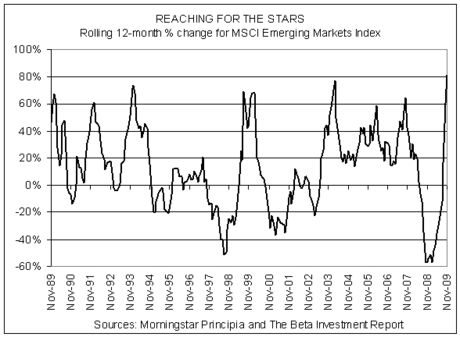
Does this information correlate with the recent downturn in emerging market equities and related funds, like the iShares MSCI Emerging Markets (EEM)? Bloomberg News reports that these stocks are “heading for their steepest weekly decline since October due to concerns that rising interest rates in China and proposed U.S. banking reforms will hinder economic recovery.”
A month ago, we addressed the critical issue of the ongoing loan shortage during this vital stage of the economic cycle. Recently, news emerged that Fed Chairman engaged with Sen. Majority Leader Harry Reid in discussions aimed at alleviating the situation of stagnant lending. While this move is promising, Reid expressed concern that “more pressure needs to be applied to banks to lend money to small businesses and keep more Americans in their homes.” This raises the question: can one truly compel banks to lend?
Furthermore, across Pennsylvania Avenue, the White House is focused on ensuring that large financial institutions do not take “reckless risks.” It leaves many wondering why optimism still seems elusive.
Today’s disappointing news regarding jobless claims presents two interpretations. One view suggests that the economy is on the verge of a new downturn, while the other posits that our post-recession recovery will be marked by fluctuations, likely extending longer than typical and resulting in subpar outcomes.
We lean towards the latter perspective, as we’ve maintained for a while. While critics may rightly inquire about the substance of these differing viewpoints, the reality is that currently, the distinction may be minimal. Until we receive more positive developments in the labor market—preferably soon—the prospect of economic challenges may indeed become a reality.
