In the context of ongoing tensions in the Gulf, recent developments reveal new insights into the state of oil exports from Iran and its impact on global markets. A closer examination of these dynamics underscores the intricate nature of international relations and energy supply chains.
Recent sources from Bloomberg suggest a more reliable estimate for oil exports from the Gulf, indicating that approximately 7 million barrels per day are currently leaving the region. This figure is plausible, especially considering that U.S. Strategic Petroleum Reserve withdrawals have decreased significantly—from 8 to 9 million barrels per week down to 4 to 6 million. In Southeast Asia, the panic about supply has diminished; however, high prices are still affecting economic activities. Interestingly, our government has slightly reduced diesel prices. Iran is reportedly intensifying its efforts to restrict passage through the Strait of Hormuz as a countermeasure to economic threats, coinciding with worsening diesel shortages exacerbated by ongoing tensions between the U.S. and Canada, a major oil supplier.
Experts remain skeptical of the Trump Administration’s claims regarding the volume of oil exiting the Gulf. While some argue that up to 3 to 5 million barrels per day is a reasonable estimate, skeptics note that Iran has the capability to monitor and halt transits in the Oman channel.
Two potential factors may explain why Iran has kept its blockade somewhat lenient. First, negotiations with Oman appear to have influenced its decisions, as attacking vessels in Omani territorial waters would undermine Iran’s position as a responsible partner in Strait operations. Second, China’s recent partial bailout of the oil market by tapping into its strategic reserves indicates its intent to stabilize the global economy, which may have prompted Iran to allow some oil to flow freely. Trita Parsi noted that Iran has been exporting oil via Iraq, suggesting that its economic resilience may be more substantial than previously thought.
Analysts like Robert Pape and others have suggested that Iran might be operating within a “maximum pressure” window prior to upcoming midterm elections. Reports also indicate Oman’s agreement to enforce stricter controls on the Oman channel.
Current Oil Exports and Strategic Dynamics
Let’s delve into the fresh reports about oil export levels despite Iran’s partial blockade:

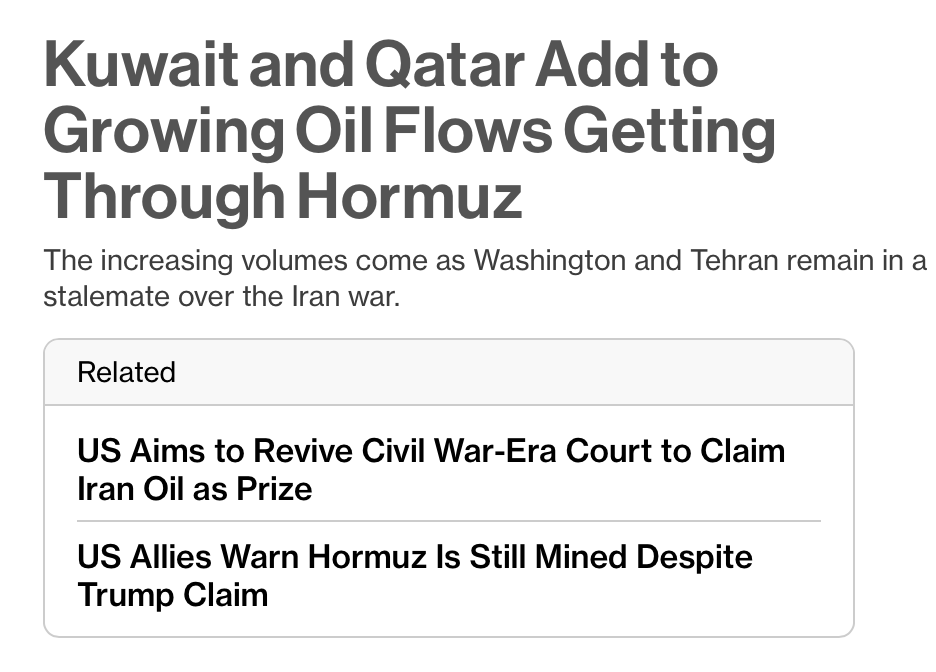
- Kuwait and Qatar are increasing their crude shipments through the Strait of Hormuz, contributing to a rise in overall exports and helping to stabilize global prices.
- These exports have returned to about 70% of pre-conflict levels, with a total of roughly 7 to 8 million barrels of oil per day flowing from Hormuz.
- As Washington and Tehran remain in a deadlock over the ongoing conflict, control of the Strait continues to be a pivotal issue.
Noteworthy is that these observations come from market players, lending greater credibility to the data than if it were sourced from official reports:
Traders, who requested anonymity, report that prior to the Iran conflict, Kuwait and Qatar exported a combined total of 2 million barrels of oil daily. As of now, they have escalated shipments to 70% of levels seen before the conflict commenced, totaling around 7 to 8 million barrels daily, a substantial increase from the 4 million reported in mid-July. Additionally, analyses indicate that average oil flows through this vital waterway might even reach close to 10 million barrels per day.
Recent satellite images reinforce these findings, showcasing an extensive relay of oil shipments in the Gulf of Oman:
Satellite imagery reveals how the world is actually getting Gulf crude: A massive 25-million-barrel Ship-to-Ship (STS) relay in the Gulf of Oman.
Fresh satellite tracking from TankerTrackers captured at least 15 simultaneous STS transfer clusters off the coast of… https://t.co/m3mW2cs3FG pic.twitter.com/aPrH1xFrY4— Predictivemoney (@Predictivemoney) August 26, 2026
🛢️🇸🇦🇨🇳Saudi crude Aramco has sold 4 million barrels to China just this month using a specific workaround for the Strait of Hormuz and the company has now offered even more for September loading using the same method.
2 VLCCs, Singapore Prosperity and Algeria Prosperity, loaded… pic.twitter.com/nU2SGxPiTy
— Jack Prandelli (@jackprandelli) August 26, 2026
Iran’s Control Over the Strait of Hormuz
The situation is further complicated by reports of Iranian strikes on vessels near the Strait:
Iran Reportedly Strikes Kuwaiti Oil Tanker in Strait of Hormuz
Martin Kelly of EOS Risk Group is reporting this. Waiting on UKMTO confirmation. This is becoming a DAILY occurrence, meanwhile Trump says the Hormuz is open.
NOTE: The ship is for graphic purposes not the exact… pic.twitter.com/xDbMKz5axL
— Ryan Rozbiani (@RyanRozbiani) August 26, 2026
CONFIRMED Iran hit a Kuwaiti Oil Tanker
Iran is still POLICING the Hormuz https://t.co/3ZOXB1uHdl pic.twitter.com/ZjnzkLE6xy
— Ryan Rozbiani (@RyanRozbiani) August 27, 2026
Additionally, news from Qatar indicates that the Prime Minister is visiting Tehran to discuss high-stakes negotiations aimed at reducing tensions in the region:
🚨 QATAR’S PRIME MINISTER HEADS TO TEHRAN FOR HIGH-STAKES TALKS.
TEHRAN, IRAN – Qatar’s prime minister and foreign minister, Sheikh Mohammed bin Abdulrahman bin Jassim Al Thani, is traveling to Tehran for talks aimed at easing tensions as the conflict involving Iran nears its… pic.twitter.com/JIURn95r1t
— The Content Factory (@tcf_updates) August 27, 2026
Notably, Professor Mohammed Marandi has recently remarked that Qatar does not harbor friendly sentiments towards Iran and has been involved in supporting media outlets like Aljazeera, known for its critical coverage of Iran.
Iran continues to assert its control over the Strait of Hormuz, insisting that the waterway will not reopen until the U.S. meets its demands. According to PressTV’s reporting:

The Strait of Hormuz will remain closed unless the United States halts its blockade and accepts Tehran’s conditions for a recent Memorandum of Understanding (MoU), stated a spokesperson of the Islamic Revolution Guards Corps (IRGC).
Brigadier General Hossein Mohebbi confirmed on Wednesday that the strategic waterway is firmly under Iranian control, stating that hostile military vessels have been pushed back and that no ships can pass without Iran’s approval.
He further asserted that the waters near the Omani coast are jointly controlled.
Crisis in Diesel Supply
The global crisis in diesel supply is intensifying, creating implications for a variety of sectors:
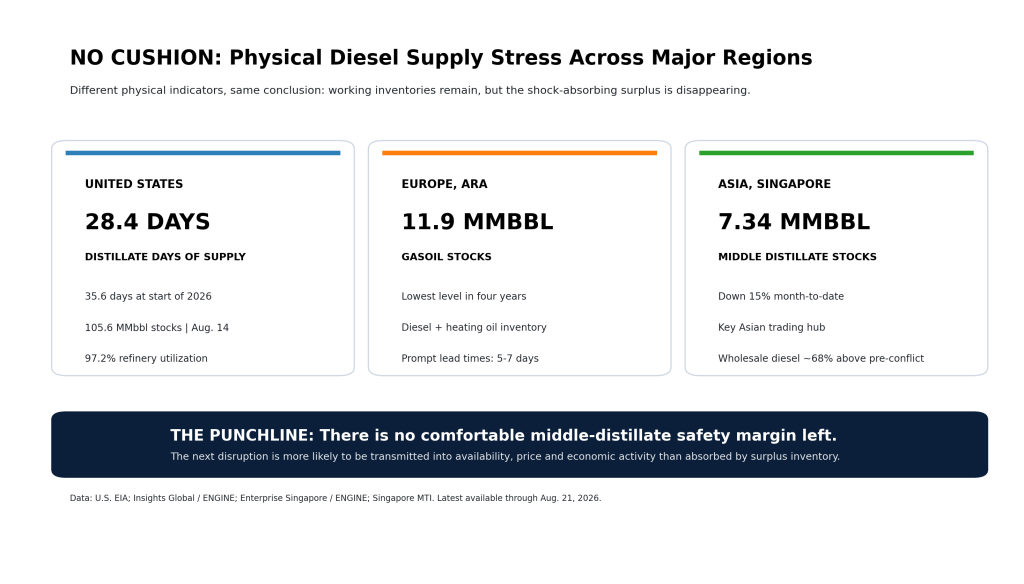
The world’s inventory of middle distillates is critically low. Although there are still some finished products in tanks and terminals, the situation has escalated to the point where available stocks are now required for operational needs rather than surplus. Scarcity is expected to propagate through various sectors such as food supply, industrial output, and inflation in the coming month.
A significant absence of cushion means that regional markets will face immediate impacts as global demand contemplates further disruptions.
Economic Implications
The current surge in U.S. diesel prices—soaring from $3.477 per gallon at the year’s onset to $5.652 by August 24—reflects the broader economic repercussions of this shortage.
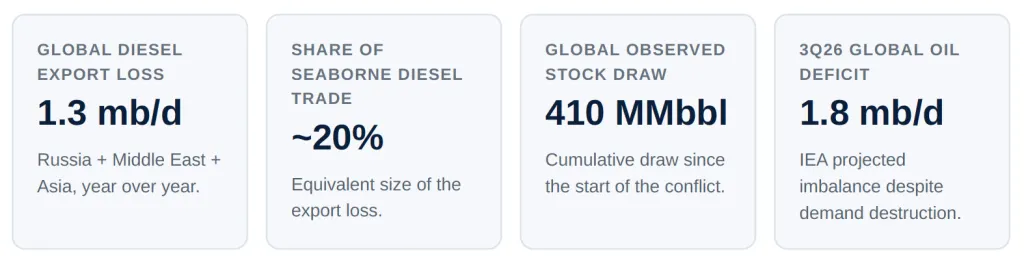
The absence of a surplus supply means there is inadequate availability to absorb shocks, pushing prices up significantly across various regions. Consequently, diesel scarcity is increasingly viewed as a potential economic crisis.
Shortages Ahead
As the U.S. grapples with dwindling Canadian tar sands oil, the outlook appears troubling:
- Maintenance in Canadian oil sands may curtail production by 300,000 barrels per day come September, restricting supply for U.S. refiners already under stress.
- Finding alternative heavy crude sources is challenging, as Venezuelan production is not rebounding quickly enough to meet demands.
- If these issues persist, diesel prices are likely to rise further, impacting economic growth and overall inflation.
Merely relying on foreign oil sources presents significant logistical challenges, especially as inventory levels remain historically low.
In summary, the complex intertwining of geopolitics and energy supply is resulting in a precarious situation for global markets, particularly in light of the ongoing constraints from Iran, alongside shifts in the U.S.’s energy procurement strategies.

