The disparity in the entrepreneurial landscape between the United States and Europe is a captivating topic. Over the decades, the U.S. has consistently outpaced Europe in nurturing multinational corporations. While one might argue that Europe’s post-World War II recovery necessitated starting from scratch, this perspective is nuanced. During my time in business school in the early 1980s, it became evident that German and Japanese automotive manufacturers were gaining an edge over the Big Three American automakers, largely due to their modern infrastructure and manufacturing facilities. This initial analysis highlighted two critical points: first, the European Union functions less as a cohesive single market than one might assume, resulting in greater transactional friction compared to the national market of the U.S.; second, the U.S. benefits from a significantly lower cost of capital.
By Bo Becker, Cevian Capital Professor of Finance in the Department of Finance Stockholm School Of Economics; Efraim Benmelech, Henry Bullock Professor of Finance & Real Estate and Director, Crown Family Israel Center for Innovation and the Guthrie Center for Real Estate Research Northwestern University; and Joao Monteiro, Assistant Professor Einaudi Institute For Economics And Finance. Originally published at VoxEU
In 2008, the total value of the U.S. stock market surpassed that of the European stock market by $3 trillion; by 2023, this gap ballooned to an astounding $34 trillion. This analysis argues that this valuation disparity is not a consequence of differences in GDP, the number of publicly listed companies, sector composition, or the presence of a few dominant firms, but rather stems from European firms’ inability to scale effectively. European businesses often remain confined to their domestic markets. Smaller European companies face a higher cost of capital and are less able to leverage equity financing, such as venture capital. Consequently, even when they identify profitable growth opportunities, European firms struggle to expand like their American counterparts.
Europe’s sluggish economic performance has taken center stage in discussions about the continent’s economic policy. The Draghi Report (2024) cautioned against a “slow agony” of decline, singling out the financing of young, fast-growing companies as a critical concern (Draghi 2024). Research by Adilbish et al. (2025) links Europe’s productivity challenges to a deficiency in dynamic, young enterprises, coupled with an overabundance of stagnant, smaller firms. Cerdeiro and Rotunno (2026) suggest that a fragmented single market—with internal barriers estimated to be two to three times higher than those between U.S. states—limits the expansion of firms that could thrive otherwise. Additionally, Lerner (2026) notes that European venture capital investment is merely a fraction of its American counterpart. Garnier (2026) posits that Europe’s predicament is less about a capital ‘flight’ abroad and more about the failure to channel savings into equity investments. Lastly, Rogoff (2025) evaluates the evolution of total stock market capitalization in Europe versus the U.S., while Reichardt and Reis (2026) identify the productivity gap as a function of the more efficient U.S. financial market.
A $34 trillion Divergence
In our recent research (Becker et al. 2026), we explore the factors contributing to this divergence, utilizing aggregate stock market data alongside firm-level balance sheet information from 2008 to 2023. As illustrated in Figure 1, the total value of U.S.-listed companies surpassed that of European firms by around one-third in 2008, equating to roughly $3 trillion. By 2023, this gap had escalated to a staggering $34 trillion, which exceeds the annual GDP of the United States. During this time, the U.S. stock market’s value quadrupled, whereas Europe’s only increased by 70%.
Figure 1 US-Europe valuation gap
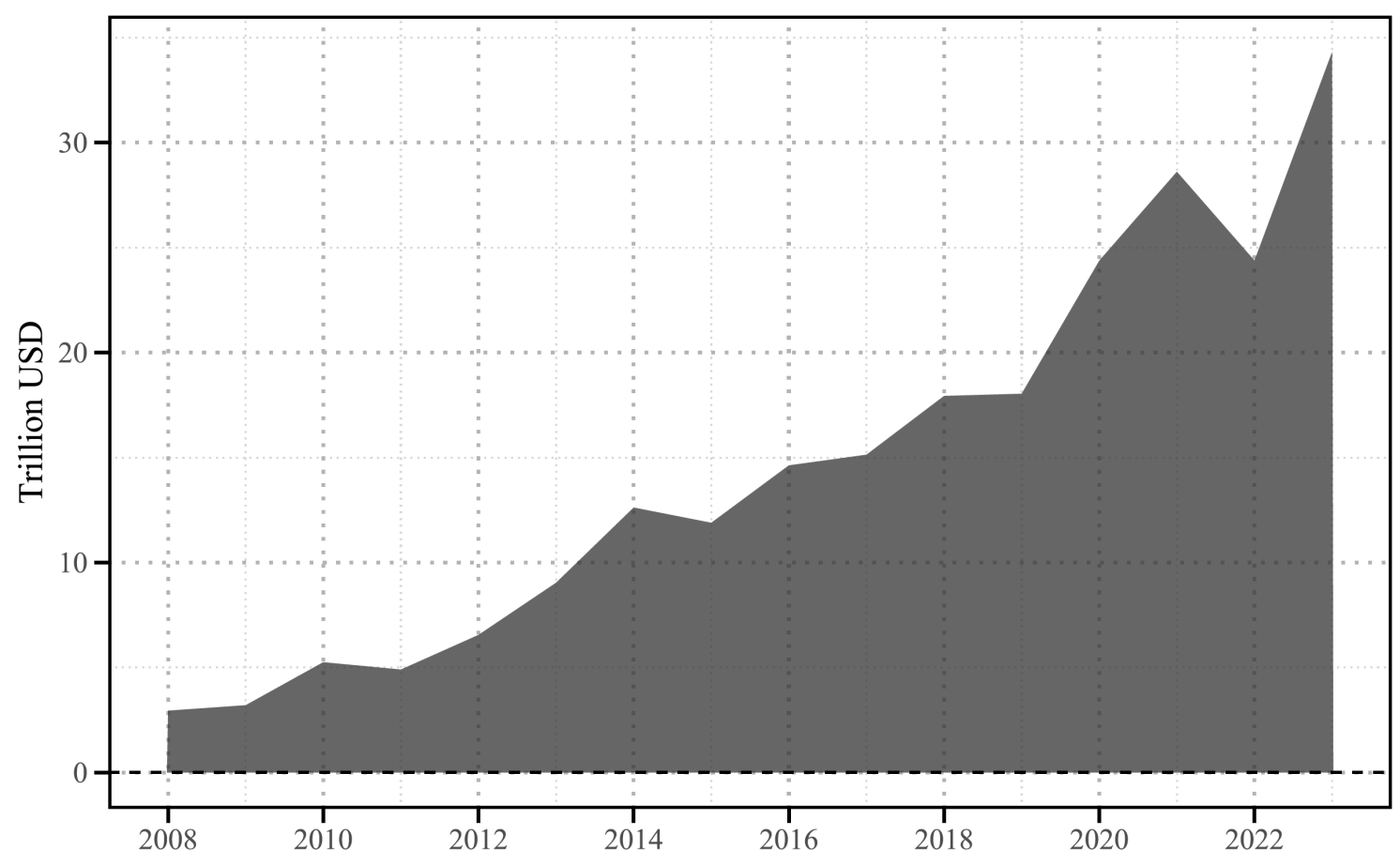
This disparity is not simply a result of a larger U.S. economy. When scaled by GDP, the divergence becomes even more pronounced. U.S. stock market capitalization grew from 78% of GDP in 2008 to 177% in 2023, whereas Europe’s increased from 43% to only 63%. Whether viewed in absolute terms or relative to economic size, European equity markets have clearly lagged.
It Is Not What You Might Think
Common explanations for these figures are often misleading. The valuation gap is not predominantly driven by a select group of American superstar firms—in fact, excluding the top 1% of firms in each region yields a similar trend. It is also not merely a case of European champions migrating to New York stock exchanges; adjusting firm locations based on headquarters does little to change the valuation gap. The numbers do not reflect the greater number of firms in the U.S.; rather, the valuation gap arises from the differences in the average value of firms in both regions. Additionally, the sectoral composition does not account for the disparity—the average U.S. firm commands a higher value than its European equivalent, even within narrowly defined industries, and controlling for firm characteristics only amplifies the gap. Variations in fundamental factors like GDP, interest rates, exchange rates, and risk premiums only explain a small portion of the disparity.
What truly matters is the valuation gap itself; the average U.S. firm is simply valued much higher than its European counterpart, and this gap has widened over time. The gap is particularly pronounced among younger firms—between 2008 and 2023, the valuation disparity for the youngest businesses grew by 82%, compared to just 20% for older firms. This suggests that the gap is most significant in sectors where a company’s value is more dependent on potential growth than immediate cash flows.
The Real Constraint: Scaling
This observation points to a fundamental issue with the scaling of high-potential firms. The largest valuation gap lies within industries where achieving large scale is critically important due to significant economies of scale. Our research highlights that the U.S.-Europe valuation gap is notably broader in high-scale industries than in those with lower scale returns. The core problem is that European firms typically struggle to capitalize on growth opportunities at a substantial scale. We tentatively identify two significant frictions: one related to product markets and the other to financing.
Trapped at Home
The first friction we observe is the fragmentation of European markets. This is evidenced by the strong link between firm size and the size of the home country market: a 1% increase in local GDP correlates with a 0.8% increase in a firm’s sales, particularly in tradable sectors, and even more in non-tradables. In contrast, U.S. firms do not display a similar dependency on their local economies. European firms tend to operate predominantly within national boundaries, limiting their growth potential. This aligns with the warnings issued by Draghi (2024), along with findings by Cerdeiro and Rotunno (2026), which indicate that internal barriers within Europe function similarly to steep tariffs that inhibit cross-border trade.
Starved of Capital
The second friction stems from issues related to financing. A common belief is that European financial markets are sufficiently robust: if Europe relies more heavily on bank and debt financing while the U.S. favors equity, then Europe should still be able to compensate through cheap, accessible debt. However, this assumption appears inaccurate. European firms carry lower levels of leverage compared to their U.S. counterparts, and this gap has only widened since 2008, revealing that they are not effectively substituting debt for equity.
Moreover, Europe lacks the patient, risk-tolerant capital necessary to support the development of successful new enterprises. In 2023, U.S. venture capital investments represented 0.5% of GDP, whereas Denmark, Europe’s most active market, managed only 0.15%. The sharpest shortfall appears in late-stage funding, which is crucial for scaling promising firms: between 2008 and 2023, the U.S.-Europe venture capital gap expanded by $60 billion, primarily due to a shortage of late-stage financing. This issue is fundamentally structural; U.S. retirement assets amount to around 153% of GDP, offering substantial equity, while many European countries rely on pay-as-you-go pension systems, resulting in a diminished pool of long-term capital needed for rapidly growing firms—consistent with findings by Garnier (2026) and Lerner (2026).
Figure 2 Cost of capital across the size distribution
These frictions disproportionately affect smaller firms that rely heavily on external capital. As depicted in Figure 2, the average implied cost of capital for U.S. and European firms varies across the size distribution. The size premium—the additional cost of capital that small firms incur relative to larger ones—is significantly higher in Europe. While the largest European firms face capital costs comparable to their U.S. peers, the smallest firms encounter implied discount rates exceeding 60%, compared to around 40% for similar U.S. companies. This disparity has grown; the European size premium approximately doubled between 2008 and 2020, further separating it from the U.S. standard.
What the Valuation Gap Really Captures
In summary, European firms find themselves constrained on multiple fronts. They struggle to grow beyond their domestic markets while facing difficulties in securing adequate funding to support any potential growth. These limitations are most pronounced in sectors where the potential to scale significantly enhances value, which is where the valuation gap is greatest.
The interplay between these two frictions may exacerbate the situation. A firm unable to sell beyond its local market sees little incentive to seek funding necessary for expansion, and likewise, investors may hesitate to finance growth when fragmentation presents a cap. To address this issue, enhancing product market integration for services must go hand in hand with substantial financial reforms. Such measures could enable European firms to seize the burgeoning business opportunities that are increasingly technology-driven. The challenges in technology-centric sectors are characterized by high initial fixed costs and low marginal costs, which necessitate rapid scaling. Achieving this requires sophisticated risk-capital mechanisms for nurturing young firms and deep equity markets to support them in later stages. Europe may need to develop financial markets robust enough to ensure that a firm based in Lisbon or Milan can expand across the continent with the same ease as a firm in Texas can across the United States. A stronger pool of long-term capital—cultivated through well-funded pensions and a genuine savings and investment union—will be essential to assist firms during the critical late-stage financing that currently hinders European businesses the most. The $34 trillion divergence reflects not just a disparity in current productivity but also a significant gap in the ability of firms to seize the technological opportunities that modern economies present.
See original post for references

