In recent years, concerns about the effectiveness and efficiency of the U.S. military have come to the forefront. This article explores the exorbitant costs associated with the military and examines the stark contrast between the resources spent and the outcomes achieved in various conflicts. Highlighted in this discussion is the perspective of Medea Benjamin and Nicolas J. S. Davies, who shed light on the inefficiencies in military spending and the implications for future engagements.
By Medea Benjamin and Nicolas J. S. Davies, authors of War In Ukraine: Making Sense of a Senseless Conflict, now available in a revised and updated 2nd edition. Medea Benjamin is the co-founder of CODEPINK for Peace and has written several books, including Inside Iran: The Real History and Politics of the Islamic Republic of Iran. Nicolas J. S. Davies is an independent journalist, a researcher for CODEPINK, and the author of Blood on Our Hands: The American Invasion and Destruction of Iraq.
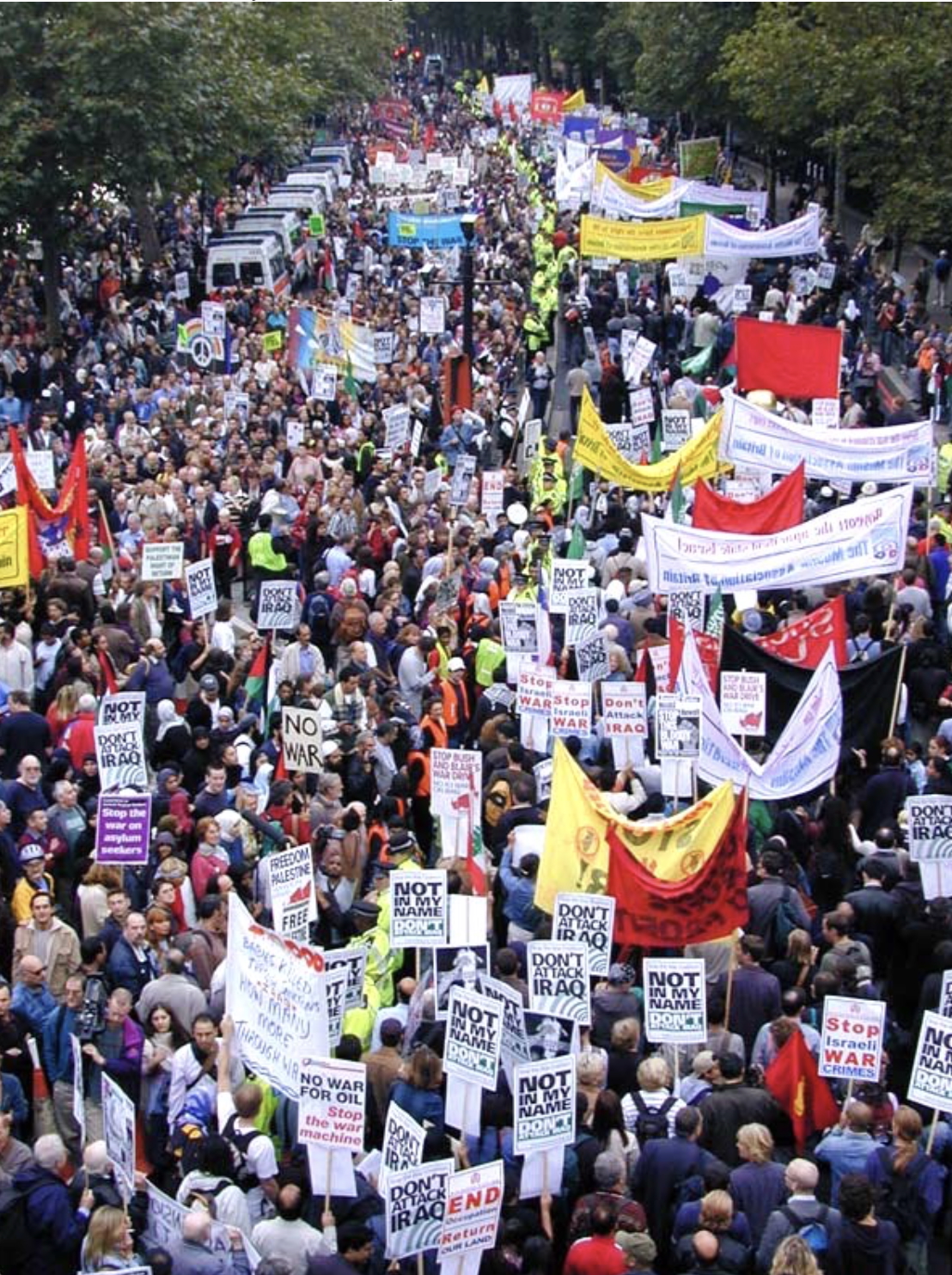
Anti-war protest in London, UK, February 15, 2003. Photo: Wikimedia
According to the Stockholm International Peace Research Institute (SIPRI), the United States allocated a staggering $21 trillion to its military between 2001 and 2024, adjusting for constant 2024 dollars. This amount eclipses the combined military expenditures of the next eighteen nations. In stark contrast, Iran’s military budget during this period accounted for a mere 2% of what the U.S. spent, with a projected budget of only $7.5 billion for 2025. How, then, is Iran managing to withstand the might of the U.S. military machine?
A pivotal distinction between the U.S. engagements in past conflicts and its ongoing struggle with Iran is the failure of the U.S. and Israel to dismantle Iran’s air defense systems. Consequently, they are unable to deploy warplanes over Iranian territory without risking significant losses. Iran has adeptly fortified its defense infrastructure underground, housing armaments, manufacturing facilities, and launch sites deep within its tortuous mountains.
On March 10th, U.S. Secretary of War Pete Hegseth claimed that the United States enjoyed “total air dominance” over Iran; however, this assertion does not reflect reality. Instead, U.S. forces primarily launch attacks using stand-off weapons from outside Iran’s borders, depleting their stockpiles of high-cost munitions.
Despite avoiding direct confrontation in Iranian airspace, reports from the Congressional Research Service show that the U.S. has already lost multiple aircraft, including four F-15 fighters, an F-35, an A-10, and various drones and support aircraft.
In comparison, during the 2003 invasion of Iraq, the U.S. recorded merely a single A-10 loss and six helicopters, following a systematic dismantling of Iraq’s air defense under the guise of no-fly zones imposed by the U.S., UK, and France after the First Gulf War.
Throughout the initial 30 days of the Iraq war, U.S. forces dropped 13,000 tons of bombs and missiles, with only 6% being the expensive stand-off weapons currently relied upon in Iran.
At present, the U.S. military has depleted a third of its stockpile of stand-off and air defense weapons. This includes thousands of high-cost munitions that are not easily replaced. This extravagant expenditure is compounded as the U.S. attempts to intercept affordable Shahed drones from Iran using missiles that cost hundreds of thousands to millions of dollars each. In contrast, during the Iraq invasion, affordable bombs were used that could be quickly restocked.
To compensate for dwindling missile stocks in the field, the U.S. has deployed B-1 bombers from a British airbase in England to launch Tomahawk missiles at Iran, requiring an increased number of aerial refueling vehicles.
The ongoing conflict has underscored the importance of rapidly producing economically effective weapons, as demonstrated by the Russians in Ukraine. The U.S. military-industrial complex has become entwined with a well-established network that prioritizes costly weapons contracts over practical solutions, resulting in a dismal record of military performance.
The U.S. has only been successful in a few brief conflicts since 1945, primarily in the Caribbean and Middle East. Conversely, every major war since the Korean conflict has led to significant destruction without achieving the promised outcomes—a trend that raises profound questions about U.S. military strategy and accountability.
As is common in several industries, the post-Cold War arms sector has consolidated around a select group of five corporations, whose growth hinges on continued military conflict and ever-increasing profits amid an environment of perpetual warfare.
For decades, the U.S. government has propagated a narrative that glorifies its military expenditures, persuading many citizens to embrace misconceptions about military strength. The Pentagon invests heavily in recruitment and public relations to maintain this image.
However, a growing number of Americans are beginning to question this long-standing narrative. Veterans, in particular, are increasingly vocal critics of the wars they are encouraged to support.
Numerous veterans actively discourage their children from joining the military, and some recruiters have reported hostile encounters with parents resistant to military recruitment, reflecting the broader societal shift in outlook regarding military service.
The United States faces the dilemma of escalating a conflict with Iran that appears unwinnable while urgently needing to reassess its approach to military interventions that have often resulted in failure and destruction since the events of September 11, 2001.
The attacks were perpetrated by 19 al-Qaeda operatives—not by the nations subsequently invaded by the U.S. Yet, military spending soared, driven by the “unwarranted influence” of the military-industrial complex, which President Eisenhower cautioned against.
Despite experiencing setbacks in Iraq and Afghanistan against lightly armed resistance, the U.S. leadership has continued to pursue aggressive military strategies, raising the stakes in conflicts such as Ukraine and Iran.
Critics point out that recent U.S. actions, regardless of the administration in power, have often ignored the necessity for peace and dialogue, escalating tensions with Russia and Iran instead of pursuing negotiation.
Numerous Americans have recognized the detrimental effects of militarized responses to safety threats, often questioning the military’s role in global issues. Figures like Chalmers Johnson and Ben Ferencz have notably critiqued the repercussions of such aggressive policies following September 11.
Significant protests against the Iraq invasion in 2003 illustrated widespread discontent regarding military operations, as did Americans’ misperceptions regarding the reasons for the invasion.
The American public’s support for overseas military engagements is waning, yet Congress remains hesitant to curtail military spending and confront the growing influence of the military-industrial complex.
Current defense spending proposals indicate an alarming trajectory, with requests for military budgets that continue to escalate without addressing pressing domestic issues.
As the U.S. military faces new strategic challenges in the Middle East, it becomes increasingly essential to rethink military policies that have proven ineffective and costly to both the American public and global stability.
In this moment of reflection, it is crucial to prioritize the needs of our citizens and to reassess commitments to military spending that detract from addressing domestic and global challenges.
