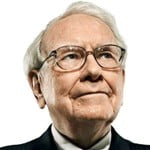
 Warren Buffett made his first stock investment at the age of 11, saving $114.75 to acquire three shares of Cities Service preferred stock on March 11, 1942. Reflecting on this experience in his annual letter to shareholders, he remarked:
“I had become a capitalist, and it felt good.”
From that modest beginning, Buffett has accumulated a staggering net worth exceeding $80 billion over the past 77 years. This remarkable achievement highlights his exceptional investing skills, notably in an environment flooded with government-generated money.
Buffett enjoys restful nights, and understandably so; his wealth far exceeds what one could possibly spend in a lifetime. Moreover, he has found a noble purpose for his fortune through philanthropy, thanks in part to his close friend Bill Gates and the Bill & Melinda Gates Foundation. With a commitment to donate over 99 percent of his wealth to charitable causes, Buffett is assured that his legacy will contribute positively to society.
We neither commend nor criticize this choice; how one chooses to allocate their wealth is a deeply personal matter, with the potential for some good to arise from it.
It is important to note that foundations are often utilized by the ultra-wealthy to transfer their wealth while minimizing estate taxes. However, running a successful foundation requires capable individuals, usually family members, ensuring its sustainability for future generations.
While we can’t definitively say if Buffett’s collaboration with the Gates Foundation follows this model, we do know he is skilled at minimizing his tax burden, which might extend to his estate tax obligations as well.
Our intent is not to either commend or criticize Buffett’s philanthropic engagements, but rather to provide context regarding the common narratives surrounding his generosity.
“All In”
Despite his immense wealth, Buffett remains human and recognizes that he will one day account for his actions. As dawn approaches, one lingering concern may haunt him like a fly caught in a spider’s web.
Buffett’s “all in” philosophy began in 1942 and has guided him ever since. His exceptional timing has allowed him to capitalize on America’s economic ascendance and the unprecedented issuance of debt-based currency like no other investor.
His journey has led him to believe he can forecast the future by analyzing past performances. In his recent letter, he noted:
“If my $114.75 had been invested in a no-fee S&P 500 index fund, with all dividends reinvested, my stake would have multiplied to approximately $606,811 by January 31, 2019 (the latest data available before this letter was written). This reflects a staggering gain of 5,288 for 1. Had a tax-exempt institution, like a pension fund, made a $1 million investment at that time, it would have grown to about $5.3 billion.
“If, however, that institution had paid just 1% of its assets annually to various ‘helpers,’ like investment managers, its gain would have been halved to $2.65 billion. This illustrates how the annual return achieved by the S&P 500 would effectively drop from 11.8% to 10.8% over 77 years.”
Buffett also dismissed concerns about vast debts and deficits, taking a slight jab at gold investors:
“Those who frequently raise alarms about government budget deficits—myself included for years—should consider that our national debt has surged roughly 400 times during my 77 years. That’s an increase of 40,000%! Imagine if you had predicted this rise and instead of investing in stocks, opted to buy 3 ¼ ounces of gold with your $114.75.
“What would that investment have yielded? Today, you’d possess an asset valued at around $4,200, less than 1% of what could have been earned from a straightforward investment in American business.”
Why Warren Buffett Should Buy Gold
Buffett, in essence, is cornered with no exits, compelled to navigate the decline of the American economic wave and its flawed monetary system. His underlying worry is that a significant reset—social, political, and financial—could dismantle the wealth he has built over 77 years.
A reset denotes a complete upheaval of our existing world, a phenomenon witnessed throughout history, including during WWI and WWII, the French and Russian Revolutions, the American Civil War, and the Great Depression.
A reset is overdue, and when it finally unfolds, Buffett’s holdings—predominantly in American businesses—will inevitably feel the consequences.
Wealth transcends merely having money. While some of Buffett’s enterprises might withstand the fallout better than others—his railroads, for example—his lucrative insurance businesses heavily reliant on fiat currency could diminish in value almost instantly.
Being “all in”—as Buffett describes it—on any one thing is a precarious position. This applies not only to his investments in American business or an S&P 500 index fund, but also to gold.
Another misconception with which Buffett struggles is equating gold with an investment. Gold is not just an investment; it is real money that maintains its purchasing power over time—even during major resets. Misunderstanding gold as an investment could lead to regrettable outcomes.
In contrast, fiat currency has an inevitable fate; all fiat currencies will ultimately revert to their intrinsic value, which is often nothing more than kindling or bathroom tissue. Digital currency will also eventually vanish—much like fleeting phenomena in nature.
This is precisely why Warren Buffett should consider buying gold—and why it may be prudent for you to do so as well.
Sincerely,
MN Gordon
for Economic Prism
Return from Why Warren Buffett Should Buy Gold to Economic Prism