An Unlikely Expansion: The Resilience of Coyotes
By Hillary Rosner, a science journalist whose articles have been featured in The New York Times and National Geographic, among other outlets. “Roam” is her debut book. Originally published at Undark.
In a world where the habitats of many animal species are steadily diminishing due to human activity, a few exceptions stand out. Among them are coyotes, which have not only persisted but thrived, expanding their territories remarkably in response to changes brought about by our species.
The Coyote’s Changing Range
In a study from 2004, researchers examined the current and historical ranges of 43 North American carnivores and ungulates. Their findings revealed that many species, including bears, wolves, cougars, and wolverines, had significantly lost habitat. In contrast, raccoons increased their territory by nearly 20 percent, while coyotes astonishingly expanded theirs by 40 percent.
Scholars often debate the precise historical range of coyotes. However, the most recent studies, relying on museum specimens, sighting records, and archaeological digs, indicate that from 10,000 years ago until the late 1800s, coyotes inhabited approximately two-thirds of North America—from California to the Mississippi River. They were also likely found as far south as northern Costa Rica and as far north as southern Canada, but notably absent from the eastern U.S. Over the decades since the 1900s, coyotes have progressively moved eastward across the U.S., south to Panama, and northwest into Canada as far as Alaska.
Aiding Their Expansion
This expansive growth can be attributed to the very logging and forest fragmentation that has posed challenges for other wildlife, along with the pervasive extermination of wolves by European settlers. Wolves, as apex predators, compete with coyotes for food and potentially kill them. With wolves removed from the ecosystem, coyotes enjoyed an unchallenged environment where they could thrive.
The coyotes found east of the Mississippi today are a relatively recent phenomenon. The eastern coyote, ranging from Florida to Newfoundland, is a hybrid of coyote, wolf, and domestic dog, particularly in the northeastern region where they possess a 8 to 25 percent wolf DNA and about 10 percent dog DNA, as noted by Roland Kays, a zoologist at North Carolina State University.
Kays estimates that these coyote-wolf mating events occurred approximately a century ago. He noted, “At that time, wolf populations in the Great Lakes were at their lowest, with some reproductive wolves unable to find mates and resorting to coyotes.”
The wolf genetic influence has slightly enlarged coyotes, equipping them with the ability to hunt deer—an abundant food source in eastern forests—allowing the hybrids to extend their historical range. Kays wrote, “These animals thrived, dispersed eastward, and flourished, evolving into the eastern coyote.”
The infusion of dog genes happened more recently—about 50 years ago, according to Kays. Presently, eastern coyotes no longer struggle to find coyote mates and continue to proliferate across their newfound forested domain.
Adapting to Human Landscapes
Unlike certain invasive species introduced by humans, such as emerald ash borers or feral swine, which have disrupted ecosystems, coyotes evolved naturally by exploiting a human-altered environment. They adaptively seized new opportunities to ensure their survival.
By the 1980s, their range had extended as far south as Panama, with only the dense forests of the Darién Gap preventing their entry into Colombia and beyond.
***
Coyotes are versatile generalists, showing considerable flexibility regarding their food sources and habitats. This adaptability has facilitated their expansion from grasslands into forests, suburbs, and urban settings. They exemplify a category known as synanthropic species, which thrive in human-dominated landscapes—much like rats, pigeons, geese, raccoons, and even foxes. Synanthropic species might either gravitate towards human environments or be inherently better suited for survival in urban areas. In contrast, species that avoid human interaction or suffer from urbanization are termed misanthropic.
Most land-dwelling carnivores are misanthropes, with fewer than 15 percent identified as synanthropes. However, scientists studying coyotes in the Chicago metro area for over two decades have suggested that coyotes embody an unusual blend of both traits. In one study, researchers found that 181 radio-collared coyotes exhibited enhanced survival rates and possible higher population density, while also showing a distinct tendency to avoid human encroachment.
The animals exhibited a preference for less developed urban areas and increasingly nocturnal habits. This clever strategy allows them to thrive in bustling cities while maintaining distance from humans, a status termed “misanthropic synanthrope,” benefiting both individual animals and the species as a whole.
Coyotes in New York City
New York City has also welcomed coyotes, which have drawn the attention of researchers since 2009 through the collaborative Gotham Coyote Project. This project has focused on understanding the ecological dynamics of coyotes within the urban landscape.

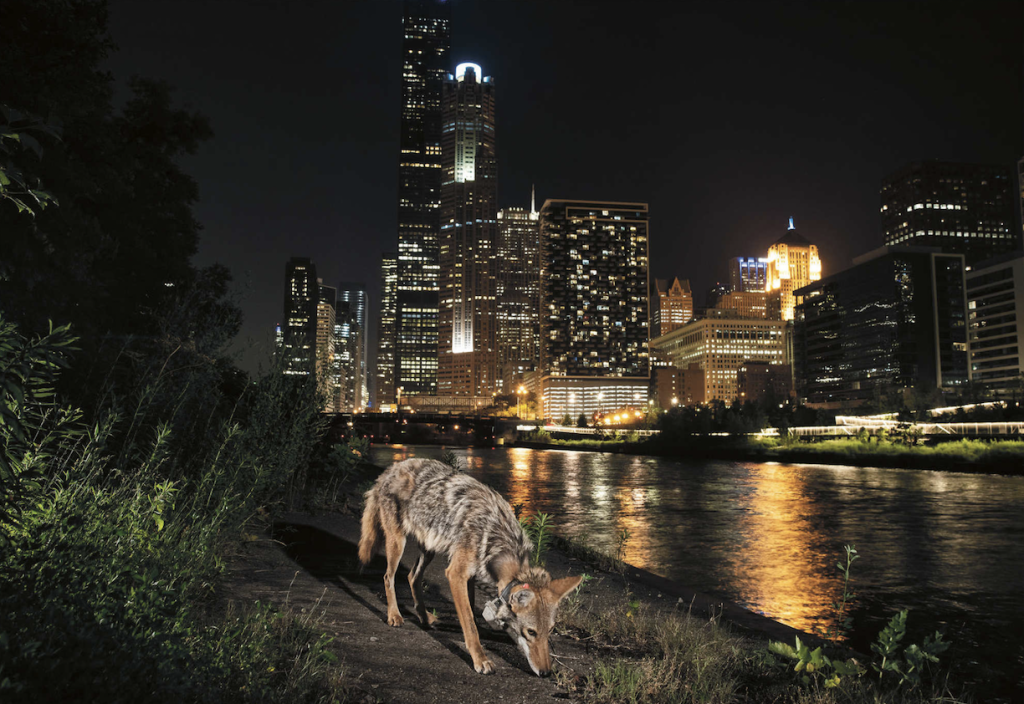
A radio-collared juvenile male coyote in Chicago, where the Urban Coyote Research Program has studied the animals since 2000. This coyote, who roamed across the city to find a territory for himself, was hit by a car a few months after the photo was taken. Visual: Corey Arnold
To learn more, I spoke with Anthony Caragiulo, a geneticist involved with the project and former assistant director for genomic operations at the American Museum of Natural History’s Institute for Comparative Genomics. His role focused on analyzing DNA from coyote feces collected by volunteers in parks throughout the city and suburbs. “I don’t personally collect anything,” he explained over the phone. “People mail me boxes of samples.”
Similar to many city dwellers, coyotes occasionally venture into Manhattan but primarily inhabit the outer boroughs. They particularly thrive in the Bronx and keep expanding their range, moving across the East River into Queens and toward the suburbs of eastern Long Island. The researchers aimed to create a “genetic connectivity map” to understand the familial relationships and origins of the local coyote population.
Caragiulo’s responsibility was to extract DNA from coyote feces delivered to him via mail. The concept was amusing to me: post office deliveries of animal droppings. I asked him, “So, do people just package it up and write your address on it?” He clarified, “They use a brown paper bag.” Sometimes, they even include silica beads, similar to those found in shoe boxes.
“And it ends up in your museum mailbox?” I marveled. As a child, I had spent considerable time in that museum, and I imagined the contents of its scientists’ mailboxes to be nothing short of fascinating, like rare gemstones or impeccably preserved fossils—definitely not coyote feces from the Bronx.
Caragiulo kindly invited me to see the process firsthand, so we met one Tuesday morning in the fall of 2021 at the museum’s basement entrance. Due to pandemic-related staffing shortages, the museum was closed that day. Aside from security personnel and some maintenance crews, the building felt hauntingly empty, with a public vaccination clinic in the lobby.
We took a large elevator to the eighth floor, traversing echoing, deserted hallways. Most staff were still working remotely, which impacted supplies and delayed essential items, including pipette tips and DNA sequencing kits—crucial for Caragiulo’s work. “I’m the bottleneck,” he admitted, as his lab was overwhelmed with samples.
We reached an area lined with boxes and stacks of envelopes. At a designated “scat bench,” he opened a box containing multiple small paper bags. One bag, marked “Cedars Golf Course, Cutchogue,” had notes mentioning the collection site and potential goose-related remnants. Various other bags bore names of park-goers who had collected samples from various locations on Long Island, each with GPS coordinates.
Caragiulo donned latex gloves, placed a tissue on the table, and opened one of the bags. Inside, he found a small, dried scat sample. While it appeared unremarkable, he noted, “This could be anything. I have no idea.”
However, the majority of the samples he assessed over the past year were confirmed to be from coyotes, with only a few being domestic dogs or foxes. By extracting and analyzing the DNA, he could quickly identify whether the scat originated from a coyote, and then use microsatellites—short, unique segments of genetic code—to trace familial connections among individuals.
He could assess how closely related different coyotes were, aiming to build a historical narrative over 5, 10, or even 15 years regarding successful families and their colonization patterns.
Molecular biologist Carol Henger, who studied coyote DNA for her PhD, noted that each park in the Bronx is home to its distinct family group. Analyzing the DNA from these samples permitted insights into familial relationships, as Henger explained, “This coyote at New York Botanical Gardens is also related to the ones in Pelham Bay.” There was a consistent dispersal throughout the city.
The genetic connectivity map allowed Henger and the Gotham team to hypothesize how coyotes first settled in New York City. They propose that “they initially moved into parks to the north of the city” from the suburbs of Westchester, with their descendants dispersing to other parks and forming their own groups. Interestingly, the newer arrivals in Queens shared genetic ties with the Bronx populations.
It’s a story of immigration and survival—a narrative familiar to many in New York.
Scientists find this snapshot particularly captivating as they observe coyotes establishing themselves in landscapes they had previously never inhabited: Long Island, a narrow, crocodile-shaped landmass juts into the Atlantic Ocean, located east of Manhattan and bordering Brooklyn and Queens to the west.
Chris Nagy, a cofounder of the Gotham Coyote Project, remarked, “We often hear about black bears or bobcats returning to their former habitats, but coyotes are making new appearances for the first time.”
Nagy is fascinated by the extensive range of these adaptable animals. “When I discuss this,” he noted, “I highlight not only their presence in urban environments but also their spread from Alaska to the tropical rainforests of Central America. They are finding ways to thrive wherever opportunities arise.”
Conclusion
As coyotes continue to adapt and expand in response to urbanization and human alterations of their environment, they serve as a remarkable example of resilience in the face of change. Their story of survival and expansion highlights the intricate relationships between species and their habitats—reminding us how life can thrive even in unexpected circumstances.


