 “When you masturbate with the hand of fate expect the worst because life is a JOKE!”
– Charlie Vurmin
(Artwork by Charlie Vurmin. Source: Institute of Sociometry)
Hard Luck Chuck
Some choices in life are so disastrous that they become irreversible. There are no take-backs or second chances; the impact remains forever.
Charles Twain Clemans, better known as Charlie Vurmin, was a notorious punk from Pacific Beach in San Diego, California, during the early ’90s. He was part of a small-time beach gang named the P.B. Vurmin. Our paths crossed briefly in the vibrant, yet often destructive, world of skateboarding.
One fateful afternoon at a popular skate spot on a local school playground, Chuck made a memorable mark on the community—he publicly defecated on the concrete embankment in broad daylight, shocking a mix of skaters, punks, and drifters.
His behavior was socially deviant, reflecting the chaos of a man with a few screws loose. What could possibly go awry?
Not long after that incident, on October 2, 1995, Chuck engaged in a fistfight at a backyard party on Felspar Street. Ideally, he should have taken a cold shower, calmed down, and prepared for work the next day as a silk screener for a popular skateboard apparel brand.
Instead, pushed to madness by alcohol and drugs, he returned to the gathering with a gun and shot four individuals. Fortunately, none lost their lives.
Chuck was arrested that evening and later sentenced to 28 years in a California State Prison without the possibility of parole.
Throughout the years that followed, he underwent personal reform, spending his final years of incarceration at the Norconian, a former luxury hotel turned minimum-security prison, surrounded by high chain link fences and barbed wire in Norco, California, within the Inland Empire.
Life’s a Joke
We recount Chuck’s story deliberately, not to dwell on his past misdeeds, but to highlight the insights he gained during years of reflection in confinement.
Like many troubled individuals grappling with the harsh consequences of their reckless actions, Chuck fell into what he termed the “would’ve, could’ve, should’ve” syndrome. He fixated on the moments he had missed—his daughter growing up, supporting his wife, and the daily freedoms he once took for granted. He even composed a song about this.
Chuck likened this daydreaming to an annoying rash on his leg—he knew he should avoid touching it, yet the urge was hard to resist.
It was also like being trapped in quicksand: the deeper he sank into thoughts of what he lacked, the less he appreciated what he still had.
After several years of daily contemplation, Chuck formulated his “Life’s a Joke” philosophy, illustrating how different aspects of life connect in a diagram he created in 1998.
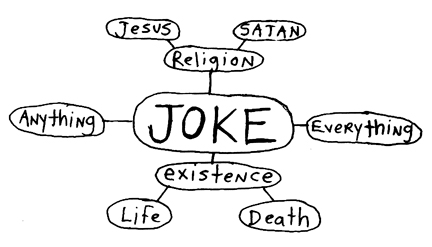
(Diagram by Charlie Vurmin. Source: Institute of Sociometry)
While Chuck’s philosophy isn’t particularly constructive, it likely provides some comfort amidst the severe disappointment of life after such destructive acts.
Finding humor in life’s absurdities may offer a way to bear daily challenges.
Irreversible Wreckage
It’s unclear whether Chuck understands the concept of central banking or its workings, but if he did, it might strike him as a cruel joke—certainly fitting within the “anything” and “everything” realms of his life’s a joke philosophy.
The Federal Reserve, after injecting over $5 trillion to cover the fallout from self-inflicted pandemic shutdowns, is set to repeat history. After shrinking its balance sheet from $8.9 trillion to approximately $6.6 trillion over the past three years, it appears to be backing off before completing the task. Thus, the Fed’s balance sheet will likely never return to its pre-COVID figure of $4 trillion.
Eventually, the Fed may resume Quantitative Easing (QE) through balance sheet expansion as this easing cycle progresses. Initially, it will likely continue lowering interest rates. For example, last week, the Fed reduced the benchmark federal funds rate by another 25 basis points, decreasing the target range to 3.75-4 percent. This reckless monetary easing occurs amid persistently high consumer price inflation.
The long-term risks include the irreversible erosion of the currency’s purchasing power. By financing extensive government deficits with QE and low rates, the Fed fosters unchecked government debt and rising inflation rates.
While the intention behind monetary easing may be to relieve short-term pressures, its long-term impact can be devastating. American workers, savers, and retirees bear the brunt through sustained high prices and the societal debasement that follows. That embodies the twisted humor of the Fed’s financial maneuvers.
Yet, where is the punchline?
Waiting for a Punchline that Never Comes
Traditional comedy often relies on a recognizable setup leading to a punchline. It establishes an expectation before delivering a surprising or humorous conclusion that turns the setup on its head, producing laughter.
In contrast, Steve Martin pioneered an unconventional style of comedy that defied this format by incorporating non-sequiturs, leaving audiences without punchlines. He articulated this approach in a 2008 Smithsonian Magazine article:
“What if there were no punch lines? What if there were no indicators? What if I created tension and never released it? What if I headed for a climax, but all I delivered was an anticlimax? What would the audience do with all that tension? Theoretically, it would have to come out at some point. But if I kept denying them the formality of a punch line, they would eventually laugh from desperation.”
In one of his final reflections from the Norconian in 2016, Chuck shared:
“On the surface, I still hold to my belief that ‘life’s a joke.’ I genuinely do. I also understand that my opinions constantly evolve. They will never be completely honed or ready for final judgment. Currently, I see my life as a joke—an exhausting cycle of mundane routines. We all stand on a precarious edge, and much of life feels like a brief cycle (consume, reproduce, die…). Along the way, we should try to enjoy the show… Perhaps one day I’ll discover my purpose, and then life won’t feel so much like a joke.”
Chuck’s story mimics the structure of Steve Martin’s humor—after all these years, he’s still left waiting for that punchline that never arrives.
Similarly, the Federal Reserve’s ongoing farce of currency devaluation and enduring inflation appears to lead nowhere…and lacks a punchline. Yet, this joke has dire consequences for all of us.
We bear the costs—through our time, our talents, and our lives—for the relentless dollar devaluation and the lasting destruction caused by financial bubbles and crippling debts.
And that, dear friends, is no laughing matter.
[Editor’s note: Join the Economic Prism mailing list to receive a complimentary copy of a significant special report titled “Utility Payment Wealth – Profit from Henry Ford’s Dream City Business Model.” If you’re interested in a special trial offer for MN Gordon’s Wealth Prism Letter, you can find that here.]
Sincerely,
MN Gordon
for Economic Prism
Return from Waiting for a Punchline that Never Comes to Economic Prism