In the ongoing conflict surrounding Iran, we find ourselves in a period of decreased kinetic activity, yet tensions continue to mount. The large-scale funeral services for Ayatollah Ali Khamenei and other casualties of the Iran War have showcased the profound desire for retribution against figures like Trump and Netanyahu. This surge of sentiment is likely to empower hardline factions within Iran, ensuring the anticipated failure of the already tenuous Memorandum of Understanding (MOU). Trump’s provocative statements only exacerbate the already dim prospects for this agreement. Meanwhile, after a brief lull, the U.S. has resumed its efforts to challenge Iran’s attempts to control shipping routes in the Strait of Hormuz.
We will also investigate the perplexing decline in crude oil prices, even as inventories tighten and the market remains in a precarious state. Financial expert Satyajit Das has penned a significant article in the Financial Times explaining why oil futures markets often fail to align with actual prices in the physical market. Additionally, Philip Pilkington has provided insights into how futures markets are misrepresentative of physical market dynamics.
Lastly, we will explore an important question: What if, despite inflicting severe damage on U.S. forces, Iran falls short of achieving its strategic objectives?
Many individuals have likely encountered news stories and videos depicting the substantial turnout in Tehran for the funeral of the Supreme Leader as well as the martyrs of the U.S.-Israel conflict against Iran, despite logistical challenges and sweltering temperatures exceeding 32°C (90°F).1 Here are some observations from foreign commentators regarding the event:
I’ve just visited the largest funeral in history, where millions mourned Sayyed Ali Khamenei, the Iranian leader who was assassinated by the US-Israeli coalition along with members of his family.
It is practically impossible to understand what this scene is like, or what it… pic.twitter.com/37Hzc0NFN8
— Max Blumenthal (@MaxBlumenthal) July 5, 2026
Scroll through the poignant crowd images and listen to the interviews. You will notice the strong emotional ties to the deceased Supreme Leader.2 Notably, most individuals interviewed by Lascaris expressed opposition to negotiations, with the exceptions being those willing to defer to the decisions of the new Supreme Leader.
For those following Iranian media or statements from officials on Twitter, it is clear that there are strong demands for the full adherence to the MOU’s terms, as interpreted by Iran.3 However, it’s crucial to remember that the MOU was never intended as a binding document; it merely served as a framework for negotiations. While it’s understandable that Iran takes a rigid stance, it’s difficult to believe the negotiators didn’t recognize that the U.S. would struggle to fulfill certain MOU provisions, such as securing $300 billion in reconstruction funds and comprehensive sanctions relief. The E-3 nations appear poised to hinder this concerning European sanctions. Adding fuel to the fire is the prevalent sentiment among many Iranians that negotiations with the U.S. should not take place.
Listening to Lascaris’ interviews, some mourners articulated a perceived Shia responsibility to counter “arrogant” leaders. Trump has doubled down on his assertive rhetoric in a recent interview with Axios:
Trump remarked, “I’ve been following the funeral of former Iranian Supreme Leader Ali Khamenei, who was assassinated on the first day of the war in a joint U.S.-Israeli operation.”
- He claimed that the Iranians “are begging to make a deal” but stated that both parties decided to pause discussions until after the funeral.
- “They are all there. One shot [and we can take them all out], but we are not going to do that because then we would have nobody to negotiate with,” Trump added.
- He expressed surprise at seeing Iranians in tears at the funeral, questioning if those feelings were genuine, stating, “Maybe it’s fake tears.”
As a result, the funerals have seemingly hardened the already strong resistance within Iranian society towards a negotiated settlement. Confirmation from Iran International English on Twitter states:
The head of Iran’s parliamentary national security committee asserted that the Islamic Republic’s armed forces had transitioned from a “deterrent doctrine” to an “offensive, deterrent, and regret-inducing doctrine.”
Ebrahim Azizi added that the world should recognize that the Islamic Republic intends to avenge the murder of Ali Khamenei and other military leaders.
On the issue of the Strait of Hormuz, Iran previously asserted that the only authorized transit route lay on its side. Nevertheless, tanker tracking data reveals that a greater number of vessels opted for the Oman route. Thus, Iran has begun adopting more stringent measures. According to Bloomberg just two days ago, in Tankers U-Turn in Hormuz:
At least eight ships attempting to depart the Persian Gulf along the Omani coast turned back between Friday and Saturday, with some vessels adjusting their courses closer to Iran.
Some had progressed as far as the Musandam Peninsula before making abrupt pivots. Among those vessels were a crude tanker, two product tankers, and one bulk carrier that ultimately headed north to follow Iran’s prescribed exit route.
The reasons behind these U-turns remain unclear, although Iran has consistently stated that vessels should only navigate through the Strait using the routes approved by it.
Traffic seems to be returning to what has been the recent norm, possibly due to Iran’s restraint during the funerals to avoid conflicting narratives. A review from
An analysis of commercial vessel traffic through the Strait of Hormuz indicates that in the past 24 hours, only one merchant ship successfully used the U.S.-endorsed traffic separation system through Oman waters (south). The overwhelming majority… pic.twitter.com/rshgSLheeX
— OSINTdefender (@sentdefender) July 4, 2026
The IRGC has permitted a limited number of ships, heavily escorted by the US military, to traverse the Strait of Hormuz via the Omani route without interference (as far as we know) throughout the week.
Today, on July 4th, the IRGC is tightening its grip and shutting the Omani route again https://t.co/cYExW3NXBq pic.twitter.com/yR4gofbaC8
— JustDario (@DarioCpx) July 4, 2026
New updates provide further insights:
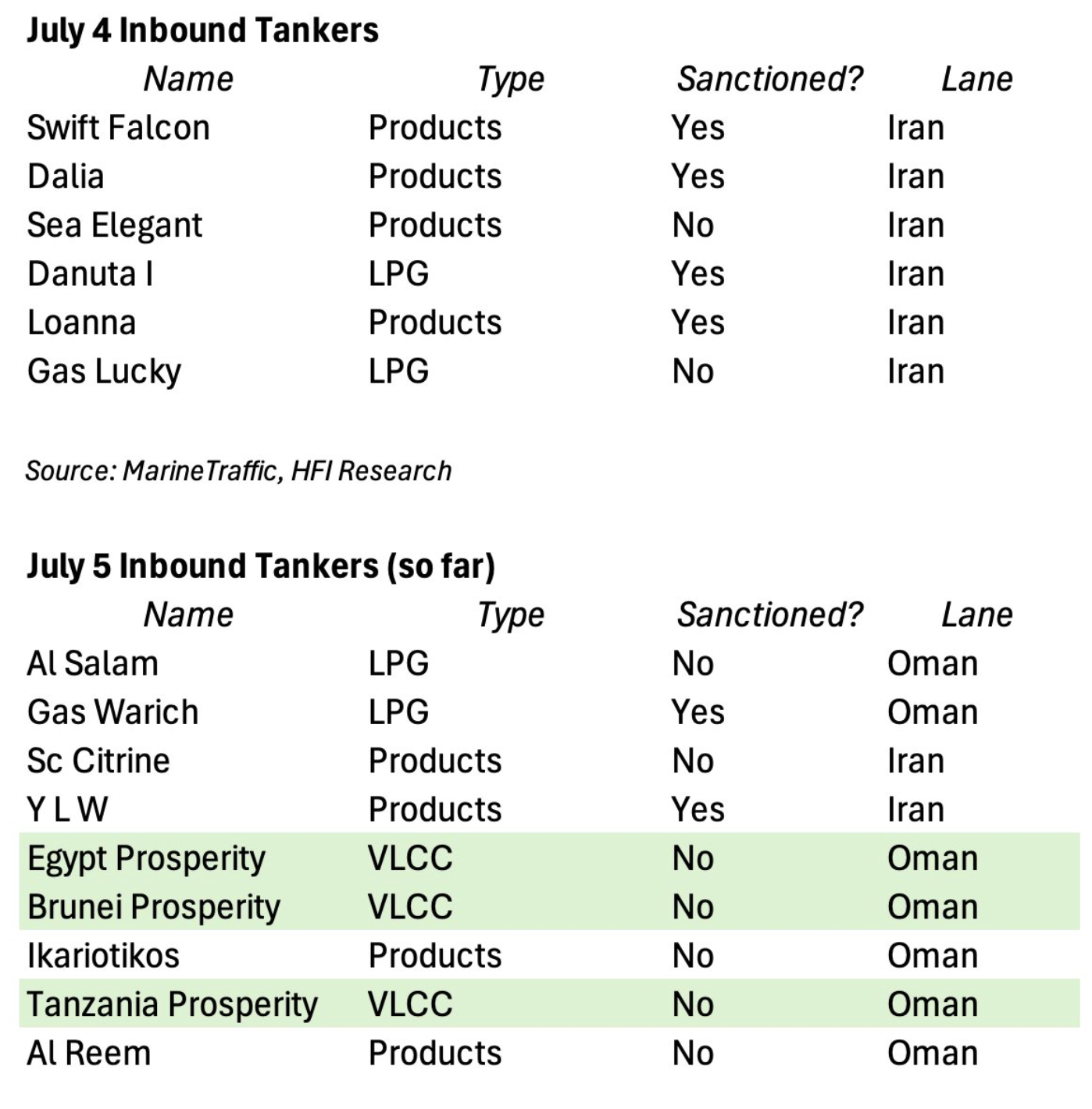
Recent movements in the Strait of Hormuz confirm the return of U.S. tanker escorts, with numerous tankers both departing and arriving.
We monitored three VLCCs inbound, concluding with “prosperity.” If you observe the VLCCs at Fujairah, expect to see 3 to 4 more Prosperity VLCCs arriving… pic.twitter.com/kZBP2YOfGb
— HFI Research (@HFI_Research) July 6, 2026

Developments are intensifying in Yemen:
Iran has bypassed sanctions on Sanaa, Yemen, for the second consecutive day. Mahan Air landed in Sanaa and transported 200 wounded along with a senior Ansar Allah Yemeni delegation to Iran. This defiance is significant given the regional and international pressures against Yemen.
— Elijah J. Magnier 🇪🇺 (@ejmalrai) July 5, 2026
Additionally, an apparent provocation has emerged in the Bab El-Mandib area:
BREAKING: A cargo vessel was attacked 30 nautical miles southwest of Yemen’s Al Hudaydah port on Sunday, according to UKMTO. The vessel sent a distress call stating it was “under attack by unknown armed assailants.” A skiff opened fire on the bulk carrier before retreating to a larger vessel… pic.twitter.com/xWZWQT0uAV
— The Hormuz Report (@HormuzReport) July 5, 2026
Moreover, Israel continues its violations of the MOU and the more recent agreements to maintain peace in Lebanon. A report from Aljazeera’s live feed states:
Israeli forces have conducted airstrikes on Nabatieh in southern Lebanon, despite a U.S.-brokered agreement with Lebanon aimed at ending hostilities.
Regarding the ongoing enigma of oil pricing, Satyajit Das applied keen analysis in his article titled “Why the ‘oil price’ isn’t always the oil price.” A key point he highlights is:
The Iran war has underscored the stark differences between physical and paper commodities, addressing the complexities that arise when dealing with tangible goods versus financial products.
While future prices hovered near $100 per barrel during heightened conflict, actual cargoes were being exchanged for prices 80 to 100 percent higher due to scarcity in refining and increased costs.
Politicians, keen to downplay rising energy prices, focused on the lower futures prices while disregarding the reality of physical costs, emphasizing that futures prices are poor predictors of actual market conditions.
Das elucidates the complexities behind oil pricing, explaining that factors like storage, insurance, and transportation costs complicate the relationship between spot and futures prices, which leads to frequent misalignment.
A further complication arises because physical oil is challenging to short sell, and participants in physical and futures markets differ significantly. Today’s trading volumes for oil derivatives are up to 60 times higher than those for physical oil.
Das’s insights reveal why actual futures prices often fall below spot prices during turbulent times in the oil market, remaining relevant to the broader discussion surrounding ongoing energy issues.
Mario Nawfal recently hosted discussions with oil specialists and economists following the engaging conversation with Philip Pilkington.4
Recalling that Philip Pilkington earlier indicated that investor trading is driven significantly by public sentiment and headlines, he noted that future trading can be profitable until trends reverse. He also addressed the high crack spreads which may indicate refiner price gouging rather than heightened oil prices. Pilkington warned that sustained high crack spreads would affirm this analysis.
Pilkington also clarified misinformation regarding claims that “10 million barrels out of the Gulf” included Saudi oil transported via pipeline, estimated at approximately 5 million barrels a day. Therefore, only about 5 million barrels are actually passing through the Strait of Hormuz. Some oil is being rerouted over land via Iraq. Considering pre-war levels were over 20 million barrels a day, with demand destruction seemingly minimal, Iran’s output shortfall could total around 14 million barrels a day, primarily drawn from inventories.
In a recent post, Nick Wade debunked the narrative surrounding an oil surplus, indicating that:
Claims of a “global glut” misconstrue a localized bottleneck for a worldwide issue, then interpret the consequent price drop as validation.
Two distinct mechanisms are driving prices lower: coordinated withdrawals from strategic reserves and the alleviation of wartime congestion in the Gulf, both of which are one-time events.
The UAE and Iraq have heavily discounted oil to clear backlogs, with China’s teapots seizing the opportunity to buy cheap. Iran, on the other hand, appears to be waiting for better prices.
The localized nature of pricing disruption reflects a chronic condition rather than an indication of a widespread oversupply. OPEC’s output in June was approximately a quarter below February totals, and U.S. crude inventories sit near historic lows, which aligns with the idea that the underlying market is still tight despite recent price declines.
Wade asserts that Iran is deliberately holding oil supplies at sea, aiming to achieve optimal pricing rather than hastily flooding the market:
The observed increase in Iran’s crude oil waiting for delivery, as evidenced by reports of 58-68 million barrels floating offshore, indicates strategic positioning rather than inadvertent delays.
Ultimately, the complexities of the oil market and geopolitical tensions continue to create volatility and uncertainty. Price dynamics reflect underlying conditions and market behaviors that are not easily captured by traditional metrics. Continued observation will be necessary to navigate these shifting grounds.
Stay tuned for updates as the situation evolves.
______
1 Professor Marandi indicates that proximity to the prayer hall made access difficult, requiring a two-hour walk.
2 Observations regarding crowd size and authenticity of mourners’ sentiments should be approached with caution, as biases may color interpretations.3
4 Nawfal’s dialogue with Jeff Currie brought to light interesting predictions and discussions about the oil market’s trajectory.