 One of life’s mysteries is why many individuals oppose freedom. When presented with choices of liberty and autonomy, they often push back.
These individuals frequently call for more government initiatives, increased economic intervention, and greater regulation in their personal lives.
Much like pigs contentedly wallowing in their own filth, they find comfort in this dependency. A recent example is the election of Zohran Mamdani, a staunch socialist, as the Mayor of New York.
However, there are rare moments when the cumulative effects of ineffective governance lead to extreme hardship. In such instances, the public may finally recognize that more government isn’t the answer; rather, it has been the source of their problems.
Argentina has reached such a juncture after nearly a century of ineffective government. The populace is awakening from its collectivist delirium, a sentiment that was recently reaffirmed during the country’s midterm elections.
In today’s article, Joel Bowman, our correspondent in Buenos Aires, provides an update on President Javier Milei’s ongoing libertarian experiment. After reading, please visit his website and subscribe to his newsletter to stay informed about developments.
Enjoy!
MN Gordon
P.S. We have no financial ties with Bowman and do not gain from publishing his insights. We simply find his writing and observations compelling and believe you will too.
—
Chainsaw First
A nation stirs from its collectivist illusions…

“A hallucination continues for as long as it is not contested.”
~ Elias Canetti, Auto-da-Fé (1935)
Joel Bowman with today’s Note From the End of the World: Buenos Aires, Argentina…
Limited government… balanced budgets… free markets…
Zero deficits… decreasing inflation… lowering taxes…
Laissez-faire… individual rights… live and let live…
It turns out these so-called “radical” concepts resonate with decent, honest people.
Who would have thought?
As attentive readers may already know, Argentina’s grand libertarian experiment is progressing at the End of the World.
After nearly two years of Javier Milei’s “Chainsaw First” policies, in which the self-proclaimed anarcho-capitalist drastically reduced the bloated state bureaucracy, Argentine voters granted his La Libertad Avanza (LLA) party a substantial mandate in the recent midterm elections. (For a deeper understanding of the Peronist aftermath, refer to Monday’s Note.)
But how is this even possible?
Concept Inflation
After all, isn’t Milei portrayed as a “far-right” radical… a fascist intending to close hospitals, shutter universities, and cause havoc? An “authoritarian” whose policies result in despair and societal breakdown?
In a word: no.
Only a misguided mainstream journalist could fail to discern the stark difference between a limited government libertarian and what they casually label “far-right authoritarianism.” (Of course, they conveniently ignore the concept of “left-wing authoritarianism.”)
Yet, what kind of authoritarian diminishes political power away from the state? What type of “far-right” (or “far-left”) dictatorship endorses free elections, champions individual rights over centralized control, respects private property, dismantles state propaganda, and fundamentally embraces a free market economy?
The answer to this is far from satisfactory!
In fact, what might history’s actual dictators—who are notorious for their brutal suppression—say about this muddled terminology?
Joseph Stalin governed with ruthless political purges, enforced labor camps (gulags), engineered famines (notably in Ukraine), and conducted mass executions, resulting in the deaths of an estimated 15 to 20 million Soviet citizens by the time of his death at 74.
Mao Zedong, meanwhile, spent 25 years torturing and executing political adversaries, with death tolls from campaigns like the Great Leap Forward and the Cultural Revolution reaching around 70 million.
Then there’s Pol Pot, whose misguided effort to erase “modern society” led to the deaths of nearly a quarter of Cambodia’s population.
Suddenly, shuttering federally funded diversity programs and cutting wasteful government entities equates to—what exactly?—mass starvation… political purges… genocide?
What a bewildering age we inhabit, dear reader, when a “fascist” is merely someone who cuts a line at Starbucks. Such trivial “oppression” would be beyond the imagination of our ancestors.
Real Growth
As petty slurs and overblown accusations begin to fade, the skeptical public, tired of media narratives, is once again seeking tangible truths from the real world.
What they find are cracks beginning to form in the established narrative. Ideas once unquestioned, proclaimed from elevated positions by modern academic elites, political insiders, and celebrity figures, are being scrutinized.
In Argentina, at the onset of Milei’s drive for a smaller government, voters were inundated with dire warnings.
The economy would supposedly “collapse” without robust public spending; greedy corporations would prioritize profits over people, leading to increased poverty; and essential workers would find themselves in a deeper state of despair.
And then, the predictions continued—endlessly.
Yet, much to the delight of hardworking citizens—and the chagrin of obstinate media—these calamities have not materialized. In fact…
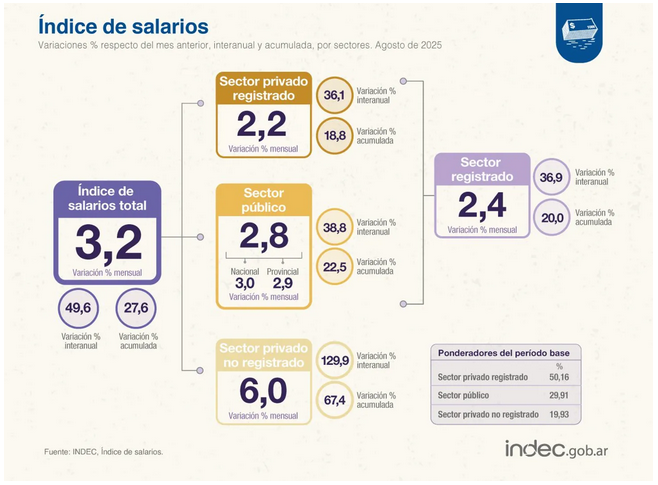
Recent statistics from INDEC (Argentina’s National Institute of Statistics), released just this week, indicate that real salaries in both public and private sectors are outpacing inflation. On average, August salaries increased by 3.2%, exceeding inflation by over a full percentage point (which was reported at 1.9% for that month).
With an exception in March, salaries have consistently outgrown inflation every single month this year. Overall, salaries have increased by 27.6% since the beginning of 2025, surpassing inflation at 19.5%.
Private > Public
Astute readers will note that the most significant real wage growth is found within the “sector privado no registrado” (unregistered private sector). These jobs in the informal market, often part-time or seasonal and subject to fluctuating wages, tend to stabilize during periods of sustained economic growth, such as the current favorable conditions in Argentina.
What does this mean for the everyday person?
When Milei took action to halve the number of government ministries last year, eliminating 55,000 “gnocchis” in the process (with even more cuts promised), many declared it would tank the economy, as if true prosperity ever resulted from tax-and-spend redistributions, akin to the mythical ouroboros feasting on its own tail.
In truth, as the workforce shifts from the public to the private sector, the economy has flourished. Driven by more informed market dynamics—supply, demand, momentum, trend, and price—the economy is transforming from a stagnant state entity to a robust powerhouse, presently the fastest-growing economy in the Western Hemisphere.
What then shall be done when those very policies that inspired this significant transformation are embraced by the public?
More free markets, not less. More vibrant enterprises, not fewer. And deeper cuts, guaranteed.
Thus, a nation awakens from its collective delusions… and envisions a future filled with opportunity and prosperity. VLLC!
Next week, we will explore a plan set to be introduced in Congress this December that aims to transition over 100,000 jobs from the public sector to the private sector. How will this be executed? Is it even feasible?
Stay tuned for more Notes From the End of the World…
Cheers,
Joel Bowman
founder of Notes from the End of the World
P.S. To keep up with Bowman’s latest insights, visit his website and subscribe to his newsletter for timely updates.