Exploring the Future of Conflict Management: The Emergence of Peace Power
In an era marked by the complexities of modern conflict, the systems traditionally used to address international disputes—collectively known as War Power—are facing significant challenges. This article examines the evolution of these systems and proposes a transformative concept: Peace Power. By leveraging advancements in technology and institutional design, we can envision a new paradigm for managing conflict that emphasizes trust over coercion.
In the earlier Armed Madhouse article, I contended that War Power has become a self-perpetuating institutional ecosystem that increasingly incentivizes actions with grave risks of escalating armed conflict. This observation raises a critical question: If War Power is becoming less effective at managing international disputes, what institutional framework could take its place?
History demonstrates that civilizations typically do not discard essential social functions; they replace outdated systems with more effective alternatives. Blood feuds eventually transitioned to organized criminal justice, trial by combat gave way to evidence-based courts, and dueling fell out of favor as legal systems emerged to manage conflicts peacefully. These changes often stemmed from the need for institutions that could deliver the same functions but with lower social and economic costs.
This article suggests that War Power may be on the verge of a similar transformation. The destructive capabilities and economic strain associated with modern armament are rising, while innovations in communication, detection, computation, and information analysis are enhancing the potential for new conflict management systems. The pivotal question is not whether humanity longs for peace but whether we can develop new ways to manage international disputes and avert disaster.

I introduce the term Peace Power to describe an emerging institutional ecosystem focused on managing international conflicts by systematically fostering trust rather than predominantly relying on coercive measures. I also propose the concept of Trust Engineering as the discipline tasked with designing, assessing, and enhancing the trust frameworks that underpin Peace Power.
This manuscript does not offer a definitive blueprint for replacing War Power. Instead, it asserts that technological advances have paved the way for a new direction in institutional evolution. Peace Power represents not an unrealistic dream, but a potential next phase in humanity’s ongoing pursuit of more effective, safer, and economical institutions for managing international conflict.
War Power as an Historical Phenomenon
Throughout most of human history, organized violence served as the primary means of addressing conflicts that could not be resolved peacefully. In a world devoid of reliable international law, independent verification, rapid communication, and trusted institutions, military strength emerged as the ultimate arbiter of disputes. War Power developed because it fulfilled a necessity that no alternative system could adequately address.
Over centuries, this necessity spawned not only weaponry and armies but also a comprehensive institutional ecosystem that included military organizations, alliances, intelligence agencies, defense industries, logistics networks, command structures, diplomatic protocols, strategic doctrines, military education systems, and supportive political entities. Together, these elements constitute what we now refer to as War Power.
Like any successful institutional system, War Power brings both benefits and drawbacks. It deters aggression, establishes political boundaries, safeguards trade routes, enforces treaties, and occasionally prevents conflicts through credible deterrence. It has enabled states to survive in an international environment often marked by distrust and a lack of independent verification. Thus, the enduring nature of War Power should not come as a surprise; institutions persist because they offer solutions to pressing societal challenges. For centuries, no alternative has existed that could manage international conflict as effectively as War Power.
The Obsolescence of War Power
Successful institutions rarely disappear overnight. More often, they gradually become obsolete as changing circumstances disrupt the balance between the benefits they offer and the costs they impose. History is replete with institutions that were once rational responses to their time but eventually lost their justification as superior alternatives became available.
For instance, blood feuds were replaced by formal legal systems because organized justice could resolve disputes more reliably and with fewer social costs. Trial by combat faded as rules of evidence became more efficient than physical confrontations in establishing contested facts. Dueling, once a legitimate means of settling personal differences, eventually disappeared when courts and civil institutions offered less destructive alternatives.

A nineteenth-century depiction of a formal pistol duel, once seen as a legitimate means of resolving disputes.
These institutions were not abolished simply for their violence; they were replaced because they were no longer the most effective economic or political methods for fulfilling their societal roles. Viewed through this historical lens, War Power warrants similar scrutiny. For centuries, military action has been the primary means of managing significant international conflicts. Despite its extreme human costs, no alternative institutions capable of fulfilling this function more effectively have existed. Under these circumstances, investing in War Power was a rational strategy for coping with existential uncertainties between states.
In the past, episodes of warfare were often interspersed with periods of peace, allowing civilizations to progress and nations to flourish. Today, however, every conflict involving major powers carries the threat of nuclear catastrophe, turning crises into a game of nuclear roulette. The costs associated with the War Power system have escalated dramatically—not only in financial terms but also in risks to humanity itself.
The pressing question now is whether the cost-benefit ratio is shifting. Modern warfare threatens not just armies and cities, but entire nations as well. Nuclear weapons, autonomous systems, cyber warfare, and other advanced technologies have significantly heightened both the potential for destruction and the economic burden of maintaining credible military capabilities. Meanwhile, advancements in information technology expand the horizon of what effective conflict-management institutions can achieve.
As these two trends unfold, the costs of an overreliance on War Power continue to surge, while the feasibility of alternative conflict-management structures appears to be improving. This doesn’t imply that war has suddenly become obsolete or that military capabilities are irrelevant. Historical changes are rarely instantaneous. Rather, it suggests that War Power might be approaching the same transformative transition that other essential institutions experienced when their costs began to outweigh their benefits.
Such institutional transitions rarely happen in a single dramatic shift. More often, they occur gradually, as new systems progressively take on responsibilities once held by their predecessors. For the foreseeable future, War Power and Peace Power will likely coexist. As institutions that foster trust become more capable, the burden of managing significant international conflicts may increasingly shift from coercive power to trust-driven frameworks—much as societies have previously transitioned from blood feuds to court systems or from dueling to regulated law.
Why This Historical Moment Is Pivotal
One might reasonably wonder why this particular moment in history is more consequential than previous times when humanity has sought to reduce the destructiveness of conflict. Every generation has aspired to reduce the costs of war; what makes ours different? The answer may not reside in changes to human behavior but in the transformative potential of technological advancements.
Civilizations are always shaped by the technologies accessible to them. New technologies do more than enhance existing institutions; they can create entirely new classes of institutions. For instance, the advent of writing facilitated the establishment of legal systems and bureaucracies. Printing revolutionized education and scientific collaboration. Innovations like railroads and telecommunications rendered modern nation-states and continental economies feasible. Digital computing led to the development of global financial networks that might have seemed miraculous to earlier generations.
This pattern illustrates a broader principle: every institution has implicit informational and computational requirements. Societies cannot build institutions that demand more information processing than available technologies can support. Modern financial systems, air traffic control, satellite navigation, and internet commerce only became viable after advancements in computation dramatically improved humanity’s capacity to process information reliably and at scale.
This observation carries significant implications for managing international conflict. For much of history, reliable trust production on a global scale was computationally unfeasible. Independent verification was slow or unavailable, leading to limited communication and fragmentary evidence. Under such conditions, military capability emerged as the most viable mechanism for handling uncertainties between rival states. War Power was, therefore, civilization’s practical substitute for trust production when the informational demands of more sophisticated institutions exceeded available technologies.
Today, however, those constraints are beginning to shift. Global communication enables real-time connections between governments and institutions. Satellite technology provides independent verification of events that were once obscured from international oversight. Emerging technologies—such as distributed sensing, cryptographic authentication, continuous monitoring, big data integration, collaborative digital platforms, and advanced analytical systems—collectively enhance humanity’s capacity to verify information, identify deception, evaluate competing claims, and synthesize evidence from various independent sources. None of these technologies alone will establish Peace Power; however, they broaden the spectrum of feasible institutional designs.
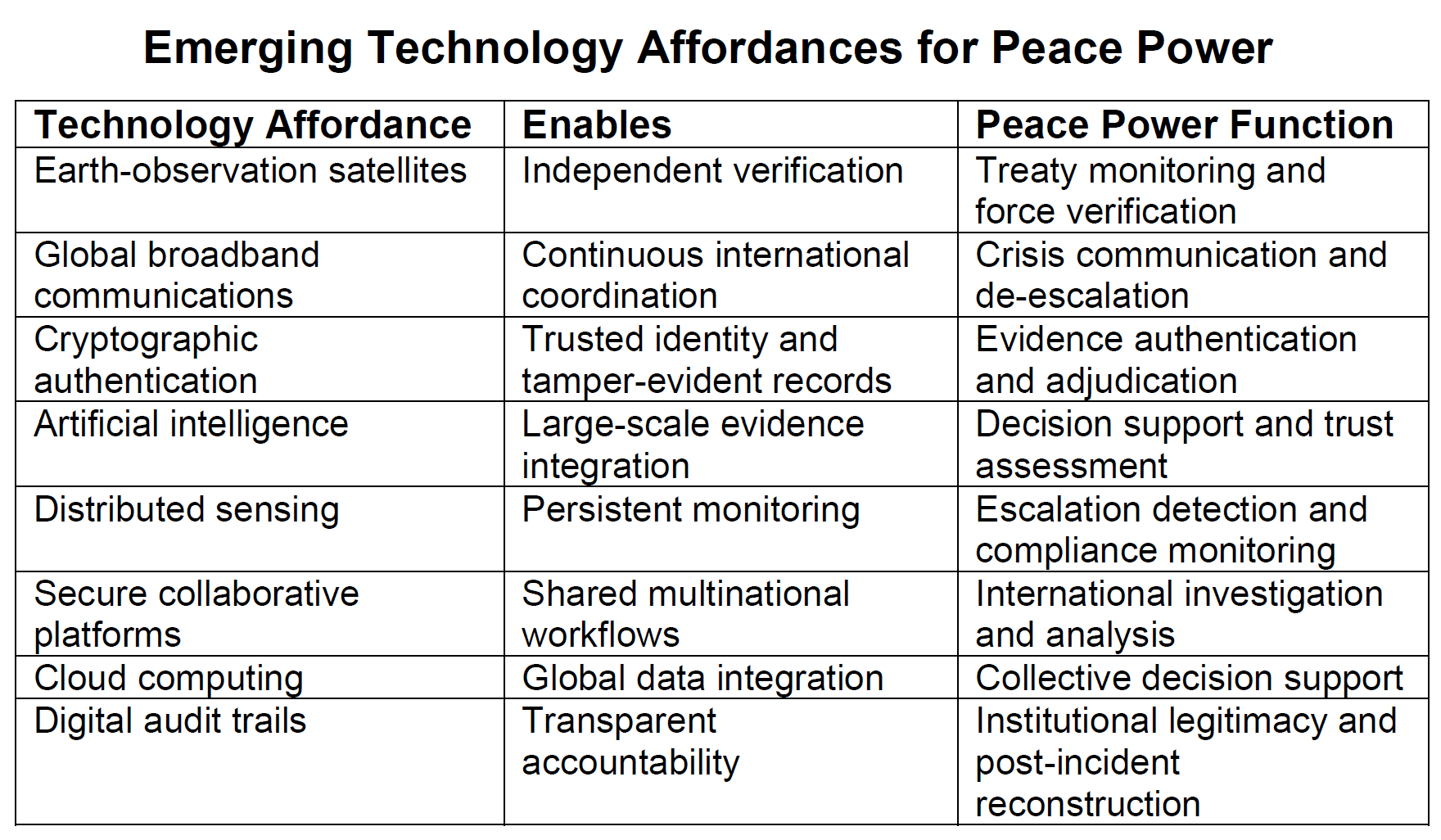
Table 1. Emerging technological advancements are enabling the formation of institutions capable of generating calibrated trust for international conflict management.
The history of aviation serves as a useful analogy. Early pioneers recognized that controlled flight was an engineering problem, even before practical aircraft were developed. Their work did not yield a final solution but established that flight was within the engineering domain rather than just a fantastic idea. The aviation ecosystem that followed was built over decades through advancements in aircraft design, navigation, airport infrastructure, weather forecasting, regulation, and air traffic control.
Peace Power should be perceived in a similar light. Although a comprehensive framework for generating calibrated trust necessary for managing international disputes has yet to materialize, the essential technical prerequisites are increasingly in place. The central thesis of this essay is not that Peace Power has already manifested but that the production of trust itself has reached a stage of engineering feasibility. If this assertion holds true, then the practical institutions of Peace Power will gradually emerge through experimentation, demonstration projects, performance assessments, institutional learning, and the integration of various complementary innovations rather than through a singular, transformative invention.
If this hypothesis is accurate, civilization may be on the cusp of a significant historical transition, wherein technological advancements facilitate a fundamentally new model of conflict management. Peace Power serves as a framework for understanding that this transition may already be underway.
Peace Power
Peace Power represents an emerging capability within civilization dedicated to handling international conflicts by systematically fostering trust rather than relying chiefly on coercive power. It should not be misconstrued as the absence of military capability, nor as a directive for unilateral disarmament or political idealism. States will maintain competing interests, strategic rivalries, territorial disputes, and legitimate security concerns. Conflict remains a persistent reality in international relations. The aim, therefore, is not to eliminate conflict but to develop institutional capabilities that manage it with decreasing economic costs and significantly diminished risks compared to armed confrontation.
Peace Power is not synonymous with diplomacy. While diplomacy constitutes an important aspect of Peace Power, just as military operations are a facet of War Power, neither term captures a singular institution. War Power encompasses a collective ecosystem of militaries, intelligence units, alliances, defense industries, logistics, strategic doctrines, educational systems, and supportive technologies. Similarly, Peace Power signifies an ecosystem where various institutions interact to produce calibrated trust through verification, transparency, secure communication, independent monitoring, collaborative analysis, confidence-building measures, and other trust-enhancing mechanisms. Like War Power, its effectiveness will emerge not from any solitary entity but from the synergy of multiple interdependent institutions. What sets Peace Power apart from conventional peace advocacy is its proactive commitment to building enabling structures.
Throughout history, civilizations have resolved complex societal challenges not merely by voicing commendable ideals, but by creating the institutions necessary for their realization. Courts replaced blood feuds, financial systems supplanted the physical movement of gold, and public health infrastructures addressed public health crises more effectively than past approaches. Sustained progress has resulted from constructing new institutional capabilities rather than merely advocating for desired outcomes.
Peace Power adheres to this historical precedent. Its purpose is to develop an ecosystem of institutions dedicated to producing calibrated trust for managing significant international conflicts. These institutions need not eradicate disagreement; they merely need to enhance verification, cooperation, and conflict resolution to the point where reliance on coercion becomes less essential.
As with any major institutional shift, this evolution is unlikely to occur abruptly. For the foreseeable future, War Power and Peace Power will likely coexist, with Peace Power gradually taking on functions that have historically relied on coercive frameworks. No single innovation will catalyze this transition; it will arise from the gradual refinement and integration of verification systems, transparency mechanisms, secure communication channels, distributed sensor networks, independent auditing processes, collaborative decision-support tools, diplomatic confidence-building initiatives, and many other trust-enabling structures that have yet to be fully envisioned.
A mature Peace Power ecosystem must also have robust mechanisms for responding to aggression. Trust-enhancing institutions cannot assume universal cooperation. Their goal is to establish sufficiently reliable verification, adjudication, and legitimacy, allowing for the identification of deliberate aggression with widespread international confidence. Once aggression is conclusively established through transparent institutional processes, the Peace Power system facilitates coordinated collective responses, ranging from diplomatic isolation and economic sanctions to, in extreme situations, authorized military action. Thus, Peace Power does not eliminate coercive force but subjects its legitimate use to increasingly trustworthy verification, adjudication, and collaborative decision-making processes.
Moreover, Peace Power aspires to reduce uncertainty surrounding both facts and legitimacy. Verification confirms what has occurred, while adjudication determines whether established norms have been breached. Collective institutional processes clarify what responses are warranted. By decreasing uncertainty across these three dimensions, Peace Power allows states to coordinate responses with greater confidence, reduced informational friction, and increased international legitimacy than has historically been achievable.
Peace Power, therefore, does not represent a utopian goal or a singular institutional breakthrough. It embodies the long-term evolution of humanity’s ability to manage conflict by purposely investing in trust production, just as previous generations invested in military might.
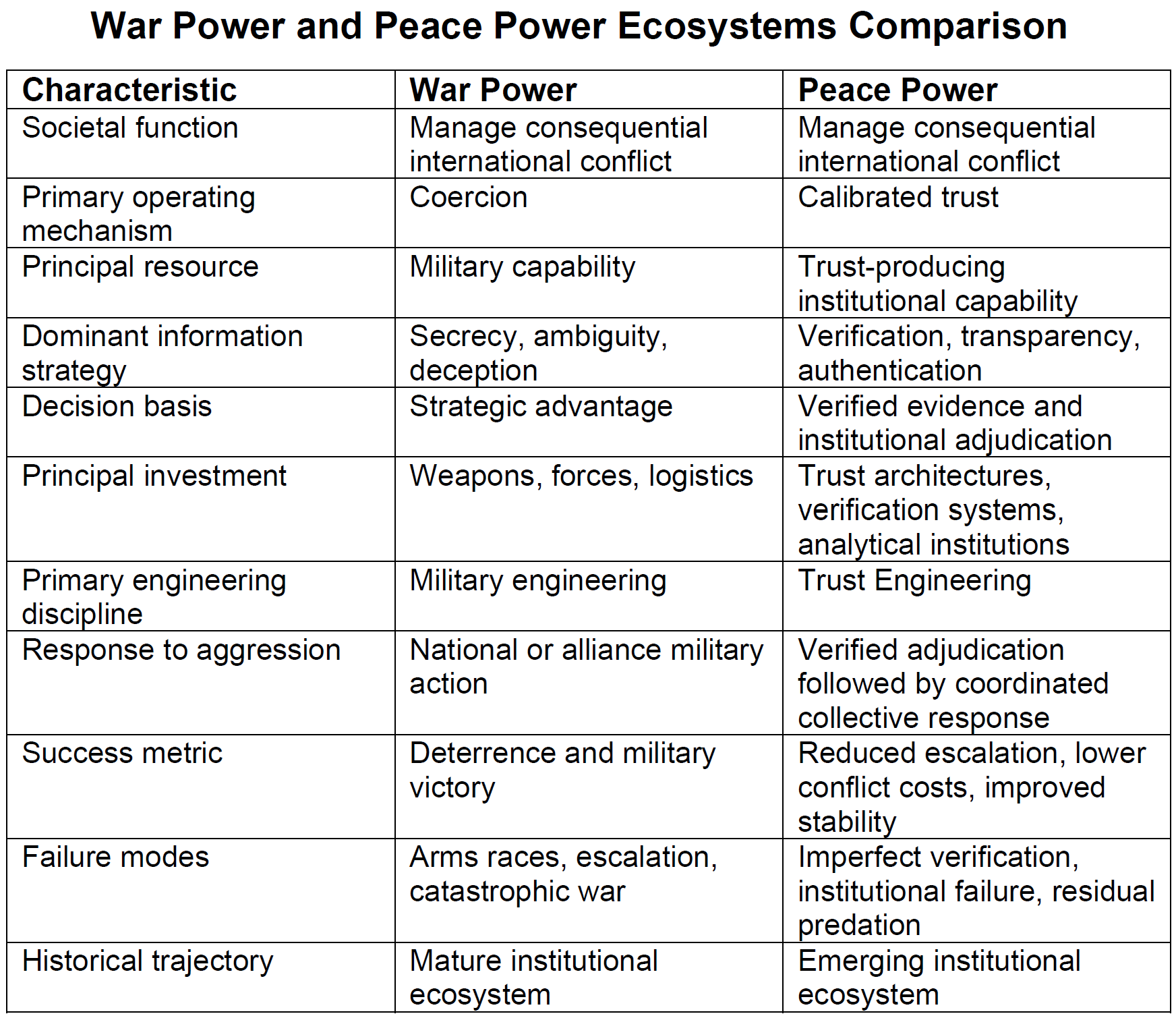
Table 2. War Power and Peace Power serve the same societal function through fundamentally different institutional mechanisms.
Trust Engineering
If Peace Power signifies a developing capability for civilization, it logically follows that another question arises: Who is responsible for designing, evaluating, and enhancing the institutional structures that facilitate this capability? History offers a familiar answer. When technological progress creates opportunities for entirely new forms of societal capability, new engineering disciplines emerge to ensure that such capabilities develop safely, reliably, and effectively.
For example, steam power prompted the creation of mechanical engineering, electrification necessitated electrical engineering, and the aviation sector gave rise to aeronautical engineering. Modern computing has led to software engineering and cybersecurity. Each of these engineering disciplines developed in response to society’s need for systematic approaches to designing increasingly complex systems, moving beyond reliance on intuition or trial and error.
Peace Power will require a similar discipline. I propose the concept of Trust Engineering to denote the systematic design, assessment, and continuous improvement of institutional frameworks that foster calibrated trust for high-stakes decision-making. The objective of Trust Engineering is not merely to encourage greater trust among individuals but to build institutions that become objectively more trustworthy through transparency, verification, independence, redundancy, accountability, auditability, and consistent calibration against observed outcomes. This distinction is crucial.
Traditional discussions surrounding trust often spotlight individual sentiments or interpersonal dynamics. Trust Engineering treats trust as an institutional design challenge. Its focus lies not in whether specific leaders or nations feel confidence in each other, but in whether the systems through which information is gathered, verified, communicated, and evaluated consistently facilitate decisions that align more accurately with reality.
This distinction leads to a significant paradigm shift in international strategy. Throughout history, states have often gained advantages through secrecy, misdirection, and strategic ambiguity, as reliable verification was challenging or often unattainable. As verification technologies and institutional trust frameworks develop, the anticipated benefits of such strategies begin to wane. Trust Engineering does not aim to abolish deception—just as modern banking does not aim to eliminate fraud. Rather, it seeks to diminish the practical rewards derived from deception by enhancing the reliability, independence, and continuity of verification processes. While War Power thrived within an information landscape that favored secrecy and deceit, Peace Power will arise within a framework that increasingly prioritizes verification and transparency.
The comparison with mechanical engineering is illustrative. Mechanical engineers cannot completely eradicate friction but aim to minimize it enough to enable complex systems to function efficiently, dependably, and safely. Trust Engineering fulfills a corresponding role for institutions by enhancing the quality of verification, transparency, and accountability, thereby lessening the informational friction that can hinder effective diplomacy, commerce, governance, and international conflict management.
There will not be a single invention that achieves this goal, nor will a universal “Trust Engine” emerge. Instead, Trust Engineering will manifest through a multitude of specialized innovations—improved verification systems, more reliable information authentication methods, independent auditing protocols, collaborative decision-support tools, transparency strategies, confidence indices, and institutional designs that we have yet to fully envision. Collectively, these advancements will form the foundational structures of the Peace Power ecosystem.
Engineering the Peace Power Ecosystem
For the concept of Peace Power to be realized, it must adhere to the developmental patterns observed in successful complex societal ecosystems: by creating many complementary elements rather than seeking a singular transformative invention. Thus, the Peace Power ecosystem will consist of numerous independently valuable components that mutually reinforce one another. Some of these will be theoretical, while others will encompass technological, institutional, educational, or political facets. Together, they will enhance civilization’s ability to manage international conflict through more trustworthy institutions.
The first necessity is a cohesive conceptual framework. Every engineering discipline begins with clear definitions of the problems it aims to address, the principles governing effective solutions, and the criteria through which progress can be measured. Trust Engineering requires this same intellectual groundwork.
Second, emerging information technologies must be strategically applied to conflict management. Innovations in communication, satellite observation, distributed sensing, cryptographic security, collaborative digital platforms, and analytical methods provide capabilities that previous generations lacked. The challenge lies not in inventing these technologies, but in integrating them into institutions that systematically enhance verification, transparency, and the quality of decision-making.
Third, the Peace Power ecosystem should be deconstructed into manageable subsystems. Instead of attempting to engineer international trust as a monolithic undertaking, distinct functions should be identified and developed independently—verifying, authenticating, auditing, building confidence, synthesizing information, monitoring escalation, ensuring treaty compliance, and others. Advancements within each subsystem will benefit the ecosystem as a whole.
Fourth, meaningful performance metrics must be established. Engineering disciplines flourish because they objectively measure progress. Trust-building institutions should likewise be assessed based on their capability to bolster verification, minimize informational friction, reduce transaction costs, lower strategic uncertainty, and mitigate conflict escalation risks. Without measurable performance standards, continuous improvement becomes elusive.
Fifth, institutional backing is crucial. Universities, research bodies, governments, international organizations, foundations, and private entities all have roles to play in cultivating the knowledge, standards, educational programs, and professional communities essential for a robust engineering discipline. Additionally, sustained political advocacy is vital—not as a replacement for engineering but as a means to secure ongoing investments in its growth. Throughout history, major public infrastructure initiatives—from transportation systems to public health frameworks—have demanded political commitment before their long-range societal benefits became apparent. Peace Power will require similar dedication.
Lastly, engineering disciplines establish credibility through demonstrative projects. They tackle confined challenges before pursuing broader transformations. One promising illustration is the long-standing territorial dispute between India and China. Neither country desires a large-scale war but both invest heavily in managing their ongoing territorial confrontations. A Peace Power demonstration project wouldn’t aim to solve the underlying political dispute. Rather, it would focus on alleviating uncertainty by enhancing institutional capabilities: implementing shared verification protocols, authenticated communications, independent oversight, transparent reporting of incidents, collaborative data analysis, and confidence-enhancing mechanisms. Success would not be gauged by the achievement of diplomatic agreements but by tangible decreases in escalation risks, military friction, and the costs of sustaining stability.
This incremental approach reflects how every thriving engineering discipline has evolved over time. The Wright brothers didn’t establish commercial aviation—they demonstrated the feasibility of controlled flight. The aviation ecosystem emerged through decades of accumulated innovations in aircraft design, navigational advancements, airport infrastructure, weather prediction, regulation, and air traffic management. Peace Power should be understood in a comparable manner. It will not emerge fully formed but will develop through the gradual accumulation of successful institutional innovations, each contributing another component toward a safer and more reliable international order.
Conclusion
Civilizations are inherently dynamic. They continuously replace institutions whose costs outstrip their benefits with better-suited alternatives adapted to evolving technological and economic conditions. Blood feuds have given way to criminal justice systems, trial by combat has been replaced by evidence-based courts, and dueling has faded as more practical conflict resolutions have emerged. In each instance, civilization has preserved essential societal roles while metamorphosing the institutional mechanisms that fulfill them.
War Power may now be on the brink of a similar transformative moment. The destructive capacity and economic burden of contemporary armed conflict continue to grow, while advancements in communication, computation, verification, sensing, and information analysis expand the available institutional designs. Whether these changes ultimately suffice to support a mature Peace Power ecosystem remains an open question. However, it is no longer sensible to dismiss the potential without exploration.
Peace Power does not claim to be a fully realized institutional alternative to War Power, nor is Trust Engineering yet an established field. This exploration does not propose a universal “Trust Engine” nor promise perpetual peace. The assertion is that managing conflict through reliable verification, legitimate adjudication, calibrated trust, and collaborative actions is an engineering problem within reach. If this proposition proves valid, then the institutions of Peace Power will emerge as the discipline of Trust Engineering matures: through experimentation, demonstration projects, performance assessments, institutional learning, and continual refinement.
The realization of this opportunity hinges not solely on technology. It will depend on whether governments, universities, research organizations, engineers, diplomats, and citizens recognize the engineering of trust architectures as a productive area of inquiry and development rather than an impractical aspiration. Civlization has repeatedly progressed by replacing outdated conflict-management institutions with more capable systems. Peace Power embodies the hypothesis that another such transition may now be within humanity’s grasp. The future will determine the pace and extent of our shift from War Power to Peace Power. Our task is to pursue the potential before us, to construct the Peace Power ecosystem, and to aspire to the vast benefits it holds for the future of humanity.