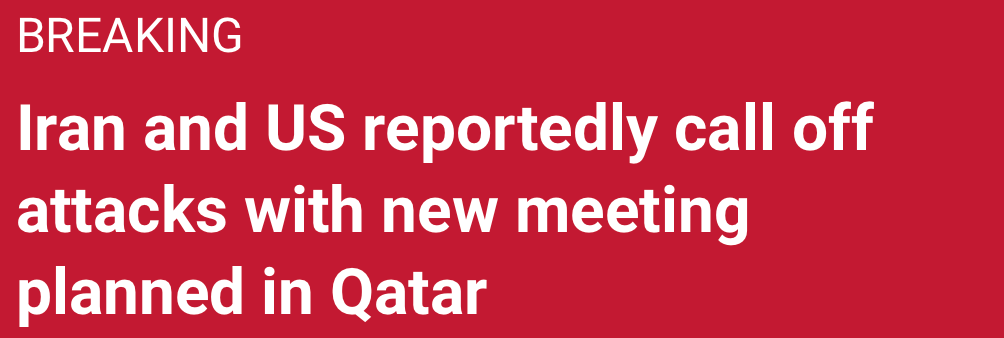
As tensions escalate in the Middle East, Iran and the U.S. are expected to engage in discussions on Tuesday in Doha to address issues surrounding the Strait of Hormuz. This comes after both nations have exchanged attacks, hinting at a complex and evolving situation.
From Aljazeera’s landing page:

It’s crucial to consider the credibility of sources, particularly Axios—which has a history of inaccurately predicting outcomes regarding negotiations—and Reuters, which often showcases narratives favoring the U.S. Additionally, this meeting in Doha is set to follow the postponement of technical discussions that were planned for today:
JUST IN: 🇮🇷🇺🇸 Iran says it did not attend scheduled technical talks with the US today after recent attacks.
— BRICS News (@BRICSinfo) June 28, 2026
Israeli media claim the next round of US-Iran talks has been canceled due to recent fighting
— Michael A. Horowitz (@michaelh992) June 28, 2026
No official confirmation from Iran has surfaced regarding the Doha meeting at this time:
I don’t think these technical talks are going to happen at all, and Iran’s leadership is likely to announce this shortly, reiterating previous statements made on state TV yesterday https://t.co/BjKuJlCJHE
— JustDario (@DarioCpx) June 29, 2026
Despite the high likelihood that discussions may not bridge the chasm between the U.S. and Iran, there’s little downside for Iran in attending. Conversely, it may leverage the situation to influence oil prices and assert its stance, perhaps announcing no confirmed meeting just before the markets open.
Following a brief surge in transit activity through the Oman channel, maritime crossings in the Strait of Hormuz have regressed to previous low levels:
Here’s a look at the Strait of Hormuz over the last 24 hours.
Inbound tankers were limited, with one group managing to pass through the Oman route under U.S. escorts. Outside this grouping, no AIS signals indicated tanker movements through Oman.
The other inbound tankers are… pic.twitter.com/6g7IRYu1ht
— HFI Research (@HFI_Research) June 29, 2026
A competent analysis regarding the situation in the Strait of Hormuz from HFI Research:
If tankers use the Iranian route, they are typically linked to Iran. Conversely, those taking the Omani route are not subject to sanctions.
Shipowners… pic.twitter.com/5WgFxgb2RK
— S p r i n t e r (@SprinterPress) June 28, 2026
While not yet confirmed, credible reports suggest:
An informed European source indicated that Iran has been routinely launching six drones at commercial shipping attempting to navigate the Strait of Hormuz nightly.
— WarMonitor🇺🇦🇬🇧 (@WarMonitor3) June 28, 2026
Additionally, significant obstacles remain:
🇮🇷 80 Mines Litter Hormuz Shipping Lanes as Normal Traffic Stays Frozen
About 80 mines are scattered across the main shipping lanes of the Strait of Hormuz, as per estimates from the UN’s International Maritime Organization (IMO).
🔹 The explosives are concentrated in the central traffic… https://t.co/RPDiNVxcID pic.twitter.com/HkS5JB2wbg
— Drop Site (@DropSiteNews) June 28, 2026
A report from Lloyd’s List emphasizes that even operations meant to navigate trapped vessels will face difficulties:
- Stern-to-bow convoys would minimize collision risks.
- However, there’s no guarantee regarding crew reactions under duress or if errors occur.
- Fatigue poses a significant risk, raising the chance of human errors.
Traversing unconventional routes through the chokepoint presents navigational challenges alongside the constant threat of missile fire.
Interestingly, a recent story from Middle East Eye contradicts less optimistic Twitter rumors, indicating that new oil shipments are indeed exiting the Gulf rather than merely relying on trapped inventories:
Energy shipments in Hormuz continue despite recent tanker attacks
Middle East producers are continuing to load oil and liquefied natural gas, as shipping data shows.
Washington and Iran agreed on Sunday to cease hostilities and resume talks regarding the Strait of Hormuz, despite the latest shipping assaults that had threatened an interim agreement.
On Monday, a fourth large crude carrier, capable of transporting two million barrels of oil, was observed loading at Saudi Arabia’s Ras Tanura terminal, following a helicopter crash associated with Saudi Aramco that resulted in 14 fatalities. The cause of the crash remains unknown.
Three other very large crude carriers (VLCCs) have subsequently loaded oil and gone silent after departing the terminal this past weekend, according to data.
One of these supertankers re-emerged on Monday, exiting the strait and now heading towards Japan, as per recent data.
Two VLCCs entered the strait on Sunday and are currently docked at a terminal in the United Arab Emirates for loading crude.
On the liquefied natural gas front, two additional ballast tankers have appeared in ship-tracking records west of the strait on June 26 after going dark, while two loaded LNG tankers have exited Hormuz.
From the same feed:
Data shows 48 vessels crossed Hormuz after attacks
A total of 48 vessels transited the Strait of Hormuz from June 26 to 28 after the most recent exchanges between the U.S. and Iran.
According to data tracked by Al Jazeera, the vessels included 23 oil and gas tankers, seven bulk carriers, and 19 cargo or container ships.
This marks a decline from the 70 transits documented on Wednesday and 54 on Thursday, prior to the latest escalation, suggesting renewed security apprehensions may be affecting maritime traffic through this vital route.
Experts emphasize that bi-directional shipments are critical for normalizing supply. It’s worth noting that Gulf States remain staunchly opposed to paying any fees to Iran or endorsing its claim of control over the Strait of Hormuz, suggesting vessels may likely opt for routes on the Oman side.
As the situation unfolds, Iran persistently demands sole control of its passage in the strait:
Iran military restricts Strait of Hormuz transits to the corridor south of Larak Island
On the afternoon of the 29th, Iranian military officials mandated that only vessels traveling through the Strait of Hormuz may utilize the corridor south of Larak Island. On the 28th, Iran asserted that ships must…
— CHItrader (@CHItrader) June 29, 2026
A more recent update indicates that:
Yesterday, the Strait of Hormuz remained open: 44 transits (24 inbound, 20 outbound), with no disruption to freedom of navigation amidst ongoing military operations.
Multiple OFAC-sanctioned tankers transited with AIS enabled, while two sanctioned VLCCs went dark to load an estimated 3–4M… pic.twitter.com/X6XdXOZbkR
— Windward (@WindwardAI) June 29, 2026
Despite being a low figure compared to pre-crisis normal levels, operators appear to have decided to move forward cautiously.
This observation highlights a significant fact previously overlooked:
My analysis of the Strait of Hormuz over the past 24 hours indicates distinct traffic patterns. Tankers utilizing the Iranian side are primarily linked to Iran, while those traversing the Omani side are generally outside current sanctions.
Several…
— Agnika (@AntarAgnika) June 28, 2026
Within the report:
Some ship operators noted that many avoid the Iranian route due to European sanctions related to the IRGC, leading to the Omani corridor becoming the preferred route for most commercial shipping.
Experts may opine on the current state of affairs regarding JCPOA snapback sanctions. Remember that in late 2025, the E-3 (the UK, Germany, and France) reinstated the snapback, maintaining JCPOA sanctions in effect, despite Russia and China disputing the extension’s validity.
Tensions are compounded by Oman’s consistent opposition to any fees for transit through the Strait of Hormuz, in line with its agreement with Gulf States:
Omani officials have confirmed that their stance is against mandatory fees or tolls in the Strait of Hormuz, aligning with the principle of international maritime freedom of navigation, despite statements from Tehran or media reports suggesting otherwise.
— Alex Plitsas 🇺🇸 (@alexplitsas) June 27, 2026
Many may not be proponents of Malcolm Nance, yet in a recent discussion with Mario Nawfal, he provides detailed insights into U.S. strikes on Iran and potential Iranian tactics. Nance asserts that the U.S. consistently attacks the same targets, hypothesizing that Iran might be deploying inexpensive radars to provoke U.S. responses. He elaborates on the complexities involved in executing an invasion of Iran or even attempting to seize strategic islands in the Strait of Hormuz:
However, according to various “big if true” sightings on Twitter, the U.S. appears to be positioning additional military assets in the area. This aligns with earlier claims by Larry Johnson regarding the imminent diesel shortage that would deter Trump from further strikes on Iran, even as he proceeded with attacks. While this might be perceived as erratic decision-making, it could also imply that the U.S. and Israel believe they have discovered a new strategy to successfully deliver a decisive blow.
The USA is conducting the largest logistical operation in its history – a statistical analysis.
This 30-second video illustrates U.S. air logistics in West Asia over the past week alone (accelerated by 20,000 times). Such operations have been ongoing… pic.twitter.com/E9h0bFc41P
— S p r i n t e r (@SprinterPress) June 28, 2026
Details from the tweet suggest we are witnessing unprecedented airlift operations in U.S. military history, surpassing even the logistics of the Iraq War in 2003. Such extensive cargo transfers indicate preparation for either a preemptive strike or the commencement of ground operations.
Notably, this situation raises questions about the feasibility of achieving the terms of the MOU requiring U.S. withdrawal within 30 days.
This also serves as a reminder of the precariousness of the situation: can the U.S. clear the strategic pathways rapidly enough to facilitate the aforementioned troop movements and materiel?
GROUND WAR:
It seems the CIA is orchestrating a coup, intending to lay the groundwork for ground operations against Iran from Iraq.
Iraq remains the sole viable option for staging such operations, as other GCC nations would not be suitable. Marine invasions generally incur losses of around 25%. https://t.co/dMoHrJQjqg pic.twitter.com/Utb5qSHR2Q
— 471TO (@TOzgokmen) June 28, 2026
Iran is evidently capable of controlling the Strait of Hormuz, while the U.S. and its allies seem to lack the means to secure it. However, Iranian political factions may have developed a psychological commitment to expecting considerable benefits from the MOU, given their vested interest and public reputations.
As reported in Aljazeera’s live coverage:
Iran president states the country will recover $6 billion of frozen funds in Qatar
During a visit to the holy city of Qom, Iranian President Masoud Pezeshkian remarked:
- As planned, $6 billion of our $12 billion in frozen assets in Qatar will be returned to Iran.
- Our efforts will persist in reclaiming the remaining frozen Iranian funds.
This statement reflects a lack of significant progress, as Pezeshkian implies no substantial advances have been made regarding Iran’s frozen assets, indicating they are still awaiting approximately $18 billion of the $24 billion Iran sought initially.
Moreover, the vague promise of funds being “released” is unconvincing, especially considering Iran was slated to receive that $6 billion in 2023. As reported by CBS:
The Biden administration facilitated the eventual release of five American citizens detained in Iran by issuing a waiver for international banks to transfer $6 billion in frozen Iranian assets from South Korea to Qatar without the risk of U.S. sanctions…
Secretary of State Antony Blinken authorized these waiver agreements the previous week, a U.S. official informed CBS News.
Furthermore, skepticism regarding the $300 billion fund persists:
Regarding the $300 billion, I have not seen any evidence. I wasn’t made aware of this, unlike other GCC nations. We are in the dark about the specifics of this fund, including who will finance it and who stands to benefit.
Jassem… pic.twitter.com/FpUyhuTdEY
— S p r i n t e r (@SprinterPress) June 28, 2026
New insights from Dror Balazada indicate that senior IRGC officials are dissatisfied with negotiators Abbas Araghchi and Mohammad Bagher Qalibaf following talks with the U.S.
This discontent stems from a belief that Iran has compromised on control of the Strait of Hormuz without obtaining adequate concessions in return, which could lead to increased tensions in the region once more:
• Sources indicate that the IRGC is increasingly frustrated and is contemplating intensifying operations in the Strait of Hormuz again.
• Their anger is amplified over two additional matters: the U.S. initiative to reroute shipping through Omani waters rather than Iranian waters, alongside the recent Israel-Lebanon agreement, which they perceive as a breach of the established agreements.
Bottom line:
According to my sources, the IRGC feels deceived and is re-evaluating its strategy moving forward.
For continued confrontation in the Strait of Hormuz, the U.S. might contest control, potentially leading to an indefinite conflict. Such a scenario would be detrimental due to its likely repercussions on global traffic and the economy. Lloyd’s List contrasts its current reporting with earlier optimism surrounding the Oman channel:
- Two vessel attacks since Friday have fostered a renewed caution among shipowners as they reassess crew and vessel risks.
- The fragile ceasefire complicates decision-making processes regarding strait transits, given the ambiguity surrounding the terms, which are subject to interpretation.
- An analyst noted an uptick in seafarers refusing to transit through the strait since Friday, complicating logistical operations.
Additionally, reflecting on the UN’s actions at the war’s outset, when Iran initially closed the Strait of Hormuz, record endorsements were received for censure against Iran, showing global support against such a blockade.
It seems unlikely Iran will secure any of its promised deals under the MOU unless it compromises on the Strait of Hormuz. This may result in sanctions being reinstated, while Israel remains active in Southern Lebanon and continues its confrontations with Hezbollah.
Shaiel Ben-Ephraim contends on Twitter that, despite IRGC frustrations and the firing exchanges, the two parties are actively negotiating:
The clashes around Hormuz may resemble war escalation, but they are instead a form of coercive negotiation within ongoing dialogue, not an attempt to terminate it:
- Both parties signed an MOU on June 17 and have maintained communication. The strikes commenced on June 28, with Doha talks possibly scheduled for Tuesday. One does not plan a summit during warfare; it typically occurs during high-stakes negotiations. Violence here signifies bargaining tactics rather than a complete breakdown.
- Strategic considerations dictate that force is not solely about territory but serves as a negotiating chip to assert resolve and renegotiate terms. Iran may attack shipping in the Omani route to signify authority over the strait, while the U.S. might respond by targeting coastal sites—each action communicates intent.
- The focus remains on the MOU’s text rather than territory, as Iran interprets “safe passage” and “administration” as exclusive rights, while the U.S. sees it as maintaining unimpeded international navigation.
- Continual retaliatory patterns hint at controlled reciprocity, wherein both parties calibrate their responses to signal intent without escalating to a full-scale war.
- Last week, in Switzerland, both parties agreed on a deconfliction channel to mitigate Hormuz-based attacks. Movements toward escalation and safety mechanisms often arise from the same discussions.
- Even inflammatory statements from Trump, such as “Iran will no longer exist,” are negotiation tactics designed to enhance the U.S. position in Doha.
Contrasting with this perspective, Professor Robert Pape asserts in his recent post that the U.S.-Iran MOU is deteriorating rapidly:
Less than two weeks after its inception, the U.S.–Iran Memorandum of Understanding shows signs of collapse.
This should not come as a surprise.
The ceasefire was merely a pause; the underlying motivations for conflict remain unaddressed.
In the past week, Iran’s attacks on commercial shipping unfolded precisely as anticipated. The U.S. retaliation continued, and Israel persists in advocating for escalated military operations. Current commercial traffic through the Strait of Hormuz lingers below normal levels.
What lies ahead remains uncertain as the ceasefire begins to falter.
To pivot back to Lebanon, Iran’s perceived inaction raises concerns about its influence. From PressTV’s landing page:

Additionally, another story emphasizes:

It is important to note that Iran does not propose any actions against Lebanon, which could be construed as a ceasefire violation:
Iran has insisted on establishing a concrete timetable for Israel’s withdrawal from Lebanese territories, regarding it as crucial for lasting peace and regional stability.
Foreign Ministry spokesman Esmaeil Baghaei made these statements in response to inquiries about the recently signed agreement between Israel and Lebanon, mediated by the U.S.
He reiterated that respecting Lebanese sovereignty and territorial integrity is paramount for the durability of any ceasefire agreement.
This statement stands in stark contrast to reports suggesting that the pending Israel-Lebanon agreement will erode Lebanese sovereignty:
Channel 12: Lebanon-Israel agreement includes secret security annex, permitting Israel military operations inside the ‘Yellow Line’
——
Confidential reports reveal that the framework agreement does not set fixed timelines for implementation, nor guarantees for Israeli withdrawals, conditioning any redeployment on verified progress on the ground.It was also disclosed that the two agreed pilot zones will remain unchanged without Israeli consent.
Additionally:
Numerous alarming clauses exist within the “agreement” signed by Lebanon and Israel, the most striking being point 13, in which Lebanon appears to relinquish its international legal claims against Israeli occupation.
— Craig Mokhiber (@CraigMokhiber) June 28, 2026
Heightened scrutiny surrounds claims that Iran has made threats regarding nuclear development:
This is a fabrication.
Even the Israeli-aligned Iran International acknowledged that such assertions were not reflective of the views held by Fars News.
— Max Blumenthal (@MaxBlumenthal) June 28, 2026
With the volume of conflicting reports, uncertainty prevails until more information emerges. Hence, it is advisable to remain patient.
All done! See you tomorrow!
_____
1 This issue surpasses my expertise, yet I have been monitoring the snapback process closely over the past year. I believe Russia and China have a legitimate point regarding the procedural requirements and delays regarding the snapback earlier this year, as Iran should have had opportunities to respond to any allegations of violations prior to its initiation.
2 Referencing Oman Notes on Shipping Fees for Hormuz Transit:
Omani officials have indicated that while they commit to upholding international maritime law, potential fees may arise for decontamination efforts or navigational aids in the strait. Exact obligations regarding these fees remain unclear.
Notably, this article was produced before UNIMO announced the operation to extract ships on the Oman side. Earlier assumptions that Oman could not accommodate typical traffic volumes appear unfounded now. Recent remarks from an expert suggest challenges inherent to Oman’s rocky coastline complicate navigation, justifying potential navigation fees as necessary services.
3 Despite Malcolm Nance’s controversial reputation, his technical insights are invaluable.