The Trump administration’s ongoing campaign against Latin America’s drug cartels is further alienating the United States on the global stage.
This commentary began yesterday afternoon (Thursday) in GMT+1. Just as I was wrapping up, U.S. Secretary of War Pete Hegseth unveiled Operation Southern Spear—an initiative ostensibly aimed at safeguarding American interests against drug trafficking organizations across the Western Hemisphere.
President Trump ordered action — and the Department of War is delivering.
Today, I’m announcing Operation SOUTHERN SPEAR.
Led by Joint Task Force Southern Spear and @SOUTHCOM, this mission defends our Homeland, removes narco-terrorists from our Hemisphere, and secures our…
— Secretary of War Pete Hegseth (@SecWar) November 13, 2025
Key takeaway: “The Western Hemisphere is America’s neighborhood – and we will protect it.”
This operation, entitled “Southern Spear,” appears aimed at a broad swath of the U.S.’s southern neighborhood, stretching from the Rio Bravo in Mexico to the southern tip of Tierra de Fuego. Reports suggest the U.S. is also developing a joint military base in collaboration with Argentina’s Milei government—an initiative that faces opposition from 71.5% of the local population.
Information about Operation Southern Spear remains sparse beyond Hegseth’s brief announcement. Notably, as NC reader Ben Panga pointed out, it was initially mentioned on January 27, nearly ten months ago, by U.S. Southern Command. A press release from the U.S. Fourth Fleet described it as an important step in using robotic and autonomous systems in maritime operations:
U.S. Naval Forces Southern Command/U.S. 4th Fleet is advancing the Navy’s Hybrid Fleet Campaign through Operation Southern Spear, set to commence later this month in the U.S. Southern Command Area of Responsibility (USSOUTHCOM AOR) and from the U.S. 4th Fleet Headquarters at Naval Station Mayport.
“Southern Spear will operationalize a heterogeneous mix of Robotic and Autonomous Systems (RAS) to support the detection and monitoring of illicit trafficking while gathering insights for additional theaters,” stated Cmdr. Foster Edwards, the 4th Fleet’s Hybrid Fleet Director. “This endeavor represents a shift from short-duration experimentation to long-term operations aimed at developing critical procedures for integrating RAS into maritime environments.”
Specifically, Operation Southern Spear involves deploying long-dwelling robotic surface vessels, small robotic interceptor boats, and vertical take-off and landing aerial drones to the USSOUTHCOM AOR. The 4th Fleet will utilize these unmanned systems in conjunction with U.S. Coast Guard cutters at sea and operations centers at the 4th Fleet and Joint Interagency Task Force South. The outcomes of Southern Spear will inform the optimal mix of unmanned and manned vessels for coordinated maritime awareness and counternarcotics efforts.
As Ben Panga notes, it appears that “Venezuela is set to become a testing ground for U.S. drone warfare capabilities.”
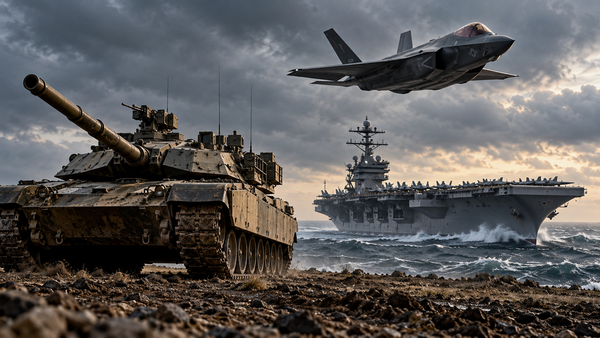
Currently, there is little else to report on Operation Southern Spear, other than its coinciding with the arrival of the USS Gerald Ford, the U.S.’s largest aircraft carrier, which joins other naval forces, B-1 bombers, and thousands of troops in the region, potentially signaling an intimidation tactic or an attack on Venezuela.
The situation is further complicated by the release of thousands of documents from the Jeffrey Epstein estate by the House Committee. A response on social media to Hegseth’s original tweet encapsulates the sentiments surrounding these developments.
— COMBATE |🇵🇷 (@upholdreality) November 13, 2025
On a lighter note, I found an alternative name for the operation by Alex Christoforou quite amusing: “Operation How to Lose the Midterm Elections.”
Now, to delve into the main topic…
With frequent strikes against small boats in the Caribbean and Eastern Pacific, Washington is increasingly estranging itself internationally. Even the United Kingdom, a traditional ally that covertly facilitated Israel’s actions in Gaza, has distanced itself from the Trump administration’s campaign of extrajudicial killings on the high seas.
CNN reported that the UK has ceased sharing intelligence with Washington regarding vessels suspected of drug trafficking in the Caribbean, as it does not want to be complicit in U.S. military operations, which it views as illegal:
The UK’s decision marks a notable departure from its closest ally and intelligence-sharing partner, highlighting growing skepticism regarding the legality of U.S. military actions in Latin America.
For years, the UK has assisted the U.S. in identifying vessels suspected of transporting illicit drugs, enabling the U.S. Coast Guard to interdict those ships. This process usually involved stopping, boarding, detaining the crew, and seizing drugs.
The intelligence was forwarded to the Joint Interagency Task Force South, a collaboration of various partner nations based in Florida working to combat the drug trade.
However, after the U.S. initiated lethal strikes against boats in September, the UK became concerned that American forces might use British intelligence to select targets, fearing that these strikes, which have resulted in 76 deaths, breach international law.
Another NATO ally, France, has also publicly criticized the boat strikes, deeming them a “violation of international law.” French Foreign Minister Jean-Noël Barrot expressed his concerns at a G7 foreign ministers’ summit, remarking:
“We have observed with concern the military operations in the Caribbean region, because they violate international law and because France has a presence in this region through its overseas territories, where more than a million of our compatriots reside… They could therefore be affected by the instability caused by any escalation, which we obviously want to avoid.”
Canada is similarly distancing itself from the U.S.’s aggressive moves in the region. A Global Affairs spokesperson stated to CBC News on October 31 that the Canadian military has had no involvement in U.S. operations in the Caribbean Sea and Eastern Pacific.
The series of operations included strikes against nine boats in the Eastern Pacific, seven in the Caribbean, and two in the SOUTHCOM area, reportedly resulting in the deaths of 75 individuals, with only three survivors being returned to their home countries due to no charges being applicable.
It’s possible that European nations have raised objections to the U.S. military actions as a strategy to pressure the Trump administration concerning Ukraine. After all, it took considerable time for many European governments to voice objections to Israel’s actions in Gaza, with some, like Germany and the UK, continuing to support Israeli military operations.
This underscores the need for caution when interpreting Europe’s condemnations of Trump’s boat strikes. Nonetheless, the actions in the Caribbean and Eastern Pacific are evident violations of international law—an assessment reiterated by UN human rights officials:
“These attacks seem to represent unlawful killings issued by governmental order, lacking judicial due process,” stated UN human rights experts recently. “Unprovoked strikes and killings on international waters violate maritime laws as well.”
In response, Secretary of State Marco Rubio has told European leaders that they lack authority to judge what constitutes permissible international actions, while highlighting their hypocrisy over arms provided to Ukraine.
🚨 ¡ÚLTIMA HORA VENEZUELA! 🚨🇻🇪
URGENTE – ¡LO ÚLTIMO! 🇻🇪 🇺🇸 —
Marco Rubio expone a Europa:“No creo que la Unión Europea pueda determinar lo que es la ley internacional (…) EEUU está siendo atacado por el crimen organizado, narcoterroristas en nuestro hemisferio”. pic.twitter.com/JJuXxIZQIy
— ¡DIFUNDELO YA! (@DIFUNDELOYA) November 12, 2025
Rubio’s last statement—“But when the United States positions aircraft carriers in our hemisphere, somehow that’s a problem”—indicates a misunderstanding of the primary concern.
The real issue lies in extrajudicial killings of individuals on boats, not the simple deployment of military hardware, which European leaders may even condone in the situation of a direct military operation against Venezuela’s government.
In fact, condemnation of the strikes is not limited to European countries; more than 50 other nations have issued joint statements opposing Washington’s illegal use of force. Russian Foreign Minister Sergei Lavrov articulated the sentiment:
“I cannot conclude without mentioning our stance on the unacceptable actions undertaken by the U.S. under the pretext of combating drug trafficking—destroying vessels without due process, without any evidence. This is the behavior of countries who operate above the law. I am certain this path chosen by the Trump administration regarding Venezuela will have dire consequences and further damage the reputation of the U.S. globally.”
The New Era of Hemispheric Governance
The U.S. seems increasingly indifferent to these global repercussions. It is now entrapped in what Jose Atiles terms the “hemispheric presidency”:
Having long been regarded as a secondary issue—particularly during President Donald Trump’s first term that emphasized relationships with countries like China, the Middle East, and Eastern Europe—Latin America has now regained prominence in U.S. foreign policy. However, what is emerging is not a revival of Cold War-era containment or the Monroe Doctrine. Instead, we see the establishment of a new doctrine aimed at merging emergency powers, economic coercion, and militarization into a cohesive hemispheric strategy.
This new doctrine relies heavily on an expansion of presidential power, signifying the full realization of the unitary executive theory or the imperial presidency within foreign policy. This shift normalizes unilateral executive actions as the guiding principle of U.S. governance both domestically and abroad. Trump’s methods illustrate how emergency powers, such as executive orders and military authorizations sans congressional approval, have been transformed into standard operations of U.S. governance.
The Trump administration’s foreign policy is predicated on a singular notion: that the president can act autonomously without regard for Congress, international norms, or established diplomatic protocols. This perspective is reflected through unilateral financial bailouts, economic sanctions, and militarized interventions.
U.S. Treasury Secretary Scott Bessent is no stranger to such rhetoric. When questioned about the benefits of bailing out Argentina, he remarked, “of course it is good… because we are taking back Latin America through our economic leadership. There will be no bullets (NC: as long as the natives comply). The whole hemisphere is coming our way.”
Scott Bessent: “Estamos RECUPERANDO América Latina a través de liderazgo económico. No habrá balas”
Recuperando?? Se supone que nos tenemos que alegrar de un nuevo Plan Cóndor solo porque al menos viene sin dictaduras sangrientas? Y si no los votamos, ¿qué ocurre? ¿Hay balas? pic.twitter.com/U2nnfZMzo5
— Arrepentidos de Milei (@ArrepentidosLLA) November 12, 2025
As the reality of U.S. ambitions in the hemisphere becomes evident, opposition is growing. Even within the U.S., dissent is rising—especially among Trump’s base—toward any proposed regime change in Venezuela.
A recent article in Time indicates that Venezuelan opposition factions led by Nobel Peace Prize winner Maria Corina Machado are misusing “misinformation” to advocate for regime change. Even FOX News commentator General Jack Keane warned against the perils of embarking on another regime change operation.
Back in late August, just before the boat strikes commenced, we questioned whether the U.S. was attempting to assemble a “coalition of the willing” for another resource-based conflict against Venezuela. The evidence supports that notion, albeit poorly executed.
The only nations seemingly eager to participate are smaller states in the region led by compliant governments willing, or feeling compelled, to enable U.S. operations against Venezuela. This includes El Salvador, the Dominican Republic, Panama, and Trinidad and Tobago.
Governments like Milei’s in Argentina and Daniel Noboa’s in Ecuador are also firmly aligned. In fact, Ecuador will hold a referendum this Sunday to authorize the return of U.S. military bases, along with possible revisions to the constitution that could enhance Noboa’s authority.
Colombia’s Suspension of Intelligence Sharing With the U.S. (Or Is It?)
In neighboring Colombia, President Gustavo Petro has ordered a suspension of “all levels of intelligence” within Colombian security forces from interacting with U.S. agencies. Petro announced that this measure would remain effective as long as Washington continues its assaults on suspected drug trafficking vessels.
This decisive action appears influenced by the UK’s announcement of halting intelligence collaboration with the U.S. regarding Caribbean drug operations. Additionally, an image taken in the Oval Office depicted a mock-up of Nicolás Maduro and Gustavo Petro dressed as prisoners, prompting further outrage.
Funcionario en el despacho Oval sosteniendo una carpeta que contiene la imagen de Nicolás Maduro y Gustavo Petro vestidos de uniforme naranja. pic.twitter.com/xiT4pySBpu
— ℂཞเ𝕤𝕥𝕚คꪀ 🎄 (@Cristancho3000) November 9, 2025
Initially, Petro considered recalling Colombia’s ambassador to the U.S. for consultations but opted instead for this suspension, igniting outrage among the political elite in Bogotá and on Capitol Hill.
“We are aware of Mr. Petro’s ties to narco-terrorist organizations within Colombia,” remarked Florida Republican Congressman Mario Diaz-Balart to NTN24, claiming that the intelligence suspension benefits drug traffickers.
However, given the CIA’s complicated history with drug trafficking globally, including in Colombia, this assertion is debatable. It is also worth noting that neoconservative politicians in the U.S., such as Diaz-Balart, Marco Rubio, and Lindsey Graham, are not strangers to collaborating with narcotraffickers (as seen below).
Here’s Lindsey Graham and fellow neocon senators with Colombia’s Alvaro Uribe, who was listed as an “important narco-trafficker” by U.S. intel
Uribe was a tool of the U.S. regime who crushed rebellious workers and peasants.
Maduro is the opposite – therefore he’s “illegitimate” pic.twitter.com/nAXcd8ffK7
— Max Blumenthal (@MaxBlumenthal) November 14, 2025
Reports suggest that the Colombian government may have backtracked on this suspension, as according to Infobae, statements from Interior Minister Armando Benedetti claimed that cooperation with U.S. agencies has not ceased.
“President Gustavo Petro never indicated that American security agencies—FBI, DEA, HSI—would cease operations alongside our intelligence agencies Dipol, Dijín, and CTI. We will continue our efforts against drug trafficking and crime in collaboration with the United States,” Benedetti stated.
Colombia’s long-standing relationship with the U.S. has established it as a primary hub of American influence in South America. As the first left-wing president in Colombia’s history, Petro has faced significant challenges, particularly regarding the conservative nature of Colombian society and the extensive U.S. interventions. Yet, he has not shied away from tackling pressing global issues, including Israel’s actions in Gaza, the failure of the U.S.-led war on drugs, and the implications of Trump’s military actions in the Caribbean and Pacific. Here is his response to the U.S. government’s threats:
ICYMI: Colombia’s🇨🇴 Gustavo Petro BLASTS The United States🇺🇸.
“A clan of pedophiles wants to destroy our democracy. To keep [Epstein’s] list from coming out, they send warships to kill fishermen and threaten our neighbor with invasion…that is only about their oil.”
They… pic.twitter.com/RF7WQ1PjAl
— Going Underground (@GUnderground_TV) November 12, 2025
As previously highlighted, Washington’s intensifying war against drug cartels is more a war of pretext than genuine intention. The underlying motives are consistent—seizing regional resources, destabilizing leftist governments advocating for equity, and re-establishing U.S. military hegemony amid rising global competitors like China, Russia, and the BRICS coalition.
This is also a diversionary tactic, akin to a Wag-the-Dog scenario. In the film of the same name, the president faces scandals but conjures a fictional war to draw public attention away from controversies in his administration.
In this reality, the president is seemingly protecting a pedophile ring tied to a deceased confidant that functioned essentially as an Israeli intelligence operation. To divert focus from emerging scandals implicating government associates and benefactors, the president appears to be launching an overarching military campaign that spans the entire region.
Sometimes, reality transcends fiction and veers into the profoundly unsettling.