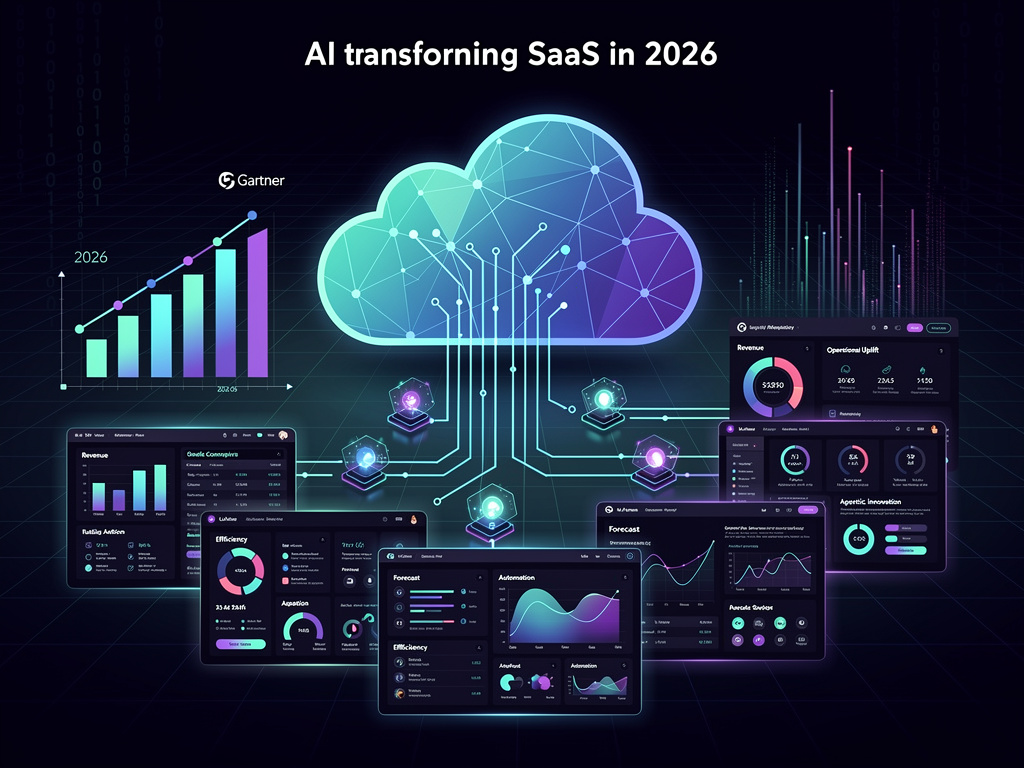
The landscape of cloud-based enterprise software is undergoing a remarkable transformation, with artificial intelligence evolving from a mere enhancement to a critical component that drives Software as a Service (SaaS) platforms toward self-sufficiency. Ankita Bhargava, a senior software engineer at Firstup, highlights in a CIO.com opinion piece, “AI isn’t just an add-on anymore — it’s making SaaS smarter, faster, and more personal, fundamentally altering how cloud tools function and influencing team competition.” This change is evident in the adoption of machine learning for predictive scaling, anomaly detection, and tailored user experiences, resulting in significant operational efficiencies that traditional systems were unable to deliver.
According to Gartner’s projections, by 2027, over half of cloud-native SaaS platforms will utilize AI and machine learning to optimize their performance, as cited in their press releases referenced by CIO.com. Numerous real-world applications support this trend, such as AI-enhanced resource systems that can predict traffic surges and automatically adjust server capacity, reducing costs and enhancing uptime. Bhargava describes this phenomenon as SaaS developing a “self-healing” capacity, enabling it to anticipate bottlenecks and security risks through effective anomaly detection.
The business implications of these advancements are equally significant. For instance, predictive models have resulted in a remarkable 15% reduction in customer churn in just one quarter for a specific team. Furthermore, McKinsey has reported that personalization can lead to revenue increases of up to 40%. Natural language processing chatbots have improved customer support by decreasing resolution times by 40%, showcasing AI’s tangible contributions to enhancing customer retention and boosting revenue.
Operational Automation Takes Command
The integration of AI into SaaS operations marks a significant shift away from manual processes. Platforms are increasingly deploying machine learning to automate mundane tasks, such as resource allocation and error correction. In multi-tenant environments, AI can dynamically adjust workloads based on usage patterns, thus eliminating unnecessary overprovisioning. Major players like Microsoft, Google, and AWS are incorporating these capabilities into their development frameworks, facilitating real-time adaptations in features, interfaces, and even pricing structures.
The emergence of agentic AI intensifies this transformation. As discussed in a RevenueGrid analysis of 2025 trends, agentic AI allows software agents to autonomously plan and execute tasks, automating intricate processes without human intervention. This advancement is expected to drive remarkable efficiency, with Gartner forecasting that 80% of enterprises will deploy generative AI-enhanced applications by 2026, according to BetterCloud’s report.
Vertical SaaS leaders such as Samsara, ServiceTitan, and Guidewire are positioned to gain significantly, as noted in various posts from industry observers. Their extensive data resources allow them to provide groundbreaking AI insights that surpass those of generalist competitors in specialized fields.
Agentic AI Ushers in Autonomy
Agentic systems are at the forefront of this transformation, evolving from supportive copilots to autonomous decision-makers. Aaron Levie, CEO of Box, remarked on X that “AI Agents are about to explode in SaaS,” as they utilize multi-user collaborative architectures for seamless automation. A16z reinforces this in their analysis, noting that AI-native startups achieve $5 million in annual recurring revenue (ARR) within nine months, far outpacing traditional SaaS growth rates due to dedicated enterprise AI budgets.
Satya Nadella’s vision, as discussed in various X dialogues, envisages applications as background data layers with agents managing workflows. This new paradigm necessitates “Agent Experience” (AX) design, emphasizing the need for AI accessibility across products—not just in developer tools, as yenkel highlighted in his X thread and linked article.
Investment trends reflect this momentum, with AI-driven SaaS platforms attracting $89.4 billion in venture capital in 2025, according to Qubit Capital. Major funding rounds, like OpenAI’s $40 billion, indicate substantial investor interest likely to continue into 2026.
Business Impact and Revenue Shifts
Metrics related to retention and revenue underscore the effectiveness of AI. Bhargava’s case studies—focusing on churn prediction and NLP chatbots—align with broader movements where generative AI enhances capabilities in customer support, report generation, and content creation, according to Qrvey’s 2026 state report. McKinsey corroborates the rapid shift toward Gartner’s 80% adoption benchmark.
Pricing models are also evolving, with usage-based and credit systems for AI functionalities, as discussed in Forbes’ Metronome piece, offering flexibility in the face of fluctuating value. Vertice’s recent $50 million funding round, reported by TechCrunch, targets optimizing the $3.4 billion SaaS/cloud expenditure it has analyzed, using AI similar to cybersecurity threat modeling.
Enterprise spending on AI applications could reach $644 billion by 2025, marking a significant 76.4% increase. This growth is projected to elevate the SaaS market from $266 billion in 2024 to $315 billion by early 2026, as reported by BetterCloud.
Implementation Roadmaps and Challenges
Bhargava provides a practical roadmap for implementing these technologies: focus on high-impact challenges like customer churn or system uptime, prioritize data quality, pilot initiatives in smaller scales, ensure compliance, and iterate. This phased strategy helps mitigate risks related to bias and privacy violations, which are crucial as AI scales.
However, challenges remain: data quality can hinder AI effectiveness, and rapid large-scale launches often lead to failure. Constellation Research predicts that pricing for agentic AI will normalize around all-you-can-eat models, amidst data access disputes, similar to those between Celonis and SAP. EY emphasizes the importance of measuring the integration of AI roadmaps and reductions in development cycle times to assess ROI.
Forbes advises focusing on augmentation rather than replacement, with Salesforce Einstein serving as a prime example of an AI-enhanced CRM that predicts churn within the SaaS landscape.
2026 Horizons: Agents and Ecosystems
As we approach 2026, MindInventory forecasts the rise of AI-driven automation, AI as a Service (AIaaS), and composable ecosystems as leading trends—democratizing intelligence through APIs without requiring in-house machine learning infrastructure. IBM anticipates that multi-agent systems will enter production, reducing barriers for business users to deploy intelligent agents.
Microsoft’s trends include AI acting as partners in areas such as healthcare and software development, exemplified by the Diagnostic Orchestrator achieving 85.5% accuracy on complex cases. Battery Ventures projects an “AI supercycle” that may unlock markets larger than those seen in SaaS 1.0, with agents performing tasks at a human-like level across sectors like software, healthcare, and legal.
Spenser Skates from Amplitude cautions against shallow AI implementations, advocating instead for restructured interfaces that build on SaaS legacies, as seen in Figma and Notion. The most successful companies will embed AI deeply into their operations, as highlighted by a16z, thereby establishing competitive advantages through effective workflow integration.
Strategic Imperatives for Leaders
SaaS companies must adopt the “AI trident,” comprising internal efficiency, AI-enhanced features, and design readiness for agents, as advised by yenkel. Speed is essential—organizations like Cursor and Shopify that act swiftly are poised to dominate the market.
In conclusion, Bhargava emphasizes that the future champions of SaaS will not view AI as merely an additional feature; instead, they will weave it into the very fabric of their product evolution. With global SaaS expected to reach $299 billion by 2026, as per Salesmate’s projections, early adopters who integrate agentic AI will lead the field, transforming software into self-evolving powerhouses.