[Today’s update on the Iran situation is being published earlier than usual due to ongoing news developments. Please check back at 8:00 AM EDT for the finalized version.]
While news from Iran has slowed significantly in recent days, it remains essential to address some key points to counterbalance the less-than-ideal reporting from mainstream media outlets.
JD Vance – A Detriment, Not a Help
JD Vance has made several claims to the media regarding Iran’s responses and agreements, which Iran has denied or dismissed outright. His comments further reinforce the Iranian perspective that U.S. officials, particularly those from the Trump Administration, are unreliable.
For instance, Vance asserted that Iran had consented to allow IAEA inspectors back into the country. However, following negotiation discussions in Switzerland, an Iranian official, likely the deputy foreign minister, clarified that the talks involved only preliminary statements from both sides regarding their positions on nuclear issues, with no real concessions made.
The BBC deserves recognition for providing space for Iran’s rebuttal to Vance’s assertion. From US eases oil sanctions as Iran denies Vance claim on nuclear inspectors:
Iran has refuted Vice-President JD Vance’s claim that it will permit nuclear inspectors to return to the country following the initial round of negotiations aimed at finalizing an agreement to end the conflict.
After discussions in Switzerland, Vance suggested talks with the International Atomic Energy Agency (IAEA) could occur “as soon as today.”
However, Iran’s foreign ministry responded through state media, stating that Tehran had made “no new commitments” regarding nuclear inspections.
This announcement coincided with the U.S. granting a temporary waiver of sanctions, allowing Iran to sell oil in U.S. dollars for the first time in decades.
It was noted yesterday that Iran had indicated that the oil sanctions had been lifted, although no actions had yet been taken by OFAC; this is now marked by a 60-day waiver.
Another example of Vance’s misinformation:
Reporter: You mentioned Iranian frozen funds could be used to buy American soy. Have the Iranians already agreed to that?
Vance: Yeah, that was something that came up yesterday. We actually asked the Qataris to assist us in establishing a mechanism to ensure that… pic.twitter.com/1bH7ZZIiQx
— Acyn (@Acyn) June 22, 2026
The complete text of the tweet:
Reporter: You mentioned Iranian frozen funds could be used to buy American soy. Have the Iranians already agreed to that?
Vance: Yes, that was discussed yesterday. We even requested that the Qataris help us set up the mechanism to ensure the funds are allocated as intended. They agreed to assist us. We have a strong relationship with them and an effective oversight mechanism in place. However, even with that said, progress must continue; otherwise, that money will not be released. This will play a significant role in ongoing negotiations.
It is highly unlikely Iran would consent to any such arrangement, particularly at this phase of negotiations. For example:
Iran imports roughly 10 million tons of corn annually, and zero of it comes from the United States, by choice.
A deal that ties Tehran’s unfrozen assets to U.S. grain is not aid; it’s a leash. Iran is spending billions on overseas farms deliberately to avoid dependency. pic.twitter.com/SpifZmyArj
— AJ Jaff (@aj_geo_analysis) June 22, 2026
Full context provided for clarity:
Iran imports around 10 million tons of corn each year, with none coming from the United States intentionally.
A deal that restricts Tehran’s unfrozen money to American grain is not assistance; it is constraining. Iran is investing billions in foreign farmland to avoid becoming reliant on U.S. sources.
Prediction: the agricultural escrow clause won’t make it into the final agreement, as JD Vance likely lacks understanding of the situation.
For an in-depth critique of Vance’s troubling statements:
Robert Pape recently reiterated previous points about the contrasting perspectives on Iran negotiations; the Trump Administration views them as transactional, while Iran sees them as a means to strengthen its influence. Pape is tactful in delivery, but the Trump Team appears outmatched as Iran plays a much more strategic game.
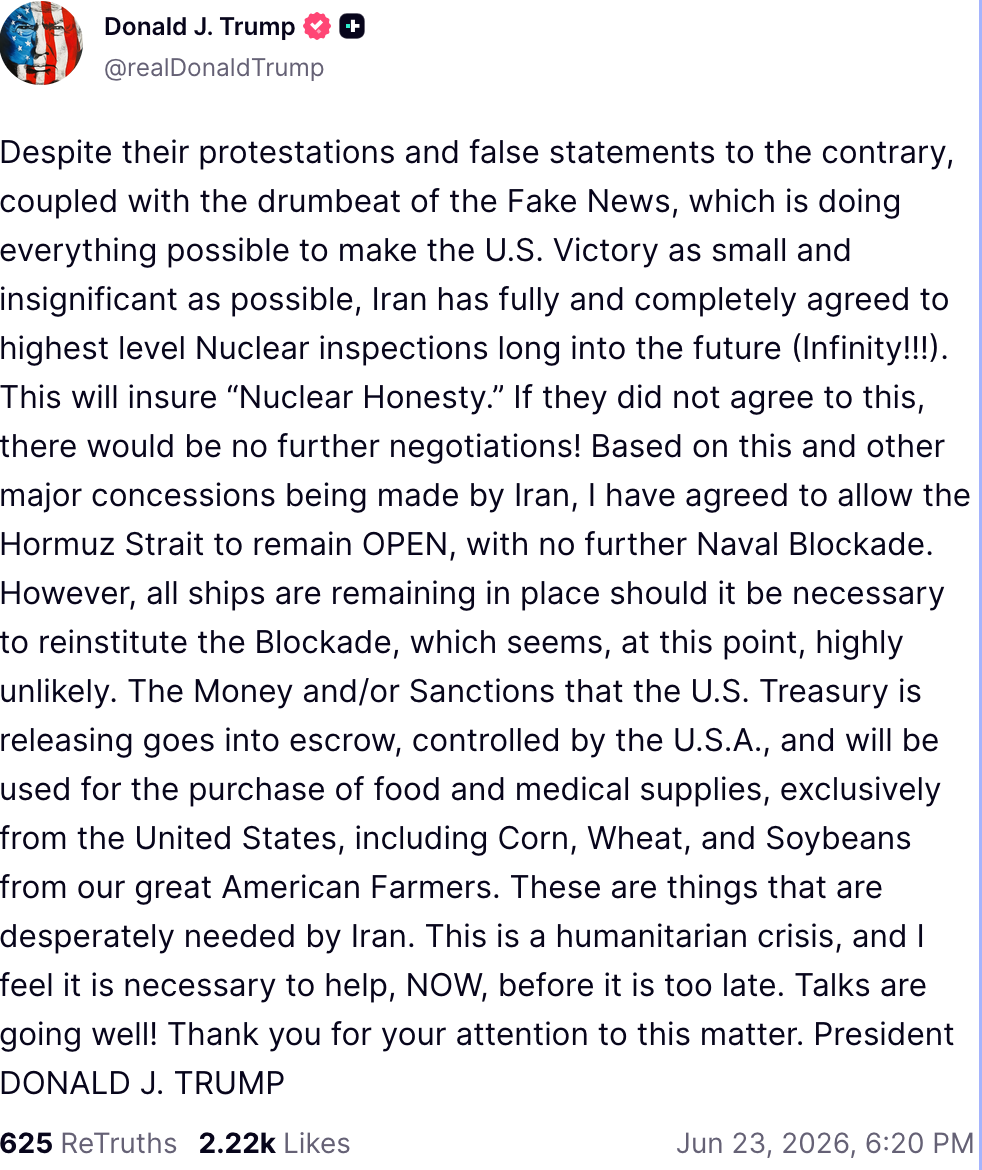
The Trump approach raises concerns once again, particularly following a recent tweet after the initial release of this update:

If this is merely a display of Trump’s bravado, the potential for this deal could diminish significantly.
Israel Faces Challenges in Lebanon
This breaking news reached my feed just as I was finalizing this update. Israel has reportedly violated the ceasefire, which might not be coincidentally timed, considering the recent departure of technical negotiators from Switzerland:
Israel breached the ceasefire in Lebanon, fabricating a justification for its actions. https://t.co/wjffnFE5Ef
— MenchOsint (@MenchOsint) June 23, 2026
BREAKING | An individual has died, and two others were injured after Israeli forces opened fire at them while they were near an excavator engaged in road work in Nabatieh al-Fawqa, southern Lebanon. pic.twitter.com/i2bpEgUTjX
— The Cradle (@TheCradleMedia) June 23, 2026
This is not to defend Israel or the IDF, who initiated the invasion of Lebanon and engaged in horrific ethnic cleansing. However, the IDF seems to be reacting defensively to U.S. limitations imposed during the ceasefire negotiations, causing heightened tensions and violations. While one might have expected these breaches given the ongoing history, the increasing pressure for restraint from the U.S. appears to contribute to the IDF’s aggressive reactions. Shaiel Ben-Ephraim notes:
Due to negotiations in Switzerland and pressure from the U.S., the IDF has adopted a more defensive posture in Lebanon. Their command structure is alarmed, fearing vulnerability. The New York Times has reported extensively on this, followed by Ynet’s coverage of soldiers’ sentiments:
- Israeli commanders received orders to limit actions to purely defensive measures. Engagement can only occur in response to immediate threats. Any proactive measures require the Chief of Staff’s approval, with strict restrictions on civilian interactions.
- Despite initial denials from Israel, Netanyahu asserted troops maintain “full operational freedom” while avoiding mentions of the new limitations. This contradiction suggests embarrassment about U.S. influence.
- Further attention has emerged regarding Lebanon, as Pakistan and Qatar plan to form a “de-confliction cell” with Iran and the U.S. to oversee operational boundaries.
- Soldiers express dissatisfaction with their reduced activities, feeling their work lacks significance. A reservist from Division 98 stated: “We feel we’re not accomplishing anything important.”
- Currently, they lack effective defenses against drone attacks. A reservist indicated: “Our protection consists of soccer nets, but they won’t prevent drone strikes. Their focus is on exposed personnel.”
- The restrictive directives are indeed real. Three senior officials spent the weekend denying or attempting to recast these orders. This restraint comes not from their own strategy, but from U.S.-Iranian negotiations backed by the new de-confliction cell, which pressures IDF operations amidst high casualty rates.
Moreover:
🇮🇱🇱🇧 Israel is preparing for a potential request from the United States for a phased withdrawal of troops from southern Lebanon, as reported by Israel’s public broadcaster KAN.
🔹Israeli and Lebanese officials will meet in Washington from June 23-25 for U.S.-mediated talks…
— Drop Site (@DropSiteNews) June 23, 2026
Strait of Hormuz Traffic Remains Volatile
Media reports and numerous social media posts have excitedly promoted the idea of increased traffic through the Strait of Hormuz. However, based on recent observations, the bulk of relevant traffic appears to be Iranian or Chinese, particularly aimed at China. While this may somewhat ease the oil supply crunch for China, it does not significantly alleviate concerns for other nations.
This situation may rapidly evolve, but there seems to be a disconnect between enthusiasm and substantial shipping movements. It’s crucial to note that the global economy needs a steady flow of trade in both directions: vessels moving into the Gulf to collect fresh cargo before heading to their destinations. Aside from Iranian and Chinese ships, there seems to be a lack of diverse traffic.
According to Lloyd’s List in VLCC rates spike yet again as ‘confusion continues to reign’ at Strait of Hormuz:
- The Baltic Exchange’s West Africa-China VLCC index jumped to $188,957 daily, a 92% increase week-over-week and the highest since March 10.
- The US Gulf-China VLCC index rose to $154,987 daily, a 46% increase week-over-week and the highest since April 2.
- The Oman-China VLCC index surged to Worldscale 276, an 82% week-over-week increase and the highest since the index’s inception on March 24.
The Strait of Hormuz isn’t fully operational yet, but the anticipation of potential openings—even partial—has attracted VLCC tonnage, inflating spot rates at loading ports worldwide.
SPOT rates for very large crude carriers are climbing, even as the flow of crude through the Strait has yet to return to pre-crisis levels.
Despite this fluctuation, comparisons indicate that the numbers remain significantly lower than before:
*6/23 Hormuz Tanker Crossings — Analyzing Tanker Traffic*
🛢️ This chart breaks down tanker crossings in the Strait of Hormuz by class: Crude, Chemical, LNG, LPG. Following a surge to 16 tankers on June 18, the count plummeted to just 3 on June 21. On June 22… https://t.co/AXEdfCq5pq pic.twitter.com/tluTr8VMCx
— Michael McDonough (@M_McDonough) June 23, 2026
Notably, some larger vessels are slowly starting to move:
Recent activity in the Strait of Hormuz over the past 24 hours.
Observe that the initial surge depicted in the video showcases mostly Iranian-linked tankers (under sanctions).
In the latter part of the video, ships connected to Korea are present.
HMM DAON (IMO: 9869227): Container Ship… pic.twitter.com/1AnDLG7Opm
— HFI Research (@HFI_Research) June 23, 2026
Iran seems to be moving toward solidifying its influence over the Strait:
JUST IN: IRAN’S GHALIBAF ON THE STRAIT OF HORMUZ:
“Iran will manage the Strait of Hormuz according to its laws and systems.”
Concerns may arise in the Strait of Hormuz. To address potential issues, we plan to establish a coordination center and hotline… pic.twitter.com/3KAaEuelIG
— Sulaiman Ahmed (@ShaykhSulaiman) June 23, 2026
Significantly, Iran seems to be progressing towards formalizing Oman’s involvement in the governance of the Strait, crucial for establishing an appearance of legitimacy in its control, rather than it merely being an exertion of power. As reported by Iran International:
Iranian Parliament Speaker Mohammad Bagher Qalibaf announced arrangements for the Strait of Hormuz in Oman, including a coordination mechanism, hotline, and contact center to resolve any disputes. He stated that parties would work closely together over the next 30 days under Article 5 of the agreements governing operation in the Strait to ensure safer and more efficient navigation of vessels.
We should not overlook the fact that The Resistance possesses other strategic leverage points beyond the Strait, positioning them to compel the U.S. to apply pressure on Israel:
🚨 BREAKING:
Reuters cited a senior Iranian official who stated:
“If tensions escalate, Iran’s allies will close the Bab al-Mandab Strait, indicating the Strait of Hormuz will not be the sole focus.” pic.twitter.com/pCG5eaZ6RA
— The Iran Observer (@tv_ir_X) June 22, 2026
This concludes today’s updates! We hope to see you tomorrow for more insights.

