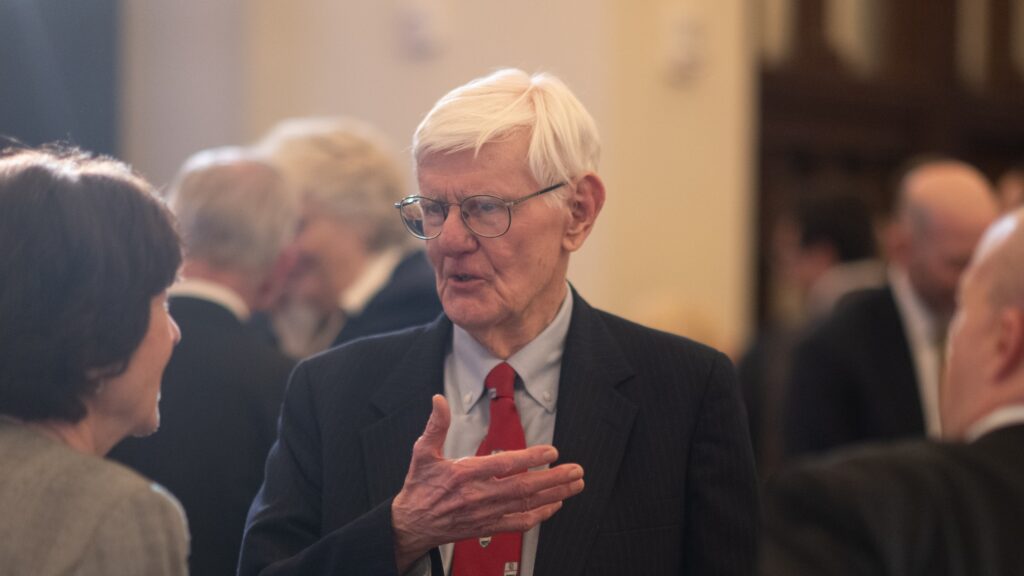
In the realm of American history, few names resonate as deeply as that of Gordon Wood. Throughout his extensive career, Wood has significantly shaped the way we comprehend the founding principles of the United States. My initial encounter with him occurred in the late 1980s when I was a graduate student. Attending a roundtable hosted by the Institute for Humane Studies, dedicated to exploring ideals of freedom and an open society, was a transformative experience for me. This gathering brought together several esteemed scholars, among whom Gordon Wood and Jack Greene particularly stood out for their genuine interest in nurturing the work of emerging historians.
Our conversations spanned various topics, including the significance of historical context, the role of biographical evidence in understanding the past, and the art of integrating narrative with analysis. Those discussions left a lasting impact on me. The enthusiasm and generosity shown by both Wood and Greene were incredibly encouraging for someone like me, a novice in the field. Their friendship exemplified what academic camaraderie could accomplish—embracing differing opinions in the relentless pursuit of truth.
Years later, as I embarked on a long-term career with an educational foundation, I had the privilege of continuing to collaborate with both Gordon and Jack. Each had longstanding ties to Liberty Fund, contributing as conference participants, directors, and later, as book editors.
Gordon Wood initially focused on the Founding era, which naturally aligned with Liberty Fund’s bicentennial programs centered on the creation and ratification of the Constitution. These seminars, organized by notable political theorists Eugene Miller and William Allen, featured Wood as a principal voice. He challenged the prevailing liberal Lockean interpretations of the American experiment, drawing upon the republican insights of his mentor, Bernard Bailyn from Harvard.
Wood’s interpretive framework, first articulated in The Creation of the American Republic, 1776–1787 (1969), positioned classical republican ideas at the core of discussions about the Constitution’s formation. Following this, his scholarly contributions and involvement with Liberty Fund unfolded hand-in-hand, continually revisiting key themes in the American political tradition.
In subsequent works, such as The Radicalism of the American Revolution (1992) and Empire of Liberty: A History of the Early Republic, 1789–1815 (2009), he probed the liberal and democratic challenges to republicanism and examined their rise in the early republic. One of the intellectual tensions he left for future scholars is the development of a liberal democratic culture within a fundamentally classical republican constitutional framework. While these three books are often heralded as his cornerstone contributions, they represent only a fraction of his extensive body of work. He also authored numerous monographs and celebrated studies, including The Idea of America: Reflections on the Birth of the United States (2011), Friends Divided: John Adams and Thomas Jefferson (2017), and Power and Liberty: Constitutionalism in the American Revolution (2021).
In recognition of his extraordinary achievements, Wood received various accolades, including the Bancroft Prize in 1970, the Pulitzer Prize in 1993, and the National Humanities Medal in 2010. Liberty Fund honored his lifetime contributions by naming him the inaugural recipient of the George F. Will Award in 2024.
As we approached the 250th anniversary of the Declaration of Independence, Wood remained actively engaged in his work. He had already played a pivotal role in planning Liberty Fund’s programs commemorating this significant milestone and was slated for several online and in-person appearances, including collaborations with Jack Greene, his longtime friend and scholarly counterpart. These initiatives aimed to leverage Wood’s vast expertise to inspire and intellectually engage younger generations entering academia.
Although these programs will continue as he would have wished, his absence leaves an irreplaceable void. We will fondly remember his unwavering charm, generous spirit, and the infectious curiosity that transformed every historical inquiry into an exhilarating adventure.
Our thoughts and condolences are with his family, friends, and students during this difficult time.
Hans Eicholz is a Senior Fellow at Liberty Fund.