Welcome, everyone!
I’ve recently begun exploring Fable, and like many others, I’m intrigued by its capabilities. However, I find myself wondering if I’ve been setting overly simple tasks to truly appreciate the dramatic advancements that have been touted. As I work on visual, interactive essays for my reference manual, I’ve been utilizing one-shot generation to cover various subjects for my kids—like playing the piano, understanding Tetris, and learning about volcanoes. They are thoroughly enjoying pressing keys on my keyboard to watch these concepts come to life.
One noticeable difference is that Fable is less conversational than Opus. I often use agents for back-and-forth interactions, and I find I need a bit more dialogue. While GPT models tend to be straightforward and concise, Claude models usually offer a more detailed approach. This places Fable in a sweet spot for me, allowing for a balance between clarity and interaction. Currently, I’m leaning more towards the engaging manner in which Claude models converse with me.
Speed, however, is a major factor for me. My struggle with ADHD makes it challenging to juggle multiple agents simultaneously; therefore, efficiency is essential. I’ve found myself tempted to switch from High or XHigh reasoning levels to more basic options, even though it feels counterintuitive, particularly when considering token usage.
Among the fastest models I’ve tried is Composer 2.5 Fast from Cursor, which I enjoyed using in Pi. It has raised my expectations significantly, especially when compared to GPT 5.5, which is also impressively quick. I appreciate the ability to swiftly accomplish tasks and wish to continue that trend.
It’s always a question of balancing cost, speed, and overall usability.
With GPT 5.6 or 6 on the horizon, I suspect OpenAI is striving to enhance their models’ conversational quality to match the trending features of Claude models, especially to sustain the momentum surrounding Codex.
Ben’s Bites is sponsored by Plaid
Over half of Americans leveraged AI to manage their finances in the past year, raising expectations for financial products to unprecedented levels. Plaid’s latest report, The State of Intelligent Finance, outlines consumer expectations from AI and its implications for your team. Download the report.
-
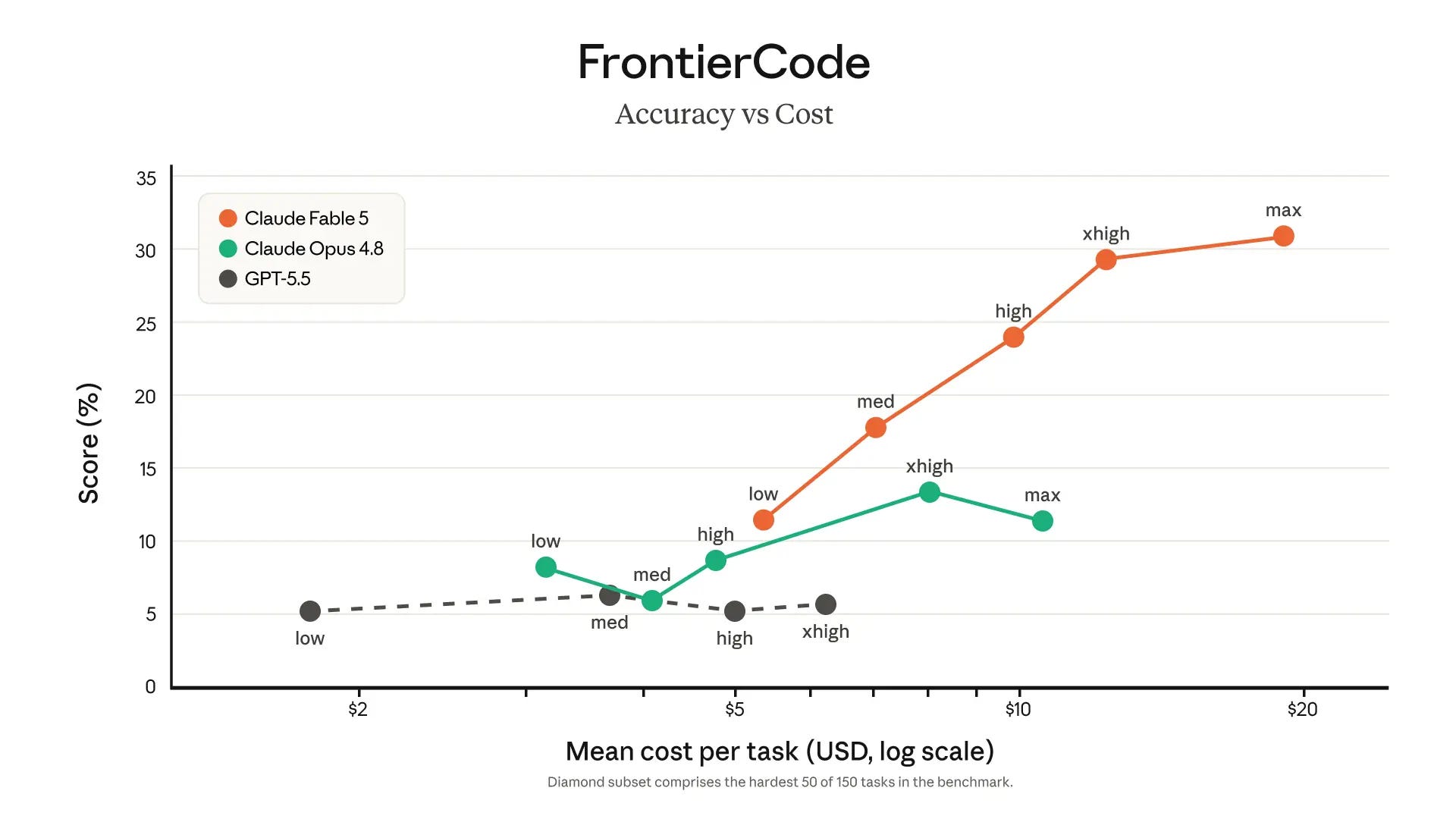
Fable 5, the new model from Claude, is engineered to be a “safer” alternative to Mythos (Anthropic’s unreleased model described as a significant cybersecurity risk, available to select organizations). Fable surpasses Opus 4.8 benchmarks significantly (though not as much against GPT 5.5). Ethan Mollick and Dan Shipper both assert it unlocks new potentials, particularly its capacity to manage extended tasks and generate multiple subagents while maintaining task context.

According to this chart, Fable medium outperforms Opus xhigh while remaining more cost-effective. -
Fable will only be available until June 22 through Claude’s subscription plans. Anthropic has plans to transition Fable usage to paid credits after that date, pending more capacity to serve all users. It is priced at twice that of Opus (in contrast, Mythos was five times Opus).
-
With the Fable rollout, Anthropic introduced a new policy that will “surreptitiously sabotage your work if used for any ML/AI-related tasks. This decision sparked significant backlash, prompting Anthropic to partially retract the “secretly” aspect of this directive.
-
Other applications of Fable include examples like: refactoring for cleaner code, editing a video, and even creating a markdown editor.
-
-
Gemini 3.5 Live Translate – Google introduces a new model that enables real-time speech-to-speech translation across 70+ languages. It’s already live in Gemini API and Google Translate, and it will soon become available on Google Meet.
-
Implications of Large-Scale Test-Time Compute – The performance of models is influenced by the amount of time, computing resources, or budget allocated for them to complete tasks; thus, it’s crucial for companies to disclose these aspects when reporting benchmarks.
-
What does AI pricing actually look like in 2026? Orb conducted an analysis of 80 AI agent organizations, including leaders like GitHub Copilot, Replit, Factory, and Intercom, to identify emerging pricing structures and monetization strategies within the industry. Download the report*
-
Claude Code now allows nested subagents, allowing each subagent to create additional subagents, currently up to five layers deep.
-
The model selector in ChatGPT has been updated to include all GPT-5 generation models, with simplified thinking levels categorized as Instant, Medium, High, Extra High, and Pro—similar to Codex.
-
Missions are now available on Factory Desktop.
-
Skribe – A local-first markdown writing application featuring an AI review partner.
-
Little Python harness allows you to evaluate your skills—determining whether they enhance or hinder the model’s performance.
-
pr.video by Mainframe transforms any GitHub PR into a narrated video walkthrough for reviewing changes (without needing code diffs).
-
New essay by Dario Amodei focusing on policy development to keep pace with advances in AI. It offers an intriguing perspective, though it carries an air of “trust me, bro” at times.
-
Supermemory is now available for local hosting.
-
DiffusionGemma – an open-weights model from Google utilizing an alternate architecture (diffusion instead of transformers) to achieve a 3-5x speedup while maintaining comparable performance.
– by Keshav
I’m in the process of developing a local-only speech-to-text app (similar to Wispr, Monologue, Superwhisper, etc.), ensuring that no data is transmitted to external servers. My motivation has been twofold: a desire to experiment with local models and a sense of guilt for paying for a similar tool that I rarely utilize.
I’ve named the app “Option AFK,” and here’s a brief overview of how I built it over 3-4 days, scattered across the past few weeks:
-
I leveraged Opus 4.7 to create a simple Python script for running Nvidia’s Parakeet 0.6B on my M3 Air. Upon testing it in the browser, the accuracy and speed exceeded my expectations.
-
Using Codex’s Computer Use, I conducted a detailed review of the tool I was subscribing to, documenting its features with screenshots. I managed to complete this on the $20 plan in a single session, only bumping against the five-hour limit once.
-
I then began building the macOS app utilizing Opus 4.8, referencing my earlier audit. During this phase, Opus 4.8 introduced me to an SDK I hadn’t previously encountered, which facilitated features like segmenting lengthy voice notes into manageable chunks and optimizing model processing speeds.
I successfully created a working version of the app yesterday with Fable 5, and I’m already using it on my device. Here’s what it looks like:
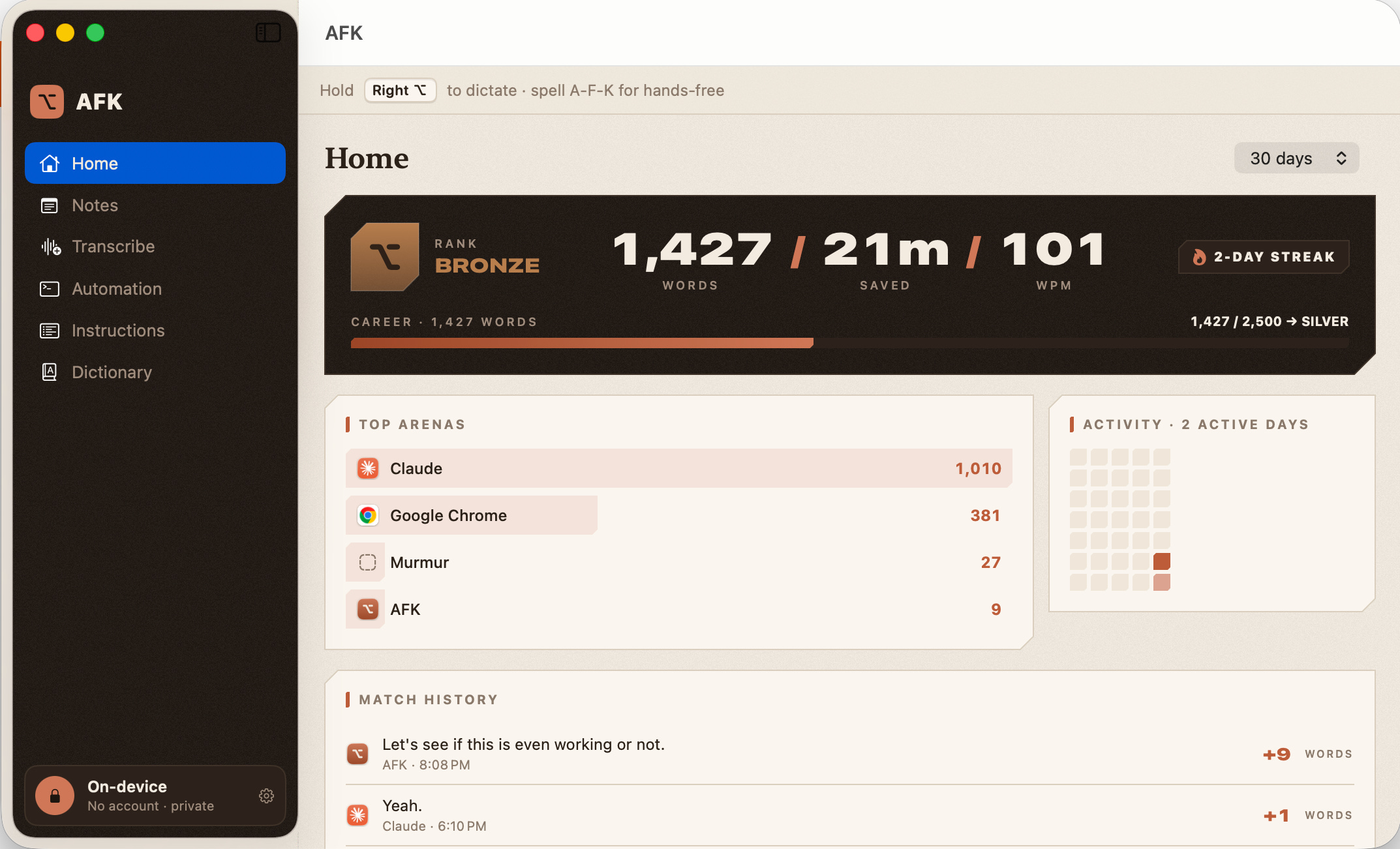
It even supports file uploads for longer voice notes, providing transcription without any additional costs.
I plan to launch this app once I complete the Apple Developer Program signup. Would you be interested in trying it?

sunil pai@threepointone
wondering why I feel exhausted. maybe: the agents do all the easy stuff, and I have to work through the leftover hard bits, which means I’m perpetually locked in. and as the models get better, “my” work just gets harder and harder, until I’m basically underqualified to do the
7:51 AM · Jun 10, 2026 · 293K Views
104 Replies · 98 Reposts · 1.58K Likes

🎭@deepfates
the future of all work is this.
You must define:
– a goal
– the criteria that define it
– the verifier that makes sure it is achieved
– the sensors that inform the verifier
– the actuators that affect the sensors
– The envelope that contains the sensors and actuators
🎭 @deepfates
The codex “goal” feature is a great way to waste dozens of hours on optimizing something trivial, by the way. If your final criteria are vague, it will lead to “specification gaming,” producing superficial evidence, “verifiers,” “gates,” and “smoke tests.” It must be challenging internally.
5:05 AM · Jun 10, 2026 · 65.2K Views
40 Replies · 38 Reposts · 765 Likes

Dan Shipper 📧@danshipper
Getting the most out of Claude Fable 5, Anthropic’s powerful new model, means maximizing your ambition:
It’s designed for complete task delegation. You simply let it run for hours or even overnight, and upon return, you’ll find a completed project. To fully capitalize on its capabilities, you need to
5:28 PM · Jun 10, 2026 · 30.8K Views
18 Replies · 23 Reposts · 427 Likes

SemiAnalysis@SemiAnalysis_
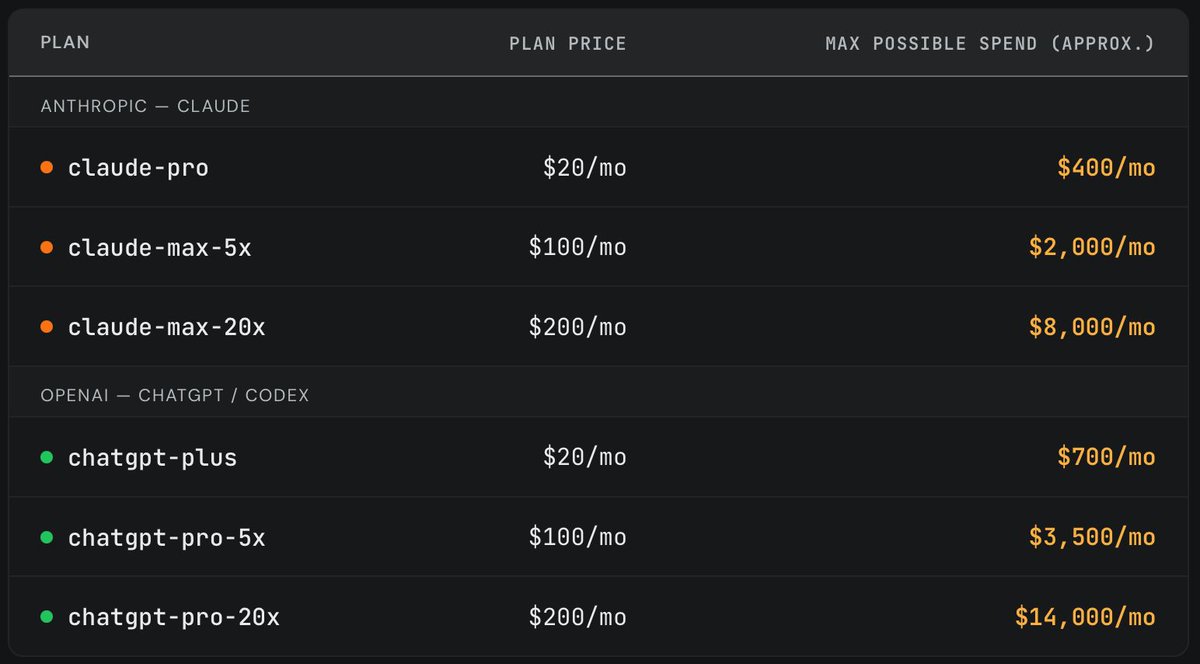
Recently, we purchased one of each Anthropic/OpenAI subscription plan and conducted extended coding tasks randomly until we reached the weekly limit. It’s commonly believed that a $200/month plan maxes out around ~$2000/month worth of tokens (based on API pricing). However, we uncovered
9:00 PM · Jun 10, 2026 · 794K Views
67 Replies · 234 Reposts · 2.53K Likes
Thank you for reading! I look forward to sharing more insights and updates with you in the near future.