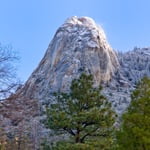
 [Editor’s Note: We find ourselves social distancing from a remote cabin nestled beside Tahquitz Peak. This serene location inspired the original version of today’s Economic Prism, published on March 30, 2018, under the title Searching for Tahquitz. It contains valuable insights regarding America’s ongoing battle with coronavirus. We are pleased to revive it for your enjoyment!]
American Myths and Legends
Every generation tends to create its own set of myths and legends. This may stem from a lack of past experience that compels young people to embrace contemporary popular delusions, regardless of their irrationality. Meanwhile, the older generation may be clinging to unrealistic expectations shaped by a world that has since transformed.
“Myths and legends die hard in America,” observed Hunter S. Thompson in The Great Shark Hunt nearly four decades ago. His observation remains relevant today, with numerous myths still alive and well in America, all facing an inevitable downfall. Here’s a look at a few:
- The belief that U.S. Treasuries are the safest, default-free investment in the world.
- The notion of American exceptionalism.
- The idea that everyone can thrive at the expense of their neighbors.
- The misconception that the President truly leads the country.
- The myth that packaging together prime and subprime loans into collateralized debt obligations and assigning them triple-A ratings somehow eliminates risk.
And the list continues…
- The legend that the U.S. Constitution is the ultimate law of the land.
- The belief that social media companies are anything other than data-collecting entities.
- The idea that more money equates to more wealth.
- The notion that might makes right.
- The belief that everyone can achieve wealth by investing in S&P 500 index funds.
Myths and legends are not a novelty unique to the American landscape. Throughout thousands of years, people across these lands have collectively embraced various delusions. Indeed, even pre-Columbian America was not without its own share of myths.
The Tale of Tahquitz Peak
According to Cahuilla Native American folklore, the San Jacinto Mountains of Southern California are said to be home to a malevolent spirit known as Tahquitz. Legends tell us that long ago, Mukat, the creator of all that exists, fashioned Tahquitz and appointed him as the first shaman. Eventually, Tahquitz became the guardian spirit of all shamans.
Initially, Tahquitz used his powers for good. However, for unclear reasons, he began to harm the Cahuilla people, leading them to banish him to a cave beneath a towering rock, now known as Tahquitz Peak.
The legend suggests that his spirit endures within these mountains, occasionally appearing as a large, green fireball streaking across the night sky, or manifesting through low rumblings from deep within the earth.
We recount this legend with purpose. Today, we find ourselves near the face of Tahquitz Peak, which rises nearly 9,000 feet above sea level. Our mission is straightforward: we are in search of answers—and perhaps a glimpse of that mythical green fireball—on your behalf.
In this mountain valley, nestled below Tahquitz Peak, early spring evenings linger a little longer. The evening sun filters through towering pines and fragrant cedars, casting a warm glow on the charming village of Idyllwild. We embrace the moment, taking deep breaths and allowing time to slow in harmony with the gentle rhythm of Strawberry Creek that flows through town.
The Search for Tahquitz
From this tranquil perch—far removed from the chaos of the Los Angeles Basin—we not only replenish our oxygen but gain a new perspective. The spirit of the San Jacinto Mountains speaks clearly: “Change is in the air,” it warns.
However, the change indicated by the spirit is driven not by rational choice but by a century of poor decisions that have compounded into an insurmountable dilemma.
America’s collection of myths and legends has placed it in opposition to both natural and political realities. Each day brings forth unfavorable truths, and yet, with each revelation, the destructive mindset originating from Washington, D.C., appears to grow stronger and more pervasive across the nation.
For instance, as the burden of debt becomes increasingly overwhelming, levels of public and private debt continue to spiral upward. Simultaneously, with the American military spread thin across roughly 800 bases in 80 countries, the drums of an impending military misadventure echo ominously.
What kind of nation willingly aligns itself with the reckless pursuit of self-induced collapse? We suspect that the resolution of the precarious situation America currently faces will be disappointing, and the aftermath equally grim.
We tossed a few rocks, pressed our ears to the ground, and listened intently. Saint Jack’s warning was sufficient, yet we still sought a clear sign from Tahquitz.
Regrettably, no ominous rumbling arose from the depths of the mountain. When night fell and the stars brightened in the crisp air, disappointment lingered. We squinted and waited patiently, yet no luminous, green fireball illuminated the sky.
Could it be that the legend of Tahquitz—as well as the myth of its lurking spirit within the San Jacinto Mountains—is simply illusionary?
Perhaps so. Yet we are certain that the world which once gave rise to such narratives was as tangible as a credit default swap back in 2008. Then, in an instant—poof!—it vanished.
Sincerely,
MN Gordon
for Economic Prism
Return from Facing Down America’s Myths and Legends to Economic Prism