The ongoing situation in Mexico raises significant concerns about external influences destabilizing the country. This campaign of destabilization has been ongoing long before the current political landscape.
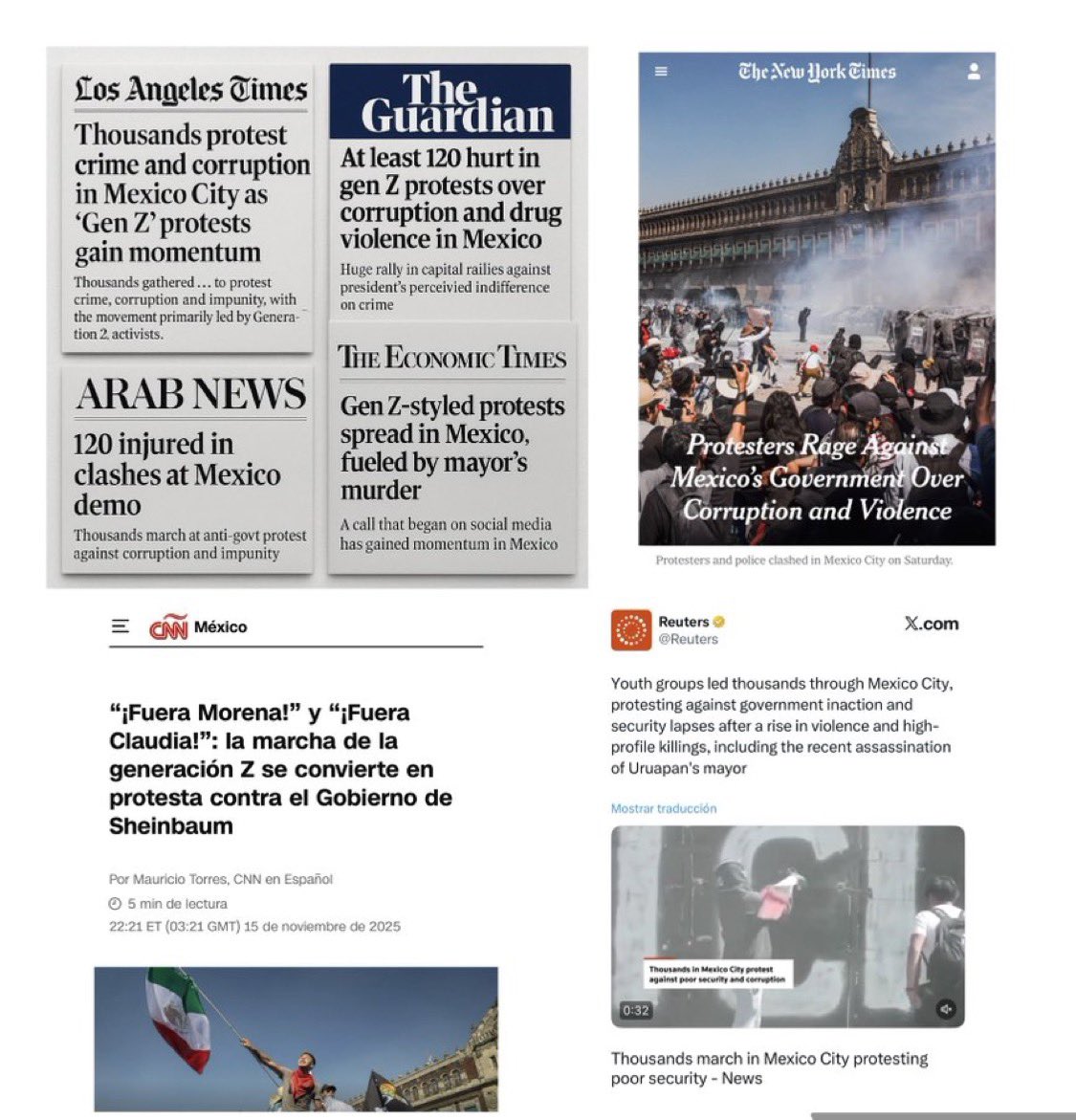
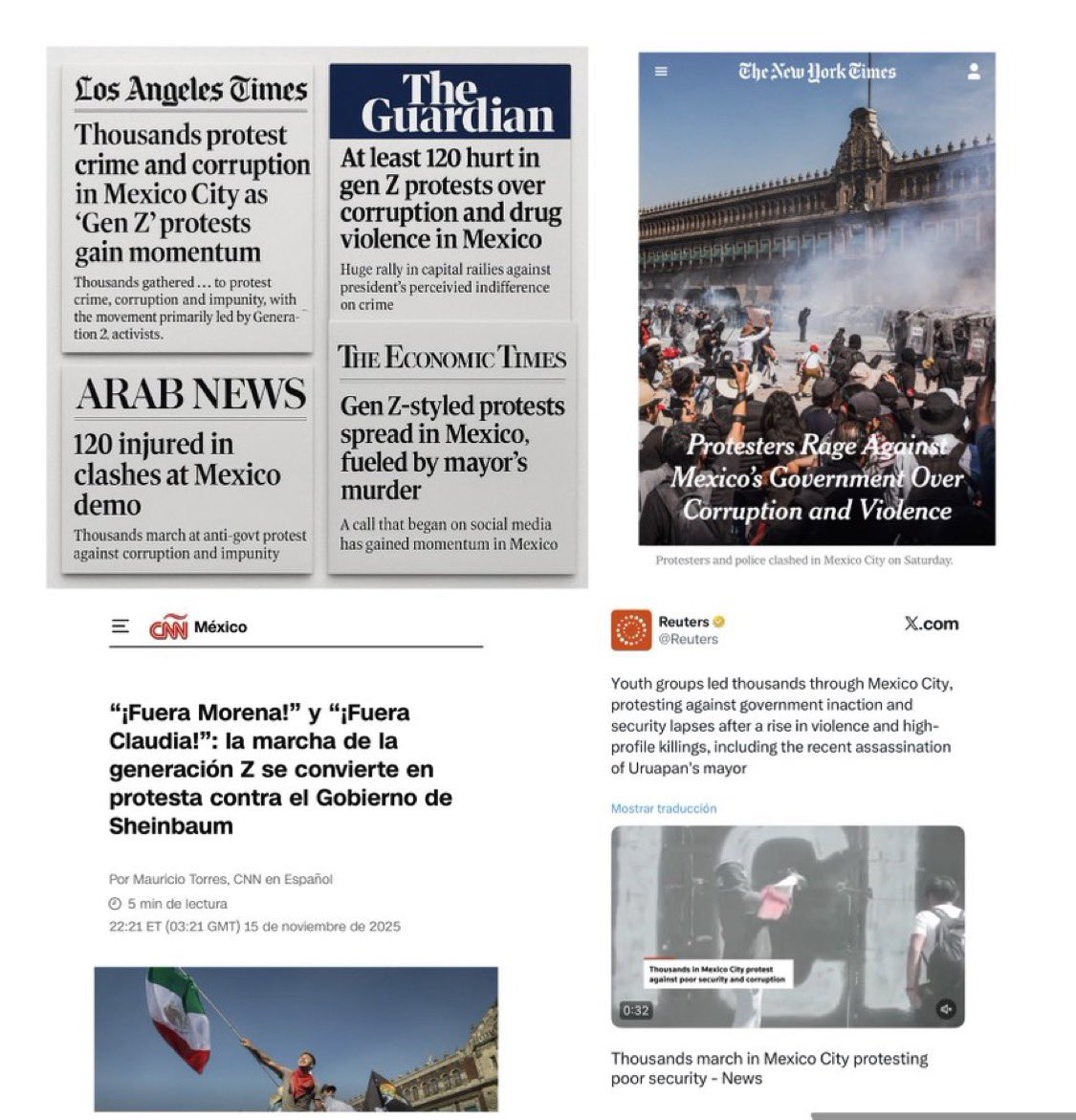
On November 15, a series of protests led by “Gen Z” demonstrators erupted in numerous cities across Mexico. The largest of these occurred in Mexico City, where tensions escalated into violence. Fringes of the protest were amplified by far-right commentators on social media, portraying the turmoil as a rebellion against a government reportedly under the thumb of drug cartels.
🚨 WOW! The Mexican people are waking up. They stormed the streets of Mexico City today because not only President Sheinbaum, but the entire ruling PARTY is controlled and financed by the cartels. pic.twitter.com/yQv9mBDUzZ
And the narco-leaders are TERRIFIED of what Donald Trump…
— Eric Daugherty (@EricLDaugh) November 16, 2025
In contrast, pro-government figures and anti-globalist commentators have raised alarms about potential US-supported interventions that could disrupt the nation’s stability.
Okay, it looks like the US has enough motives for a color revolution in Mexico.
Reason: (Long list below)
Under former Pres. AMLO and his successor Sheinbaum, Mexico has become a bit too progressive or “socialist.”
🔹Minimum wage was TRIPLED in six years under AMLO (from $5 a… pic.twitter.com/qRhqeC4eVf
— S.L. Kanthan (@Kanthan2030) November 17, 2025
This is the US trying to destabilize Mexico (which is enjoying a good run of growth, a decline in crime rates, and overall development under a very socialist sequence of administrations). Perhaps the beginning of a color revolution. They actually spoke about bombing it a couple… https://t.co/AEf9oeaf7i
— Alon Mizrahi (@alon_mizrahi) November 16, 2025
Protesters were seen waving the “One Piece” pirate flag, a symbol of youth uprisings worldwide, including in Nepal, Morocco, Paraguay, and Peru.
The focal point of the protests was Mexico City’s Zocolo, one of the largest city squares globally, with a capacity for about 200,000 people. Despite this, the turnout for the main event did not come close to filling the square. Estimates suggest that only around 17,000, many not actually part of Generation Z, participated in the demonstration within a city boasting a population of approximately 22 million. In smaller cities, participation was even lower.
Les dejo el time-lapse de la marcha de ayer, sin ediciones, con la hora y de principio a fin, se confirma que fueron 17,000 como se reportó y ni de cerca llenaron la plancha de la constitución, que no los engañen, siguen siendo una minoría ruidosa. pic.twitter.com/P4ftGuG0cG
— Chespe (@Chescan4) November 16, 2025
This suggests that the protesters comprise a small yet vocal minority. However, their issues are valid. Young Mexicans face significant challenges, including unemployment, rising living costs—especially housing—and persistent crime and insecurity.
A key catalyst for the protests was the assassination of Carlos Manzo, an independent mayor in Uruapan, who had called for stricter measures against drug cartels. His killing on Mexico’s Day of the Dead on November 1 intensified public anger and outcry.
Before his death, Manzo advocated for the aggressive pursuit of drug traffickers and raised concerns about military training camps in the Uruapan region, suggesting local instability.
The lack of governmental support for increased security led to accusations of complicity among politicians, including those from the governing MORENA party. Manzo’s death and the public discourse surrounding it highlight the serious grievances that many residents face.
Despite the real concerns that sparked the protests, surveys from January to October 2025 reveal that President Claudia Sheinbaum enjoys substantial approval ratings ranging from 71% to 86% among young people. This suggests that a significant portion of the youth continues to support her government.
Nevertheless, the protests drew a surprising turnout of older individuals, including notable politicians like former president Vicente Fox, implying diverse motivations behind the demonstrations.
Extremely convincing Gen Z protester in Mexico. Definitely an organic youth uprising. pic.twitter.com/Gfz5aze7sW
— Ryan Grim (@ryangrim) November 16, 2025
Violence Transforms the Narrative
If the protests aimed to destabilize Mexico further and challenge the government’s authority, it seems they were largely successful. Anticipated violence became a reality, marking the day.
One particularly alarming video showed a man aggressively taunting lightly armed riot police, threatening them while claiming they were armed and prepared for violence—reminiscent of past paramilitary organizations that have contributed to escalating violence in Mexico.
🚨”VAN A MORIR, VAN A MORIR, VENIMOS ARMADOS”: Así amenazaron porros de la Generación Z a policías de la CDMX.
LA DERECHA ES ASESINA. pic.twitter.com/bw69io9FZP
— Manuel Pedrero (@YosoyPedrero) November 15, 2025
Before the protests, social media was rife with discussions about storming barricades and toppling the government. Protesters did indeed cross barriers near the presidential palace and confronted riot police with stones, metal poles, and other makeshift weapons, leading to serious chaos.
Este video es la muestra clara de la incongruencia de la marcha de hoy.
Llamaron a derrocar a un gobierno y tomar Palacio Nacional, pero acusan a los violentos de ser infiltrados del gobierno.
¿Pues cómo pensaban tomar Palacio Nacional con rezos y flores?
El llamado invitó al… pic.twitter.com/MiSM1VWMUP— Cesar Gutiérrez Priego M.R. (@cesargutipri) November 16, 2025
The day turned violent on both sides:
Se lo mandamos a la señora @Claudiashein
¡Usted es la responsable de esto!
México le pagará con la misma moneda
— PEDRO FERRIZ (@pedroferriz3) November 16, 2025
Reports indicate that of the 120 individuals injured during the protests, 100 were police officers, with 40 requiring hospitalization for serious injuries. These statistics contrast with typical large-scale protests, where demonstrators often sustain the most harm.
The Sheinbaum government and its allies have attempted to downplay the scale of the protests while also highlighting the diverse demographics present. However, this strategy may appear disconnected from the genuine issues raised by dissenters, thus playing into the hands of organizers seeking to amplify their concerns.
This dynamic raises the potential for bold images of violence and repression to circulate globally, particularly influencing perceptions in the United States regarding Mexico’s governance. Such portrayals could perpetuate the narrative of a country plagued by lawlessness.
Keywords such as youth, spontaneous protests, and anti-corruption are framing the coverage of these events. As noted by the LA Times, the “Gen Z” protests appear to be gaining traction.
Unraveling the True Motivations Behind the Protests
The Gen Z movement in Mexico has garnered attention from international media as a spontaneous uprising akin to movements in Nepal and Morocco. However, an investigation by the Mexican government’s Infodemia unit suggests it may actually be a strategic initiative funded by both domestic and international far-right factions.
Remarkably, the Twitter account @GeneracionZmx, which played a pivotal role in rallying support for the protests, had been mostly inactive since its creation in August 2024, only becoming active shortly before the marches. This suggests a deliberate effort to mobilize support amid prior inactivity.
From El País (machine translated):
The [Infodemia] report points to influencers, opposition figures, and accounts linked to the Atlas Network, a US-based ultra-capitalist lobby. It is reported that over 90 million Mexican pesos (about five million dollars) were spent promoting the recent protests.
Additionally, the investigation highlights Ricardo Salinas Pliego, a media mogul whose recent legal troubles have intensified scrutiny over his financial ties to the opposition to Sheinbaum.
Salinas Pliego is often compared to a Mexican embodiment of figures like Trump, driven by a wealthy background and a desire for political power. He is currently under investigation for significant tax debts and is perceived as funding campaigns aimed at destabilizing the Sheinbaum administration.
The narrative spun by Salinas Pliego through his media channels frames the Gen Z protests as a legitimate youth movement suppressed by a dictatorial regime.
Various opposing figures have also hinted at violence as a tactic against Sheinbaum’s administration. For instance, Jorge Romero of the National Action Party has openly suggested that the opposition must consider violent measures.
Profiles in the Opposition
In this context, Senator Lilly Tellez emerges as another advocate for foreign intervention, explicitly expressing support for US aid in combatting drug cartels while echoing sentiments relatively common among her constituents.
Mexican Senator Lilly Tellez: “Help from the United States to fight the cartels is absolutely welcome, and that is how the majority of Mexicans feel.” pic.twitter.com/nHB4Yzfw1G
— Rob (@_ROB_29) November 16, 2025
However, some analysts argue that figures like Salinas Pliego and Tellez are pawns in a larger game directed by US interests, aiming to create a narrative of controlled chaos in Mexico, thus undermining the government while guiding the public towards dissatisfaction.
What the system wants to create is controlled chaos, not a people that rise up. A genuine uprising threatens the state. There are, however, efforts to breed instability, prompting citizens to question their government’s effectiveness.
Ron Johnson’s Role
Ron Johnson, a former CIA officer now serving as US ambassador to Mexico, played a key role in shaping US policy in Central America. His background, particularly his ties to military operations during the Salvadoran Civil War, informs current dynamics.
Johnson’s previous involvement as a military adviser in El Salvador, coupled with his close relationship with President Nayib Bukele, suggests a network of influence that extends beyond typical diplomatic relations.
Reports indicate Johnson shielded Bukele from scrutiny regarding controversial agreements with gang members, further entwining US interests in regional security matters.
“You Have Arrived in Hell”. That’s the title of a shocking new joint report from @hrw & @Cristosal, documenting alleged abuse and torture endured by Venezuelans deported by the US to CECOT prison in El Salvador. I spoke with @JuanitaGoe and @NoahFBullock about their findings. pic.twitter.com/VPGKalJ9v8
— Christiane Amanpour (@amanpour) November 13, 2025
The question remains: is the US orchestrating a full-scale color revolution similar to past efforts in other nations?
At this juncture, there is no definitive proof. Neither Victoria Nuland nor Samantha Power have shown public interest in the Mexican situation. Color revolutions typically arise in contexts where the existing administration is vulnerable; President Sheinbaum currently maintains robust support, reflected in approval ratings of 70% to 80% from various polls.
While the complexities surrounding potential US involvement continue to unfold, one fact stands out: the US is actively destabilizing Mexico, an initiative that predates the current administration.
US media outlets previously implicated outgoing President Andrés Manuel López Obrador in drug trafficking allegations, again without substantial evidence, further fueling political instability. Furthermore, Trump has consistently threatened military intervention against Mexico while asserting that drug issues need urgent attention.
Meanwhile, newfound tensions with Iran complicate Mexico’s position in international affairs, raising concerns about potential conflicts arising from US foreign policy pursuits.
In the interim, Trump’s suggestions of military strikes in Mexico as a countermeasure to drug-related crime reveal a troubling trajectory for US-Mexico relations.
Trump: Would I launch strikes in Mexico to stop drugs? It’s ok with me…
Reporter: Would you need Mexico’s permission?
Trump: I’ve been speaking to Mexico. They know how I stand. I’m not happy with Mexico pic.twitter.com/u16dH4bLb9
— Acyn (@Acyn) November 17, 2025
A Glimmer of Hope
In light of the turmoil, some positive developments have emerged. A notable majority of Ecuadorians rejected US military bases in their country—a significant stance against foreign intervention amidst rising violence.
A big loss for the US empire:
Ecuador’s Trump-backed, right-wing oligarch President Noboa tried to rewrite the country’s progressive constitution to allow US military bases in its territory.
61% of Ecuadorians voted against his proposal. They DON’T want foreign military bases. pic.twitter.com/vz2jH33zfR
— Ben Norton (@BenjaminNorton) November 18, 2025
This result serves as a reminder that even in the face of severe adversity, the public is capable of resisting foreign influence in their domestic policies, marking a significant victory for sovereignty in a region often fraught with external pressures.