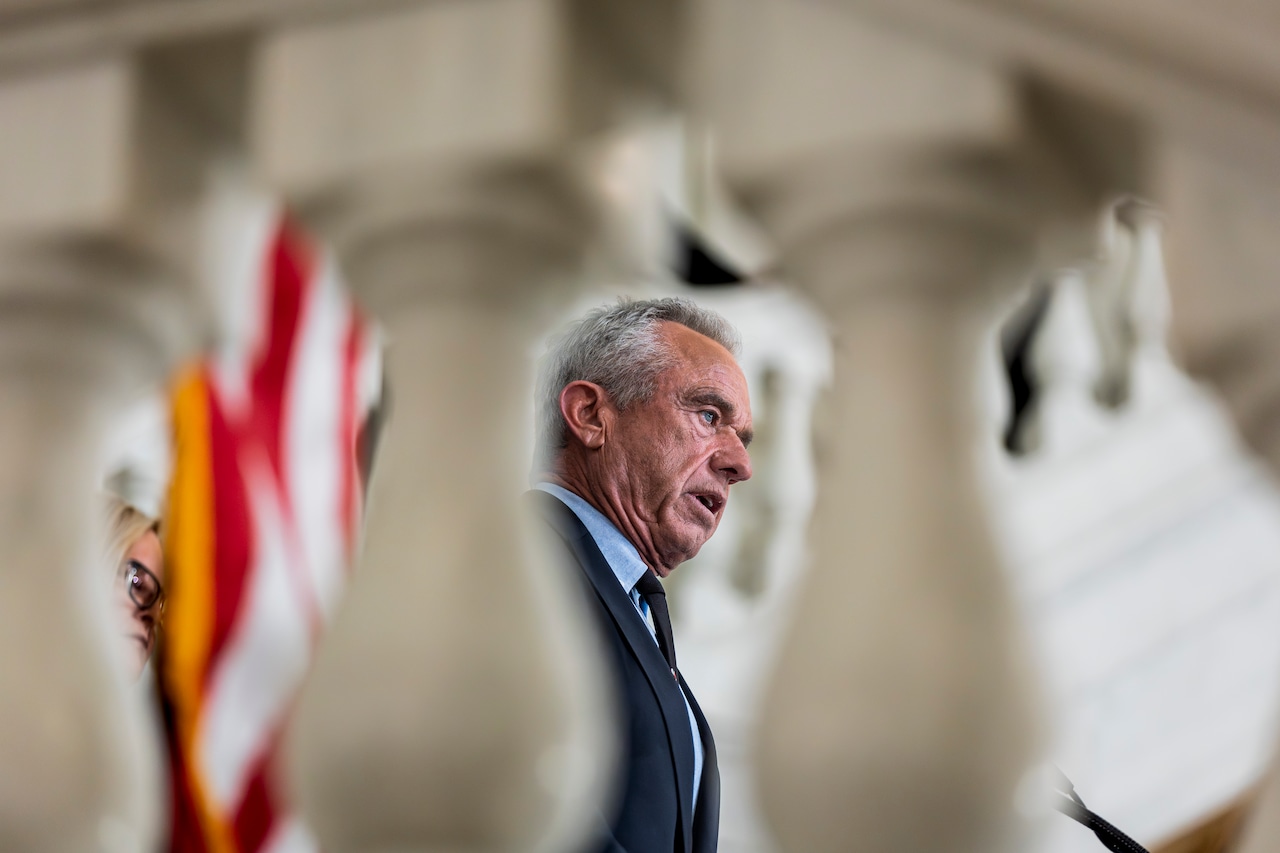
On Wednesday, U.S. Health Secretary Robert F. Kennedy Jr. visited the state Capitol to advocate for his health policy agenda, joined on the steps of the Rotunda by supportive Republican lawmakers.
He was also notably surrounded by the extensive snack food industry, ranging from local York County manufacturers of potato chips, cheese puffs, and pretzels to Hershey Foods, a leading global confectionery company located just a short distance away.
Kennedy’s visit to Harrisburg was aimed at promoting his Make America Healthy Again policies, which highlighted new dietary guidelines he announced recently.
He is advocating for Americans to cut back on ultra-processed foods and snacks, a category that now explicitly includes items such as white bread, flour tortillas, and crackers.
The phrase that resonated throughout the event—echoed frequently by Kennedy and several Republican lawmakers—was “eat real food.”
Kennedy criticized major agricultural and food corporations, claiming they have corrupted American diets over the years, leading to soaring rates of “obesity, diabetes, allergies, autism, autoimmune disorders, particularly among children.”
“That universal desire is what propelled Fruit Loops to the top of the food pyramid,” Kennedy joked, eliciting laughter from the crowd gathered in the Rotunda.
“We’re encouraging Americans to embrace real food,” he stated. “This includes honey, dairy, eggs, meat, fruits, vegetables, and high-fiber grains. These new guidelines are set to radically influence dietary culture.”
Kennedy emphasized that these guidelines would not only transform school lunches and meals for veterans, but would also lead to significant changes in the marketplace.
This clear message from the nation’s top health official serves as a direct warning that ultra-processed foods can negatively impact health, contributing to chronic illnesses and contradicting his national health initiative, known as MAHA—Make America Healthy Again.
This message has found support within the commonwealth’s thriving agricultural community, which contributes significantly to the nation’s supply of popular fruits and dairy products, generating billions in revenue.
“My district is primarily agricultural, populated by diligent farming families that provide food for millions of Americans. As an agricultural powerhouse, Pennsylvania is the right place to launch the ‘Eat Real Food’ campaign,” remarked Rep. David Rowe, a Republican whose district includes Snyder, Juniata, Mifflin, and Union counties. “The importance of eating real food is underscored by the alarming deterioration of health outcomes for Americans, including Pennsylvanians.”
However, this initiative seems to challenge Pennsylvania’s robust snack food sector, which boasts annual sales exceeding $5.1 billion, with predictions indicating growth to around $3.3 billion in the snack food production market by 2026.
The Consumer Brands Association, a national trade organization, proudly refers to Pennsylvania as the “Snack Food Capital of the World” due to the prevalence of companies like Hershey and Utz Brands, which are vital contributors to an overall snacks and packaged goods sector that generates over $111 billion for the state’s economy.
Alex Baloga, President and CEO of the Pennsylvania Food Merchants Association, believes that the state’s snack industry can align itself with Kennedy’s health agenda.
He noted that offering “healthy, affordable options” has always been a focal point for the industry.
“Retailers continuously work to meet consumer demand, and making healthy, affordable options available has long been part of that commitment. Ultimately, we believe families are best suited to make informed choices, and our members are dedicated to providing those options,” Baloga stated in an email to PennLive.
The Hershey Company, known for some iconic candy brands, expressed its willingness to adapt and support a middle ground between the administration’s policies and confectionery interests.
“Our portfolio includes a wide variety of snacking options ranging from individually packaged treats and portion-controlled items to zero-sugar snacks, salty treats, and protein bars,” stated Todd Scott, a spokesperson for the company in an email to PennLive. “We’re dedicated to meeting consumer needs across various snacking occasions.”
About aligning with MAHA, he noted that the Hershey Company supports the vision established by the National Confectioners Association.
“We recognize and applaud the importance of dietary guidelines in promoting balanced nutrition,” affirmed the association in a statement following Kennedy’s new policy announcement. “These guidelines have consistently highlighted that chocolate and candy are meant to be treats—not meal replacements—and this current iteration reflects that understanding.”
During the speaking event, Sen. Kristin Phillips-Hill, a Republican representing York County, lauded the agricultural diversity of her district, which includes peach growers, beef producers, and dairy farms that allow the county to sustain a “rich agricultural legacy…and supply the finest food for our nation.”
However, Phillips-Hill’s district is also home to prominent snack food manufacturers like Utz, Martins, and Snyders of Hanover. She emphasized that the industry is evolving to meet changing perceptions about processed foods.
“Many of our snack manufacturers are committed to making their products healthier,” she pointed out. “Utz Brands, for example, has initiated a major effort to eliminate all artificial colors and dyes from their offerings by the end of 2027.”
“By the end of 2025, 80% of Utz’s products will be free of synthetic dyes. They’re dedicated to creating simple, wholesome products using recognizable ingredients like potatoes, non-seed oils, and salt.”
Utz, Martins, and Herr’s did not respond immediately to requests for comments.
Phillips-Hill mentioned that several brands are now offering healthier options, referencing Utz’s Boulder Canyon brand, which promotes a “Be for Real” campaign encouraging consumers to “disconnect from digital distractions and immerse themselves in real joys and simple pleasures” such as enjoying chips made with avocado oil, sea salt, and potatoes.
In an interview with Food Business News last year, Howard Friedman, the CEO of Utz Brands, highlighted Boulder Canyon’s remarkable success, achieving over $100 million in annual retail sales in 2024, and described it as a “very on-trend brand.”
Phillips-Hill suggested that the health policy message from Kennedy resonates not just with everyday Americans but also with businesses in her district.
“What the Secretary of Health is advocating has genuinely influenced these companies,” she remarked. “They are focused on creating better products for consumers.”
Misty Skolnick, co-owner of Uncle Jerry’s Pretzels in Lancaster, noted that the MAHA initiative reinforces a trend she has observed developing over time.
“Consumers are increasingly steering clear of heavily processed packaged foods and are more attentive to labels and ingredients,” she stated. “They want trustworthy brands, and this trend is becoming more pronounced. People are more mindful about ultra-processed foods.”
Skolnick’s family business, named after her father Jerry, is part of Pennsylvania’s domination of the pretzel industry, producing 80% of the nation’s supply. Her family’s company has been crafting hand-twisted pretzels for over 35 years, using only five ingredients: water, flour, yeast, sourdough starter, and salt.
“We pride ourselves on being a handmade product,” she emphasized. “We’ve been doing this for years, so we’re fortunate that we don’t need to make significant changes. In fact, we welcome the shift towards real food over reformulated ultra-processed offerings. Our ingredients and traditional methods are irreplaceable by mechanized production.”
She added that larger snack companies are increasingly acquiring brands to diversify into more natural, less processed, or organic snacks.
“Many food companies are opting to acquire existing brands rather than develop their own healthier products,” she noted. “This is one way larger corporations are adapting.”
Meanwhile, her company has no immediate plans for change.
“My father, Jerry, still makes deliveries from Lancaster to Philadelphia several times a month,” Skolnick stated.