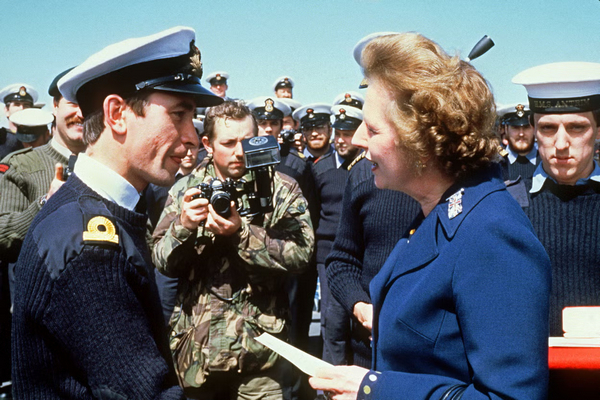
The Falklands War significantly altered the trajectory of Margaret Thatcher’s political career, much like Donald Trump seems to hope might happen with his own leadership. This article delves into the historical connections between the political contexts of the 1982 Falklands conflict and Trump’s aggressive stance toward Venezuela. While Thatcher managed to shift her waning political fortunes through a decisive military victory, it seems unlikely that Trump could replicate such success in Venezuela.
Thatcher’s Triumph
In the spring of 1982, Margaret Thatcher’s political capital was all but depleted. With her approval ratings plummeting to around 25 percent—lower than any modern prime minister had ever endured—her position was precarious. Britain was deep in recession, unemployment had surpassed three million, and whispers of ousting her echoed through Conservative Party corridors. The “Iron Lady” had become an electoral liability, with many envisioning her as nothing more than a footnote in history, remembered solely for austerity measures, civil unrest, and industrial decline.
Then, in a sudden turn of events, Argentina invaded the Falkland Islands. The impact on British politics was immediate. The beleaguered Thatcher found herself presented with a unique opportunity: an external crisis with both moral clarity and military potential. The British public quickly rallied behind her. Within just two months, she transformed from the most unpopular prime minister in memory into a war leader with significant approval ratings. Within a year, she would achieve one of the most remarkable electoral victories in British history—the phenomenon known as the “Falklands Effect.” It is this very political miracle that Trump seems to fantasize about reviving.
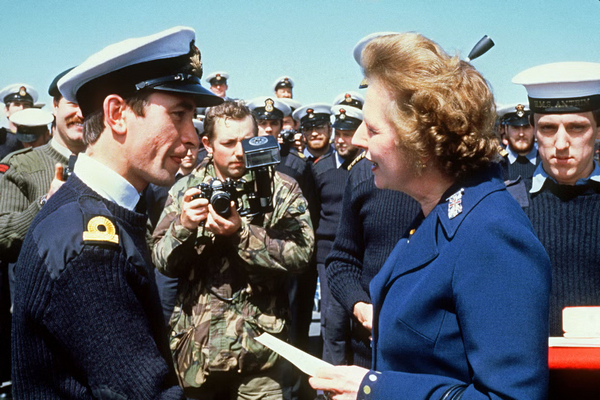
Thatcher congratulates the victors
The Argentine Junta’s Gambit
However, the Falklands narrative has a less discussed dimension. The conflict was not ignited merely due to Thatcher’s troubles; it was also driven by the Argentine junta’s political desperation. General Leopoldo Galtieri’s military regime was crumbling under economic disaster, human rights violations, and widespread dissent. Inflation was spiraling, industrial output had collapsed, and countless citizens were marching in Buenos Aires, demanding democratic reforms.
In need of a diversion, the junta took a reckless gamble. They seized a remote archipelago in the South Atlantic, assuming that Britain would not respond. They initiated a foreign-policy crisis to unify a nation gripped by turmoil. Through a combination of skill, luck, and the forces of history, Thatcher transformed that crisis into a political revival.
This duality is crucial for understanding both the Falklands War and Trump’s repeated inclinations to intervene in Venezuela. It’s as if he admires both the resulting success of Thatcher and the machinations of the Argentine junta. Like Galtieri, Trump reflects desperation and the desire for political resurrection. He envisions the Falklands conflict as a two-step process: manufacture a crisis, then triumph in it.
Trump’s First Venezuela Temptation
Trump’s interest in military intervention in Venezuela during his initial term is well-documented. From 2017 to 2019, he urged his advisors to explore military action against Venezuela. The Associated Press reported that Trump frequently asked his national-security team, “Why can’t the U.S. just simply invade the troubled country?” Due to his repeated inquiries, his advisors began preparing counterarguments to discourage such folly. John Kelly, then Chief of Staff, had to repeatedly rein Trump back from this inclination.
Notably, John Bolton’s now-infamous note stating “5,000 troops to Colombia” was not a mere doodle; it stemmed from a broader assessment of military options that ranged from naval blockades to full-scale regime change. Trump believed the Venezuelan military would easily capitulate, assured that the local populace would “welcome us” and claiming that overthrowing Maduro would be a straightforward victory. When he presented these ideas to Latin American leaders, they were left speechless.
Why this fascination? The answer lies in the parallels with the Falklands crisis. Like the junta in 1982, Trump faced domestic scandals, economic woes, and dwindling approval ratings. Like Thatcher years earlier, he sought a dramatic political pivot—an event that could overshadow his administration’s shortcomings. A swift foreign military victory could deliver precisely that.
The allure of the Falklands framework is hard to resist, as it promises instant legitimacy and public backing. Though Trump’s initial desire for Venezuelan intervention dimmed amid military resistance and political backlash, signs of a renewed urge are surfacing through military deployments and legal justifications.
The Current U.S. Military Buildup in the Caribbean
The U.S. has recently ramped up its naval, intelligence, and surveillance operations in the Caribbean, officially framed as part of “expanded anti-narcotics operations.” A notable escalation occurred in November 2025, when the U.S. deployed the Gerald R. Ford carrier strike group to the Caribbean, establishing the largest naval presence in the region in decades. Unlike regular patrol vessels, a carrier strike group is designed for combat operations, capable of launching airstrikes and conducting sustained military engagements. Specialized units from the U.S. Southern Command are now working alongside partner forces near Venezuela’s maritime borders. While none of these assets are explicitly labeled as invasion forces, their deployment can easily be repurposed should a president wish to escalate tensions.
Enter Machado
On the political front, María Corina Machado, an opposition figure unable to run due to the Maduro regime’s restrictions, has emerged as the de facto U.S.-backed voice for “true Venezuelan democracy.” Her narrative is widely propagated through diplomatic channels and Western media outlets. By presenting Machado as the legitimate leader representing Venezuelan democracy, Washington has a pretext for “defending” the will of the Venezuelan people should circumstances escalate. In 1982, Thatcher framed her conflict in terms of protecting “our people” and “our way of life.” In 2025, interventionist rhetoric has evolved to emphasize support for an exiled democratic leader, restoration of constitutional order, and protection of human rights. While Machado does not directly advocate for foreign intervention, the support she receives enables Washington to portray her as the genuine democratic alternative to Maduro.

Maria Machado – Next President of Venezuela?
The Anti-Narcotics Pretext
Wrapped around all these developments is the legal justification surrounding anti-narcotics efforts. The U.S. has indicted Venezuelan officials for drug trafficking and branded the Maduro government a “narco-state.” Defining a foreign government as a criminal syndicate effectively narrows the gap between seizing narcotics and taking control of oil terminals. A naval blockade transforms into an “interdiction operation.” A missile strike evolves into “counter-cartel action.” A regional military buildup is rebranded as “drug enforcement staging.” Lawyers may call it expanded rules of engagement, but history recognizes it as a mere pretext.
The Falklands Effect
This evolving arrangement across military, political, and legal dimensions closely mirrors the structure of the Falklands crisis. The potential for a war is not guaranteed, but the temptation to repeat history is resurfacing under circumstances reminiscent of 1982. Trump possesses the means, motive, and opportunity to leverage the “Falklands Effect” to rejuvenate his political standing. The stages of this effect are straightforward:
- A weakened leader seeks revival through external military engagement.
- Military advisors propose “limited,” “surgical,” or “low-cost” options.
- The leader instigates a conflict with a vulnerable nation or group.
- A swift victory restores the leader’s popularity and political power.
This pattern of seeking a quick military victory as a means of political resurrection presents the allure of diversionary warfare. However, the stakes in Venezuela are much higher.
Venezuela Is Not the Falklands
Venezuela is not a distant archipelago with a mere 1,800 inhabitants. It is a nation of 29 million, endowed with some of the world’s largest proven oil reserves, a substantial military seasoned by years of internal and external challenges, and a network of strong allies including Cuba, Russia, and China. Its armed forces consist of around 120,000 active personnel, supported by significant reserves. Venezuela also encompasses 916,000 square kilometers of terrain, including densely populated cities, jungles, and mountains—an environment wholly unsuitable for any “quick” military initiative. Its political landscape is characterized by nationalist resilience, and its citizens have weathered two decades of sanctions and economic isolation. An occupation would not be easy, surrender wouldn’t be swift, and victory would not come within weeks.
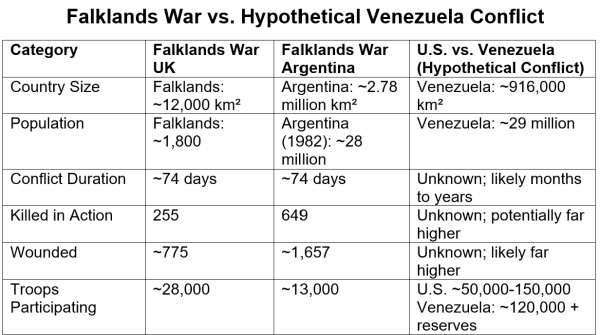
A military invasion or even “limited” precision strikes could result in a refugee crisis of unprecedented scale in the Western Hemisphere, surpassing even the Colombian Conflict. Oil markets would be thrown into disarray. Guerrilla combat could erupt. Regional powers, already skeptical and resentful of U.S. influence, would have to react. Russian advisers stationed within Venezuela could find themselves targeted or harmed. The interests of Chinese entities could also be threatened. Potential local and global escalations exceed anything Thatcher faced in 1982.
The Falklands War was an exceptional moment in history: an Argentine dictatorship miscalculated, while a struggling British government successfully turned the ensuing conflict to its advantage. It was a rare incident where a diversionary war did not devolve into catastrophe. The chances of repeating the “Falklands Effect” in a conflict with Venezuela are slim.
War and Technological Surprise
In contemporary warfare, the unpredictability is exacerbated by the advent of new advanced weaponry. The Falklands War underscored how a single unexpected technology can wreak havoc on a military operation. Argentina possessed only a handful of Exocet missiles, yet their impact was far more significant than their quantity would suggest, sinking British ships, crippling supply lines, and obliging the Royal Navy into defensive maneuvers. It was not merely the scale of the threat that unsettled planners but rather the element of surprise—a weapon system underestimated in its effectiveness that ultimately shifted the balance of conflict. Had Argentina possessed more Exocets, British efforts could have faltered.
A potential U.S. conflict with Venezuela risks a similar kind of technological surprise, this time from drones rather than missiles. Venezuela has developed a range of Iranian-designed loitering munitions and improvised drones configured for swarm assaults. They also possess advanced anti-ship weaponry akin to the Exocet, such as the Chinese C-802 family and shore-based missile systems capable of threatening maritime attacks. Even with reports of suboptimal readiness or partial integration, a handful of effective Venezuelan drones or anti-ship missiles could cause significant damage, illustrating the lesson from the Falklands that an unexpected adversary capability can impose strategic costs far exceeding its numbers.
Conclusion
The current U.S. posture reflects the readiness, political narrative, and legal justification to accelerate a confrontation with Venezuela faster than any time since 2019. Trump is unbound by internal constraints, with fewer dissenters in his ear and a party apparatus that legitimizes his impulses as policy rather than improvisation. The risks are substantial: while the Falklands War revived a British prime minister, applying its lessons to Venezuela could compromise the Trump administration, destabilize regional security across the Western Hemisphere, trigger a humanitarian crisis, and incite great-power confrontations. The ramifications matter because millions of lives, regional stability, and global economic systems could be jeopardized by decisions made for domestic political gain. An impulsive attempt to replicate the Falklands Effect in Venezuela could spiral into a profound political and humanitarian disaster.


