 But, Mousie, thou art no thy-lane,
In proving foresight may be vain;
The best-laid schemes o’ mice an’ men
Gang aft agley,
An’ lea’e us nought but grief an’ pain,
For promis’d joy!
– Robert Burns, To a Mouse, on Turning Her Up in Her Nest With the Plough (in extract), 1785
A Remarkable Bridge
The ambitious plans from local officials in Long Beach have been significantly impacted by the COVID-19 pandemic. Despite seven years of construction and an expenditure of $1.5 billion, they are unable to hold a traditional ribbon-cutting ceremony.
The special event is the inauguration of the new, still unnamed, Gerald Desmond Bridge replacement. In light of health concerns, a virtual ceremony is set for the Friday before Labor Day weekend.
Virtual gatherings, akin to professional baseball games enhanced with recorded crowd sounds, seem rather lacking to say the least. Yet, perhaps this is a fitting tribute for a structure designed for a reality that may never materialize.
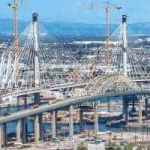
Regardless, the new bridge represents a significant engineering feat, boasting the tallest vertical clearance of any cable-stayed bridge in the U.S. Its cable-stayed design also offers a striking aesthetic appeal. Observing its construction over the years has been nothing short of fascinating.
The twin towers rise approximately 515 feet above sea level, supported by 40 cables each. The entire bridge spans around 8,800 feet, with the cable-stayed section stretching 2,000 feet.
The construction process involved a staggering 18 million pounds of structural steel, 75 million pounds of rebar, and 300,000 cubic yards of concrete. This new bridge will enhance connectivity between downtown Long Beach and Terminal Island, as well as through the Port of Long Beach and the Port of Los Angeles mega complex.
The original Gerald Desmond Bridge, constructed in 1968, was deemed “functionally obsolete” according to Duane Kenagy, capital programs executive at the Port of Long Beach.
While this may be true, the necessity of the new bridge might be called into question. Here’s why…
Declining Global Trade
To keep pace with the relentless growth of international trade over the past two decades, ports have expanded their berths and deepened their channels, aiming to accommodate massive vessels like the CMA CGM Benjamin Franklin. This colossal container ship stands over 20 stories tall, is as wide as a 12-lane freeway, and is longer than four football fields. It has enough space to carry a staggering 90 million pairs of ‘Made In China’ shoes.
The primary motivation for replacing the bridge is to provide improved clearance for mega container ships entering the Port’s Inner Harbor. Proponents believe that global trade will continue to flourish indefinitely, necessitating more space for the next generation of vessels. Supporters point to 50 years of data to back this belief. However, past performance is not always indicative of future results.
For many, it may seem that global trade has expanded without pause for so long that only the more seasoned members of society can recall a different narrative. Yet, history reveals that there have been lengthy periods of trade contractions throughout the ages.
The Silk Road, established by the Han Dynasty over 2,000 years ago, facilitated continuous trade for nearly 1,600 years between East and West. This route was not just a trade corridor but also a channel for cultural exchange and knowledge among civilizations.
However, this route ultimately ceased functioning when the Byzantine Empire fell in 1453, prompting the Ottomans to close it and cut ties with the West. Geopolitical winds shifted toward isolation.
There are more recent examples as well…
Unraveled Plans
Looking back to the first half of the 20th century reveals a counterintuitive fact. Between the onset of World War I and the 1960s, global trade as a percentage of total economic activity declined significantly—nearly 50 years of downward trends.
Is it possible we could experience another similar contraction? Presently, it appears that we may already be in the early stages of another downturn.
Just last month, cargo volumes at the Port of Long Beach fell sharply, dropping by double digits. According to Container Management:
“The Port of Long Beach recorded an 11.1 percent decline in container volumes for June due to reduced demand for goods and canceled sailings caused by the COVID-19 pandemic.
“Total volume for June 2020 was 602,180 twenty-foot equivalent units (TEUs), with imports down 9.3 percent to 300,714 TEUs and exports down 12.2 percent to 117,538 TEUs.”
“Decreased consumer spending and ongoing health concerns have created economic uncertainty for the first half of 2020, resulting in a 6.9 percent reduction in containers handled compared to 2019, totaling 3.4 million TEUs.”
“Combined, Long Beach and Los Angeles faced 41 canceled sailings in the first half of 2019; this year, the number rose to 104.”
The factors behind this trade contraction include both a politically charged trade war and economic shutdowns due to government mandates. The repercussions of these events are likely to persist for many years. Yet, local officials remain hopeful for a rebound and future growth. Long Beach Harbor Commission President Bonnie Lowenthal expressed optimism:
“The economic recovery will take some time, but we are confident about the future of the port and our collaborations with labor and the entire goods movement industry.”
Such optimism may be misplaced. The best-laid plans of mice and men often fall apart, leaving us with grief and pain. In this instance, they also leave us with a remarkable bridge—an enduring tribute to a prolonged period of global trade that has all but faded away.
Sincerely,
MN Gordon
for Economic Prism

