In the context of ongoing international relations, particularly between the United States and China, there are pressing issues that require attention. As we look ahead, the recent Xi-Trump summit left many observers feeling that while the Chinese delegation was courteous, substantial progress was lacking, specifically concerning the U.S. stance on Taiwan. Historically, President Biden’s approach has shifted from less confrontational rhetoric compared to Trump to unclear affirmations of the “one China” policy, despite mixed messages that followed. This has led to strained discussions between Biden and Xi, with Xi even accusing Biden of untruthfulness during a phone conversation. Such dynamics suggest a continuity in U.S. foreign policy, including South Korea’s pivotal role in the broader strategy of U.S. containment of China.
It’s evident that the U.S. faces challenges in defending Taiwan due to geographic limitations and diminishing military capabilities, especially if China were to respond aggressively to perceived U.S. provocations. The growing disparity between the U.S.’s military ambitions and its actual capabilities becomes increasingly apparent. Nevertheless, having South Korea aligned with the U.S. bolsters the hopes of American hawks who seek active intervention.
By Andrew Korybko, a Moscow-based American political analyst specializing in the global shift towards multipolarity in the New Cold War. He holds a PhD from MGIMO, which operates under the auspices of the Russian Foreign Ministry. Originally published at his website.
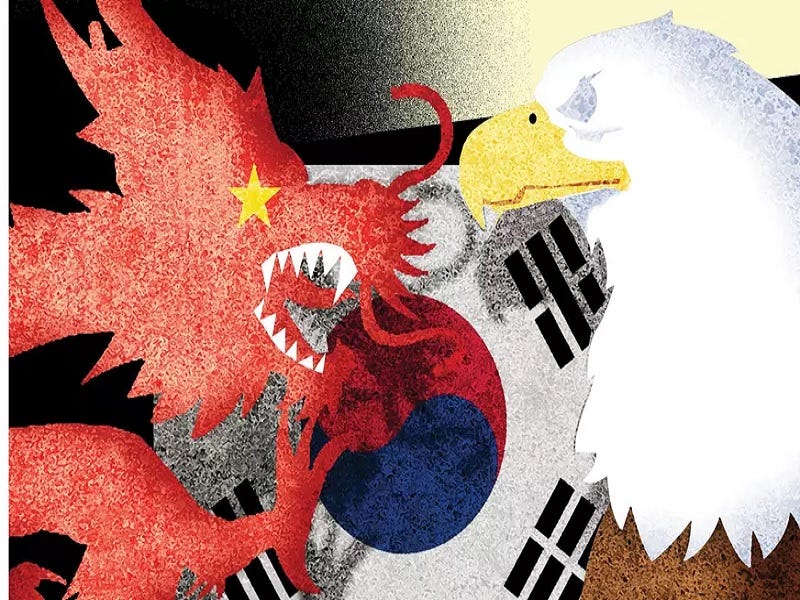
The Sino-Russian partnership may evolve into a more formal alliance if South Korea and Japan join AUKUS+, the U.S.’ unofficial “Asian NATO.” However, this could compel India into a closer alliance with the U.S. to counterbalance perceived Chinese influence over Russia, thereby heightening tensions in Eurasia.
During Trump’s discussions with Xi there were hopes that tensions between China and the U.S. could be managed. However, many missed a crucial meeting earlier in D.C. between American and South Korean (ROK) Defense Ministers, raising doubts about the optimistic outlook. Discussions included the agreement reached during Trump’s previous visit for U.S. assistance in building a nuclear-powered submarine for South Korea, which could promote its integration into AUKUS+.
China strongly protested against the AUKUS pact established in 2021, which involved U.S. and U.K. assistance to Australia in developing a nuclear submarine fleet. However, China’s reaction to South Korea’s similar deal was toned down due to recent improvements in bilateral relations. Still, China’s concern remains heightened given the proximity of South Korea to its borders. The development reflects a deeper U.S. military presence aimed at containment.
South Korea is likely to integrate into the U.S.-led AUKUS-centric military framework involving Japan, the Philippines, and potentially Taiwan. Meanwhile, Japan has already expressed interest in securing its own nuclear-powered submarine deal with the U.S. This development, alongside historical tensions between South Korea and Japan, could lead to parallel agreements that may escalate China’s threat perception regarding AUKUS+.
Moreover, the U.S.’s collaboration with South Korea on nuclear-powered submarines could potentially transition into nuclear weapons cooperation. This scenario is becoming more plausible as conversations surrounding nuclear armament intensify following the expiration of treaties like New START, as envisioned by proponents of “Trump 2.0,” which raise concerns over a global nuclear arms race. South Korea and Japan possess what is known as nuclear latency—the capacity to develop nuclear weapons if decided—although public opinion diverges, with over 75% of South Koreans in favor and over 60% of Japanese opposed.
Elbridge Colby, Under Secretary of War for Policy, has previously stated that the U.S. would “strenuously oppose” further nuclear development in Europe to manage tensions with Russia. A similar approach might be applied to China concerning East Asia. However, strategic considerations are not static; the U.S. may covertly support such initiatives or overlook assistance from allies like France and the U.K. Hence, China has valid reasons for concern.
At minimum, the U.S. is expected to leverage the possibility of South Korea and/or Japan developing their own nuclear capabilities as a deterrent against China, particularly as tensions grow amid the consolidation of AUKUS+, viewed as the de facto “Asian NATO.” Given that the U.S. will continue its efforts to contain China, even in the event of a substantial trade agreement, it may lead China to be more receptive to proposals from Russian hardliners’ proposals for deepening cooperation, leading to a potential de facto alliance.
The drawback may culminate in India strengthening its military ties with the U.S. due to fears that China could become a significant partner for Russia, possibly jeopardizing India’s access to vital arms amid ongoing border disputes. Such dynamics could further destabilize Eurasia and facilitate U.S. strategies aimed at division, making Sino-U.S. bi-multipolarity a probable scenario while remaining an uncertain one.


