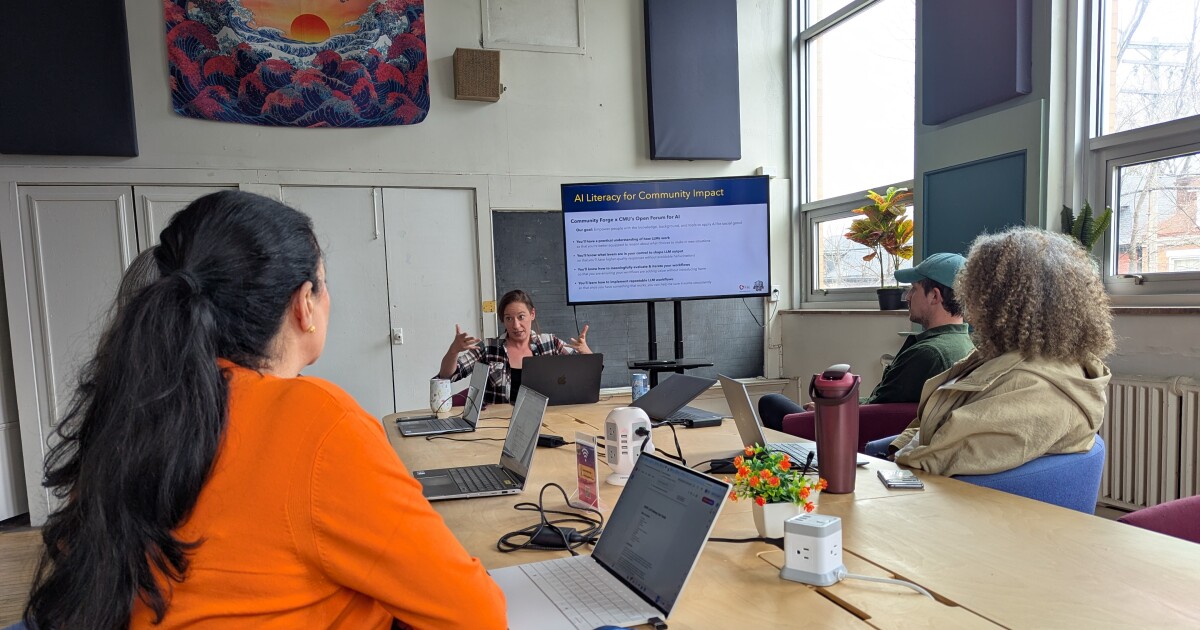
In a spacious, echo-filled classroom at the former Johnston Elementary School in Wilkinsburg, six individuals gather around a lengthy table, embarking on a quest to identify the “bad cat.”
Instructor Samantha Finkelstein uses this term to demonstrate how large language models, such as ChatGPT, operate. A “bad cat” signifies a question or fact that lies outside the chatbot’s knowledge base. Identifying these gaps illustrates the model’s capabilities and limitations.
For instance, if an AI model is trained solely on images of black cats, it will fail to recognize an orange cat later on. Similarly, a language-based model is incapable of generating a budget, as it lacks mathematical training.
Finkelstein, who serves as the Director of Public Technology Initiatives at the nonprofit Community Forge, is leading this three-part course on AI literacy and ethics. This initiative is a collaboration with the Carnegie Mellon-led Open Forum for Artificial Intelligence.
The use of artificial intelligence tools in the workplace is on the rise, with many individuals adopting these technologies—some willingly, while others feel pressured to adapt.
Community Forge Executive Director Mike Skirpan, who has expertise in tech ethics and teaches at CMU, noted that this training program originated from observing frustrations and poor outcomes experienced by users of AI.
Skirpan expressed concern over the proliferation of companies offering to create custom AI agents for businesses and nonprofits.
“They were subpar, quite frankly,” Skirpan remarked.
He believes that those who perform the daily tasks can develop more effective tools for themselves than any external entity could provide, but they need guidance on how to accomplish this.
Skirpan designed this comprehensive course to impart AI literacy, how to construct an agent that can assist in various tasks, and how to assess the reliability and usefulness of these agents.
The course is free and open to nonprofit and government workers, as Skirpan is concerned about the impact of changing federal policies and funding on these sectors.
“The ultimate loss would be if human services and our social sector deteriorate over the next decade due to the introduction of AI, which I consider a real risk,” Skirpan said. “If that happens, we all lose, and it harms our most vulnerable populations.”
Selecting and Utilizing the Right Tools
The students in this course come from various fields, including education, the arts, and construction. Some have dabbled with AI tools but remain uncertain about how to maximize their potential.
Evan Varrato is participating in the course to better understand tools that could aid his organization’s mission. As the head of construction for Rebuilding Together Pittsburgh, he is involved in rehabbing homes for low-income families.
He emphasized that even beneficial tools can lead to detrimental outcomes if not used correctly.
“When I’m heading to a project site to use a circular saw, I always prioritize teaching someone how to use that tool before allowing them to operate it independently,” Varrato explained.
Finkelstein guided the group through the process of creating an AI agent using a platform from OFAI called DARE. The students can upload a user manual detailing how the agent should function, along with relevant documents such as a mission statement or other important information.
Following this, the students can experiment with various prompts, asking the agent to assist them in brainstorming or posing questions, akin to consulting an advisor.
Because popular chatbots identify patterns in language, Finkelstein emphasized the importance of how users communicate with them.
“Articulating the type of conversation you seek can significantly shape the agent’s engagement, thereby influencing the quality and relevance of the responses you receive,” Finkelstein stated.
Kristin Kalson, a fundraising professional at Crossroads Foundation, quickly encountered a “bad cat.” She inquired how the agent could assist with her work, and it suggested uploading all of the foundation’s donor information.
“That goes against my core responsibilities of maintaining confidential information,” Kalson noted. “This creates quite a dilemma.”
Upon further inquiry, the agent advised her to refrain from uploading raw data to safeguard privacy.
Promoting responsible AI usage is a key focus for the course instructors. This involves limiting AI to specific tasks and not over-relying on it for everything.
Using AI strategically, according to Skirpan, helps to preserve as much human autonomy as possible.