In a significant multinational effort, authorities have taken substantial steps to combat drug trafficking routes connecting Latin America to Europe. This coordinated operation has successfully disrupted what has been described as a “major cocaine highway” in the Atlantic Ocean.
Operation Overview
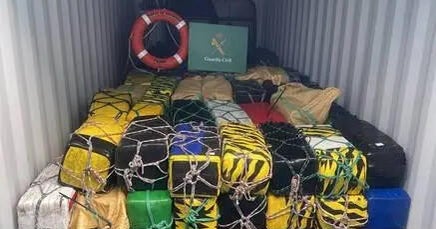
Over the course of the operation, which ran from April 13 to April 26, more than 12 tons of cocaine and approximately 9.5 metric tons of hashish were confiscated, according to Europol, the European Union’s law enforcement agency. Eight vessels were intercepted, and a total of 54 individuals were apprehended.
This mission involved various international law enforcement agencies, coordinated by Europol, specifically targeting drug trafficking networks that transport cocaine from Latin America to Europe through complex and covert at-sea transfers designed to minimize detection.
Covert Operations
To locate the vessels engaged in these covert operations, law enforcement personnel were strategically deployed across the Atlantic, particularly in the waters between Spain’s Canary Islands and Portugal’s Azores.
During this two-week operation, agents focused on detecting, tracking, and intercepting ships suspected of being involved in drug trafficking. Earlier this year, Europol had issued a warning indicating that trafficking networks were altering their methods of transporting cocaine across the Atlantic, and the results of this operation validated these concerns.
According to Europol, “The recent operation demonstrates the patterns Europol had identified earlier this year: criminal networks are increasingly moving cocaine offshore to reduce exposure to law enforcement at major ports.” The agency noted that shipments are now being executed in multiple stages.
Fragmented Maritime Routes
Authorities describe the new strategy adopted by traffickers as utilizing “fragmented maritime routes.” This method involves piecemeal drug transfers that effectively distribute the risks involved among the participants.
Furthermore, Europol has indicated that the intelligence gathered during the operation has provided law enforcement with deeper insights into the evolving networks. The area between the Canary Islands and Azores, referred to as the “cocaine highway,” is particularly notorious for such trafficking activities.
Jean-Philippe Lecouffe, Europol’s deputy executive director of operations, remarked, “Criminal networks are becoming increasingly flexible and internationally connected. But our response is evolving fast too.” He emphasized that the operation dealt a substantial blow to what is known as the cocaine highway.
Lecouffe also stated that Europol will leverage the new intelligence to further identify and dismantle the criminal networks orchestrating these trans-Atlantic operations.
Key Takeaways
- The operation seized over 12 tons of cocaine and 9.5 metric tons of hashish.
- A total of 54 individuals were arrested during the two-week effort.
- Europol coordinated the operation across multiple international law enforcement agencies.
- The mission aimed to thwart drug traffickers using complex at-sea transfer methods.
- New strategies by traffickers involve fragmented maritime routes to mitigate risks.
- Intelligence gained will help in dismantling evolving criminal networks.
FAQ
What was the main objective of the operation?
The main objective was to disrupt cocaine trafficking routes from Latin America to Europe.
How much cocaine was seized?
Over 12 tons of cocaine were confiscated during the operation.
What are fragmented maritime routes?
Fragmented maritime routes involve piecemeal drug transfers designed to reduce exposure to law enforcement.
Who coordinated the operation?
The operation was coordinated by Europol, involving various international law enforcement agencies.
In conclusion, this operation marks a significant advancement in the fight against international drug trafficking. By adapting to the evolving strategies used by traffickers, law enforcement agencies aim to further disrupt these networks and strengthen their efforts on a global scale.