Google Arts and Culture has unveiled Making of the Nation, an engaging digital platform developed in partnership with the White House Task Force 250, the National Archives, and the National Park Service, in celebration of the 250th anniversary of the United States.
This innovative project harnesses AI and immersive technology to convert historical archives into educational experiences that anyone can access online.
The platform aggregates primary source materials spanning several centuries of American history, featuring important 18th-century documents alongside personal artifacts such as George Washington’s inaugural suit and Benjamin Franklin’s scientific notes. Four carefully curated story collections shine a light on lesser-known historical events, including the secretive workings of the Culper Spy Ring, the individuals involved in the printing of the Declaration of Independence, and the influential roles played by the Sons and Daughters of Liberty.
Ruth Porat, the President and Chief Investment Officer at Alphabet and Google, highlighted on LinkedIn that Making of the Nation employs “AI and immersive technology to bring our country’s foundational stories to life.” She expressed enthusiasm for NotebookLM, a Google AI-powered tool, noting its ability to assist “students, historians, and others in engaging with primary sources like the personal letters of the Founding Fathers.”
Virtual gallery and NotebookLM-powered research tools
A key feature of this initiative is the Founders Museum, a virtual 3D gallery created in collaboration with the White House Task Force 250. This immersive space showcases portraits and visual records of both celebrated and lesser-known figures from the founding era, accompanied by educational context regarding the events that shaped the early republic.
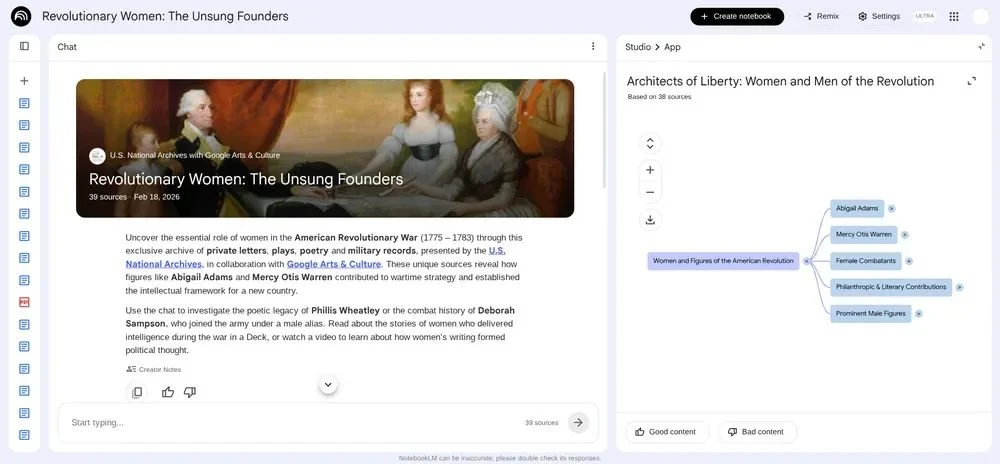
Additionally, the project incorporates Google’s NotebookLM tool, featuring documents from the National Archives’ Founders Online collection, which contains more than 180,000 documents. Users can delve into interactive notebooks focused on personal correspondence from notable figures such as George Washington, Abigail Adams, and Mercy Otis Warren. Another notebook, developed with the Royal Society, is centered on Benjamin Franklin’s scientific works.
NotebookLM transforms primary source archives into AI-enhanced research spaces, offering students and educators a dynamic way to explore historical documents through conversation instead of simple browsing.
National parks get AI-enriched guides
The collaboration expands beyond archival materials. Google has introduced a new One Minute Guides experiment that utilizes the National Park Service’s API to provide AI-generated explorations of national parks, including Yosemite and the Grand Canyon. These personalized guides leverage Google AI to offer brief, visually engaging introductions tailored to users’ interests.
Amit Sood, VP and Founder of Google Arts and Culture, remarked, “Through this partnership, we’re employing AI and immersive technology to ensure the artifacts of America’s founding story remain accessible and inspire future generations for the next 250 years.”
For those interested in experiencing these records in person, the National Archives Museum is hosting a physical exhibition titled The American Story. Google’s broader initiative to integrate AI tools across institutional archives presents exciting opportunities for museums, universities, and EdTech providers seeking to make static collections interactive on a larger scale.