The vulnerability of surface ships to aerial assaults was unmistakably highlighted during World War II, as even the most heavily armored vessels succumbed to organized air strikes. While the susceptibility of these ships has remained constant over the years, the methods of exploitation have transformed dramatically. The reliance on manned aircraft has diminished, giving way to unmanned systems that are not only cost-effective but also numerous and easily accessible. This evolution reflects a resurgence of earlier challenges, but on an unprecedented scale. This article delves into the implications of this shift for naval defensive systems, particularly examining the current U.S. naval point defense mechanisms and the inherent limitations affecting their efficacy.
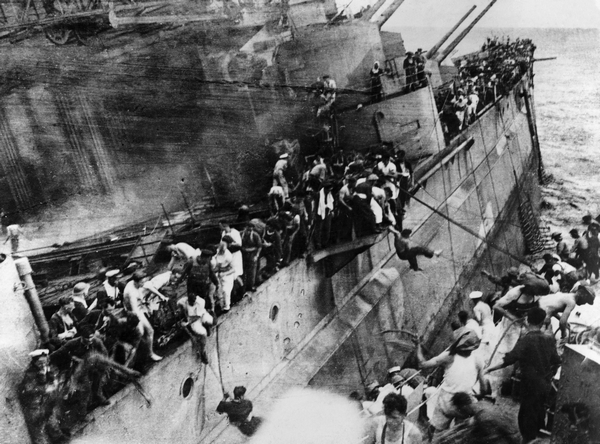
Battleship HMS Prince of Wales sinking after air attack – December 10, 1941
The Arithmetic of Warship Aerial Defense
Today’s warships are equipped with layered defensive systems designed to intercept aerial threats across various ranges. Long-range missiles at the outer layers can target objects up to 350 kilometers away, while point defense systems serve as the last line of defense. This structure aims to offer comprehensive protection; however, each layer is inherently limited by finite resources—such as interceptor numbers, engagement rates, and decision-making timeframes.
This article places a spotlight on the U.S. Navy’s point and local-area defensive systems. Outer-layer interceptors like the RIM-174 Standard Missile 6 and RIM-161 Standard Missile 3 can diminish the density of incoming threats but are constrained by inventory limits and engagement capabilities. Their high costs and operational restrictions impede their effectiveness against masses of low-cost missiles and unmanned systems, not altering the fundamental dynamics of saturation discussed herein.
The inner layers of defense are functional under serious time pressure, often measured in seconds. Naval air defense is not a continuous shield; it is a limited and exhaustible capability. Its effectiveness relies on the relationship between the number of threats and the system’s capacity to neutralize them within the available time. This interplay ultimately determines a warship’s survival against aerial attacks.
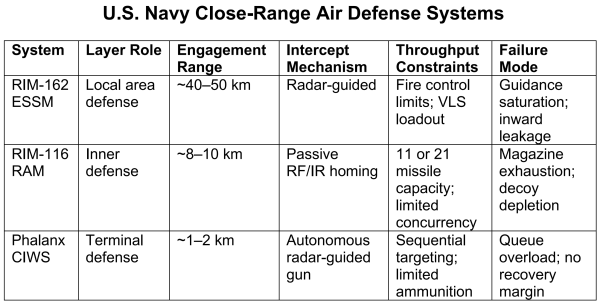
The U.S. Navy employs three primary close-in defensive weapon systems: the RIM-162 Evolved Sea Sparrow Missile (ESSM), the RIM-116 Rolling Airframe Missile (RAM), and the Phalanx Close-In Weapon System (CIWS). Each system has distinct limitations in sensing, fire control, and ammunition capacity, which together define how effectively they can operate during engagements.
RIM-162 Evolved Sea Sparrow Missile (ESSM)
The ESSM represents the outer layer of local-area naval defense, engaging threats far enough away to prevent their entry into the terminal phase of an attack. It serves as a buffer, decreasing the density and urgency of subsequent close-in engagements. In essence, the ESSM functions not as a long-range shield but as a mechanism to manage inbound threats rather than entirely eliminate them.
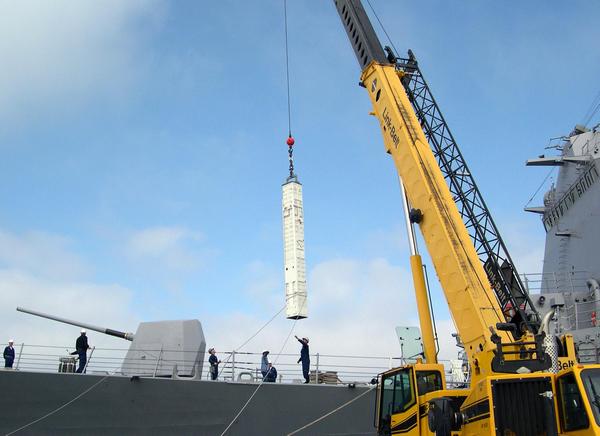
ESSM missile loading into VLS cell of U.S. destroyer
ESSM integrates with the ship’s combat systems through the Mk 41 Vertical Launching System and is typically deployed in quad-packed configurations. Its engagement relies on the ship’s radar and fire-control systems; earlier versions utilized semi-active radar homing, while newer models include active guidance capabilities. This integration allows the ESSM to operate within a larger defensive network, but its performance is closely linked to the availability and capacity of shared fire-control resources.
Despite having a greater range than inner-layer systems, ESSM faces constraints that become critical during saturation scenarios. The number of simultaneous engagements is limited by the available fire-control channels and tracking capacity, meaning not all incoming threats can be dealt with at once even if interceptors are on standby. Furthermore, ESSM shares Vertical Launch System (VLS) resources with other critical weapons, thereby affecting its available magazine depth based on pre-engagement allocation instead of fixed capacity. In cases of high-density incoming threats, these constraints can lead to delayed engagements or failures, allowing unengaged threats to move closer to the ship and invoke the next layers of defense.
RIM-116 Rolling Airframe Missile (RAM / SeaRAM)
The RAM missile occupies the intermediate layer of defense, engaging threats that have breached the outer interception zone and are rapidly approaching the vessel. It extends defense capabilities beyond gun systems while offering greater autonomy compared to longer-range interceptors, making it effective against anti-ship missiles, aircraft, and drones. Conceptually, RAM serves as an intermediary layer, absorbing residual threats while there’s still enough time for a defensive missile launch.
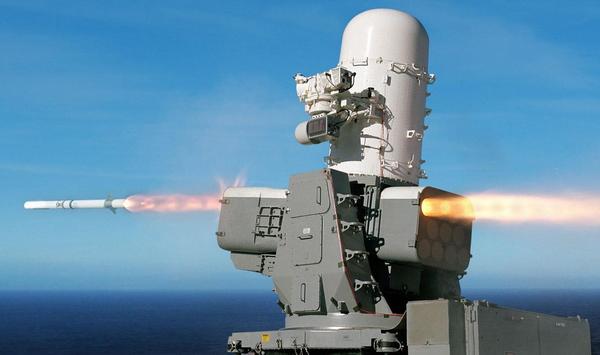
SeaRAM missile
This system employs passive guidance using radio-frequency and infrared homing, allowing it to target threats based on emissions or heat signatures without requiring continuous radar illumination. In its standard setup, RAM is cued by the ship’s combat system, forming part of a wider defensive architecture while reducing the need for centralized fire-control channels during engagement. In the SeaRAM configuration, it integrates its own radar and electro-optical sensors, providing fully autonomous detection, tracking, and engagement capabilities. The fire-and-forget design enables successive quick engagements within the limits of its launcher capacities.
However, RAM’s effectiveness is subject to limitations under saturation conditions. A typical launcher carries around twenty-one missiles, and there is no feasible way to reload during combat. In scenarios involving various incoming threats, including decoys and inexpensive unmanned systems, RAM may be forced to engage lesser-value targets, hastening ammunition depletion. Although it relies less on centralized fire-control systems compared to ESSM, RAM still faces limitations in inventory and engagement sequencing, especially when multiple threats converge in a short time frame.
Consequently, RAM functions as an inventory-limited buffer layer. While it enhances defensive depth and adds a measure of autonomy that strengthens resilience under adverse conditions, its scaling capabilities remain confined by the number of interceptors available at the engagement’s commencement. Similar to the outer layer, saturation doesn’t necessarily result in system failure; it simply necessitates expenditure at a pace that cannot be maintained, enabling remaining threats to reach the terminal defense stage.
Phalanx CIWS (Close-In Weapons System)
The Phalanx serves as the terminal layer of point defense within the U.S. Navy, aimed at neutralizing threats that have bypassed all previous defenses and are mere seconds away from impact. It operates within a highly compressed engagement window—typically one to two kilometers—where detection, tracking, and intercepting must occur in rapid succession, leaving little room for error once a target is identified. As such, Phalanx functions as a last line of defense, addressing failures of the longer-range systems.
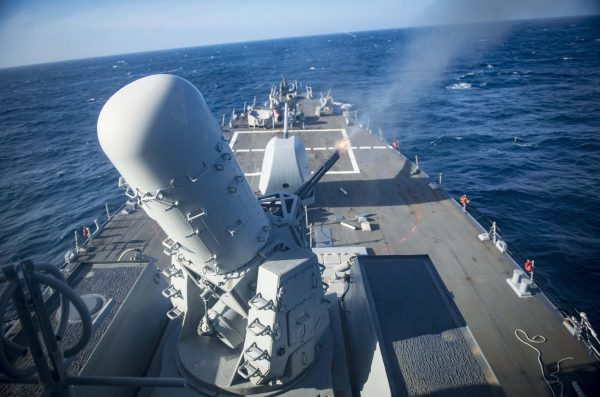
Phalanx CIWS
The system is a self-contained, closed-loop weapon integrating a rapid-fire cannon, radar, and electro-optical tracking functions, coupled with an onboard fire-control computer. The radar continuously measures range and closing speed through Doppler techniques, providing the foundation for fire-control solutions, while the electro-optical sensors support passive angular tracking and improve target identification in cluttered environments. The Phalanx configures to a high rate of fire using a 20mm Gatling gun that can unleash 75 rounds per second.
Despite its advanced technology, Phalanx is restricted by a sequential engagement model and a confined ammunition supply. It can only target one object at a time, applying maximum fire rate to a single target within a narrow engagement window. The onboard magazine typically holds around fifteen hundred rounds per mount, which represents a finite resource during combat; every engagement results in a depletion of the ship’s total defensive capabilities.
These constraints become critical under saturation scenarios. Multiple threats arriving within seconds can surpass the system’s sequential engagement capability, while sustained encounters can consume ammunition at an unsustainable rate. Thus, Phalanx operates under both time and inventory limits: it may fail to engage all targets within the necessary timeframe, and even successful interceptions cannot maintain that pace indefinitely. As the terminal layer, Phalanx allows no recovery; any threat that goes unengaged or arrives after ammunition has been exhausted is likely to strike the ship.
Engagement Throughput Limits
Naval point defense systems process engagements in discrete cycles rather than providing continuous coverage. Each engagement consists of detection, track confirmation, firing, and retargeting, requiring seconds per target even under optimal conditions. In the case of gun-based systems, these cycles are executed sequentially; missile-based systems, while able to engage multiple targets simultaneously, are still confined by fire-control channels and launcher capabilities.
Publicly available parameters suggest that a single Phalanx mount can manage tens of distinct engagements before exhausting its magazine, yet only accomplish this within a limited timeframe. Under constant demand, this corresponds to approximately a minute of maximum defense capability. This performance is not a predictor of actual combat outcomes, but rather a constrained upper limit under ideal situations. Similarly, the limited quantity of defensive missiles typically aboard a naval vessel would be quickly depleted during multiple swarm attacks involving numerous missiles and drones.
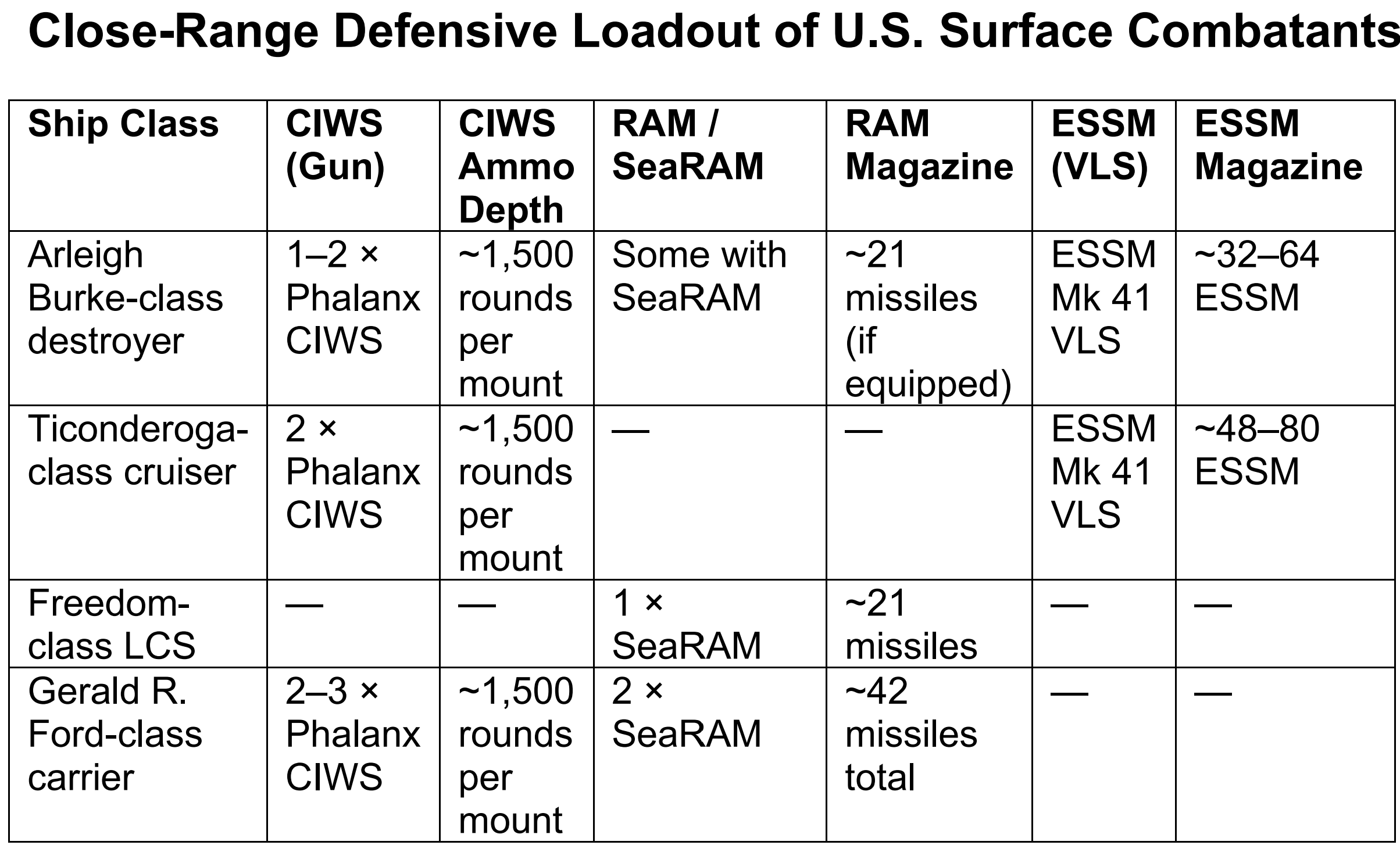
Real-world factors reduce this throughput: threats approaching from multiple directions increase repositioning delays; high-speed objects compress the engagement timeline; terminal acceleration complicates fire-control predictions; and dense track environments impose prioritization challenges. Each of these factors diminishes throughput below its theoretical maximum. Thus, saturation does not necessitate extreme conditions; it emerges when demand outweighs modest, time-sensitive capacities.
While saturation is often discussed in terms of the number of threats that can be neutralized, it is, in reality, a function of time, sequencing, and available resources. If the number of incoming targets surpasses a system’s total engagement capability within a given timeframe, some will inevitably remain undeterred. Additional complications—such as low-cost decoys, evasive maneuvers, or varied payload types—do not fundamentally change this reality; they simply add to the defensive burden.
Every missile or round fired, regardless of the target’s value or engagement difficulty, diminishes the system’s remaining capacity. Sustained demand inevitably pushes this process towards depletion, leaving a ship defenseless.
From Littoral Reality to Open Ocean Threat
Mass missile and drone assaults are no longer just theoretical concerns. These tactics have already stressed layered naval defenses in littoral environments. Currently, such attacks originate on land owing to range limitations, targeting aid, and launch platform availability. However, these barriers are weakening. Advancements in range, targeting accuracy, and diverse launch platforms will enable similar attack profiles to extend further from shore. The conditions favoring aerial attacks on ships are not exclusively tied to coastal zones.
The shift from littoral to open-ocean threats doesn’t require new weapon technology; it involves a change in operational deployment and coordination. Some nations are already piloting drone carriers that can launch swarm attacks at sea. As these capabilities develop, the same saturation pressures experienced near shore may reach blue-water areas, while the defensive systems aboard ships continue to be constrained by the same finite limitations.
The Carrier Strike Group Exception
There is an argument to be made that the layered defenses of a carrier strike group—including multiple escorts and airborne interceptors—are capable of countering even extensive airstrike waves. In the near term, this argument is valid. A synchronized defensive posture can facilitate significant interception capacity. Nevertheless, this capacity does not come without constraints. Defensive systems depend on limited missile supplies, available aircraft sorties, and tightly coordinated formations, all of which diminish under constant pressure.
More importantly, the endeavor required to maintain defense directly impacts offensive capabilities. Aircraft assigned to combat air patrol are taken away from strike missions. Missile inventories are committed to interception rather than offense. The configuration of formations emphasizes coverage over maneuverability. A force optimized for defense during saturation is not also fine-tuned for offensive operations. Although it may retain survivability, its power projection capabilities will likely be diminished. The core issue, therefore, is not whether a carrier strike group can repel an isolated saturation effort but whether it can sustain such defenses repeatedly without sacrificing its fundamental mission.
Recent U.S. naval deployments in the Red Sea exemplify these dynamics. A carrier group facing continuous missile and drone attacks had to uphold defensive operations over protracted periods. While many interceptions were successful, the cumulative demand placed constant stress on defensive systems, depleting interceptor inventories and operational focus. These conditions potentially contributed to the decision to halt operations against Ansar Allah in Yemen. The significance of this situation lies not in any singular engagement outcome but in the indication that even advanced naval forces must grapple with the sustained resource and coordination requirements imposed by recurrent, distributed assaults. U.S. Navy vessels would face similar challenges in any hostile confrontation with Iran.
Conclusion: The Return of Aerial Primacy
The susceptibility of surface ships to aerial threats is not a novel concept. Established mid-twentieth century, it was somewhat mitigated by the limitations of the systems conducting such attacks. As these constraints continue to weaken, the core dynamic reemerges. Although modern naval defensive systems possess considerable capabilities, they are still subject to engagement limitations against contemporary missiles and drones. Saturation attacks utilizing relatively low-cost aerial weapons present a significant threat to naval vessels.
This situation leads to a familiar reality: surface forces must tackle aerial threats generated in scales that exceed their interception capacity. The key difference lies in the increased number, persistence, and adaptability of these threats. A naval force forced to divert more and more resources to its defense is, by definition, losing its power projection capability. This isn’t simply a defensive concern; it is a strategic issue with considerable ramifications for the future landscape of naval warfare.