“The only person able to halt this tumultuous situation is Donald Trump, but I’m uncertain he possesses the resolve.”
In recent months, high-ranking officials within the Trump administration, particularly US Secretary of State Marco Rubio, have been vigorously promoting the narrative that military intervention in Venezuela is necessary. To bolster this narrative, a favored candidate for post-regime change, Maria Corina Machado, was awarded the Nobel Peace Prize.
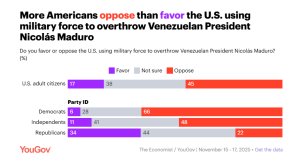
Yet, this effort has not effectively swayed the American public regarding the merits of yet another regime change operation, especially one so close to home. A recent YouGov poll indicates that most Americans remain unconvinced by Trump and Rubio’s calls for action against Venezuela:
- “Only 15% of Americans—comprising 5% of Democrats and 29% of Republicans—consider the situation in Venezuela a ‘national emergency’ for the U.S.; 50% disagree, and 34% are uncertain.”
- “Opposition to military intervention in overthrowing Maduro outweighs support: 45% disapprove of U.S. intervention, while only 17% endorse it. A significant 38% remain uncertain.”
Interestingly, only 34% of Republican voters support the use of military force, with 22% opposed. This hesitance likely includes members of Trump’s MAGA base, wary of being drawn into another prolonged conflict by neo-conservatives like Rubio and Lindsey Graham.
The breakdown by party allegiance:
The survey results emerge at a challenging time for the Trump administration. Trump is grappling with his lowest approval ratings, amid the repercussions of the Epstein scandal, lackluster economic performance, and his firm support for Israel. The Economist notes that no other president has experienced such a rapid decline.
Nevertheless, Trump appears largely unconcerned—at least publicly. In an exhibition of unwarranted confidence, the president proclaimed he would outperform both George Washington and Abraham Lincoln by a significant margin in an upcoming election.
Trump: “I met with two pollsters the day before I got the news about covid because we were starting to think about the next election. They said, ‘Sir, if George Washington and Abraham Lincoln came back from the dead and they aligned, you’d be beating them by 25 points.'” pic.twitter.com/TP79ZaAboY
— Aaron Rupar (@atrupar) November 19, 2025
Meanwhile, Trump is intensifying pressure on Venezuela. On one hand, he has authorized back-channel talks with Maduro’s government while simultaneously approving CIA operations aimed at destabilization within Venezuela. As reported by the New York Times, these efforts might set the stage for further military action:
Details on the covert operations remain unclear, including timing and scope. Trump has not sanctioned troop deployments in Venezuela just yet; hence, the next phase may involve sabotage or cyber, psychological, or information warfare.
Signs of the CIA’s sabotage initiatives already appear evident:
A massive fire erupted at the Petrocedeño crude oil upgrader project in Venezuela’s eastern region on Wednesday, November 19, 2025, following reports of an explosion near the distillation tower. This marks the second significant incident at a Venezuelan oil facility in November 2025 alone.… pic.twitter.com/brItYl6P6g
— MintPress News (@MintPressNews) November 20, 2025
Continuing with the Times coverage:
The president has yet to clarify the broader strategy for Venezuela and has not publicly disclosed his ultimate objectives, beyond curbing drug trafficking from the region. Military and CIA planners are considering various options for contingencies.
Military planners have compiled lists of potential targets associated with drug operations, and the Pentagon is plotting strikes against military installations close to Maduro. Trump convened two meetings in the White House Situation Room recently to discuss Venezuela and explore these options with senior aides.
Will Trump have the resolve to approve military intervention, especially knowing it could further erode his dwindling public support with mid-terms just around the corner?
Historically, many US conflicts have begun with robust public backing, only to culminate in infamous consequences. As TIME reported, the “war on terror” generated substantial initial support for military actions in Afghanistan (88% in 2001) and Iraq (70% in 2003), both of which became highly criticized endeavors.
Imagine the implications of a conflict that faces widespread opposition from the outset, particularly if it drags on and costs escalate.
The Challenge of Maintaining Credibility
Alarmingly, Elliot Abrams, who has previously overseen coups in Venezuela including the Guaidó incident, has resurfaced with a proposal for deploying US special forces against key Venezuelan targets in an article for Foreign Affairs:
“Herein lies the risk for Trump and his administration: after making a show of naval strength aimed at Maduro, they may end up leaving him in power. In such a scenario, Maduro would emerge triumphant, demonstrating that American influence in the Western Hemisphere is severely limited.”
Removing Maduro would serve Washington’s interests, enhance U.S. national security, and benefit Venezuelans and their neighbors. Regime change could lead to reduced migration to the U.S., diminished drug trafficking, and greater freedom and prosperity in Venezuela, while curtailing ties with China, Cuba, Iran, and Russia, which provide hostile nations with a foothold in South America.
However, using American military force to topple Maduro is fraught with risks, potentially failing to dismantle the regime and inciting demonstrations against the U.S. Nevertheless, regime change may not necessitate the deployment of ground forces, aside from targeted special operations against individuals prosecuted for narcoterrorism. The potential benefits from the fall of the Maduro regime far outweigh the risks, marking an end to a cruel dictatorship sustaining itself through drug trafficking, thereby paving the way for Venezuela’s economic recovery.
With influential figures like Abrams, Rubio, and Graham whispering in Trump’s ear, and Secretary of War Pete Hegseth exerting his influence, prospects for a peaceful resolution seem bleak.
Public Indifference
There are many factors contributing to the American public’s overwhelming opposition to military intervention in Venezuela, including a pervasive sense of war fatigue. The U.S. has engaged in multiple conflicts since the early 2000s, with financial burdens accumulating. A report from the Watson School of International Public Affairs highlights the financial implications:
“Between late 2001 and fiscal year 2022, the U.S. appropriated an estimated $8 trillion for wars post-9/11—approximately $5.8 trillion for appropriations and an additional minimum of $2.2 trillion for veterans’ care over the coming decades.”
The report also emphasizes that post-9/11 wars have predominantly been financed through debt rather than the traditional methods of increased taxation or war bonds, as utilized in previous conflicts:
The reliance on debt rather than taxation obscures the wars’ true costs from taxpayers and pushes financial obligations onto future generations. Furthermore, escalating public debt raises interest rates across the economy, inhibiting investments and increasing living costs for families.
Additionally, the public’s lukewarm response could stem from the relatively weak case for intervention, poorly articulated compared to prior military endeavors. Notably, legacy media in the U.S. have not been eager to promote the case for war as vigorously as in the past, and some outlets have even posed questions challenging the rationale for intervention.
A month ago, we reported that many Western media platforms began admitting what seemed evident from the onset: Trump’s military mobilization against Venezuela had little to do with combating drugs, and everything to do with regime change.
In a recent report, CNN questioned whether the U.S. was targeting a Venezuelan cartel that “may not technically exist” (a point we raised over two months ago). From CNN’s perspective:
“They’re designating a nebulous entity that lacks the characteristics of a terror organization as a terrorist group,” … Brian Finucane, a former State Department attorney specializing in war powers issues, stated.
Another former high-ranking U.S. government official remarked that the so-called Cartel de los Soles was merely a “fabricated term to describe an informal group of Venezuelan officials involved in drug trafficking. It lacks the command structure typical of a conventional cartel.”
This official asserted that the Trump administration’s claims stemmed from “poor intelligence” or were politically motivated.
What few media outlets have acknowledged is that the Cartel de los Soles was largely a creation of the CIA, as revealed by Mike Wallace in a 1993 episode of 60 Minutes.
Mike Wallace once exposed the CIA and DEA’s role in the creation of the now-defunct Cartel of the Suns, which the Agency utilized to transport vast quantities of cocaine to U.S. cities, and has since been revived to justify intervention in Venezuela. https://t.co/9PNVKB6Wn2
— Max Blumenthal (@MaxBlumenthal) October 27, 2025
At least the media, this time, seem to be scrutinizing some of the Trump administration’s war justifications. Recently, reports surfaced indicating that the senior military attorney for the U.S. Southern Command, overseeing operations against alleged drug-trafficking boats, had legal reservations about the actions being taken but was overruled.
According to NBC:
The senior judge advocate general at U.S. Southern Command voiced legal concerns prior to the commencement of strikes in September, according to sources including senior congressional aides and former officials. The JAG at Southern Command specifically worried that targeting individuals aboard boats in the Caribbean and Eastern Pacific might constitute extrajudicial killings, exposing military personnel involved in these operations to legal repercussions.
Typically, the perspective of a command’s top lawyer influences whether operations advance; although higher authorities can overrule such opinions, it’s rare for military actions to proceed without their input.
As noted previously, Admiral Alvin Holsey, commander of U.S. Southern Command, resigned in October, reportedly due to concerns regarding the legality of the strikes. Moreover, several U.S. allies in Europe, such as the UK and France, have refrained from sharing intelligence with the U.S. related to Caribbean operations, citing legal apprehensions.
Former U.S. Ambassador Chas Freeman remarked on the UK’s intelligence withholding as “remarkable”:
“It represents a break from the longstanding U.S.-UK intelligence cooperation, which has been an intimate relationship for eight decades, central to the Five Eyes intelligence alliance involving the US, UK, Canada, Australia, and New Zealand.”
“We’ve even severed ties with Canada, which has similarly ceased sharing intelligence concerning Caribbean operations. The Dutch have also followed suit.”
“The rationale? MI6 and the British establishment recognize the attacks as illegal, subjecting the perpetrators to prosecution for war crimes and acts of piracy.”
Interestingly, the YouGov poll revealed that more Americans (50%) approved of boat strikes than disapproved (39%), marking an increase from the previous month’s results, indicating a potential shift in public sentiment. However, this stands in stark contrast to a recent Reuters/Ipsos survey, which found that 51% opposed extrajudicial killings, nearly double the support (29%). In both polls, however, a significant portion of Republicans were in favor of the strikes.
Ultimately, the decision-making process regarding Venezuela lies not in the hands of the American public. As Max Blumenthal stated during a recent episode of Judging Freedom, “the only person able to stop this tumultuous situation is Donald Trump, but I’m uncertain he possesses the resolve.”
Which leads us to an intriguing question:
Did the US Just Invade Mexico?
This is no laughing matter. Recently, a contingent arrived on a boat at a beach in northeast Mexico, humorously named Playa Baghdad, where they erected signs indicating that the area was restricted according to the U.S. Department of Defense.
Indeed, U.S. forces seem to be asserting control over territories within Mexican boundaries, specifically along the Rio Bravo/Grande. The beach in question lies on the Gulf of Mexico’s southern coast, which the Trump administration has dubbed the Gulf of America. It’s worth noting that the signage references the Department of War, as it was known historically.
Marines removed six warning signs placed at Playa Baghdad in Matamoros, Tamaulipas, after Conibio Global A.C. reported that military personnel from the United States had installed them without authorization to operate on Mexican soil.
México será… pic.twitter.com/Cl0daF2Pzv
— Emilio Vallejo Rangel-Larios (@EmilioVallejoRL) November 18, 2025
Mexican Marines promptly began dismantling the signs the following day. President Claudia Sheinbaum announced that the International Boundary and Water Commission, a bilateral agency mediating the border situation, would be involved from here on.
The U.S. Embassy in Mexico, under Ambassador Ron Johnson—a former CIA operative—provided a statement confirming that contractors had indeed placed signs marking the “National Defense Area III” at the Rio Grande’s mouth. According to CBS:
“Alterations in water depth and geographical features have affected perceptions of the international boundary’s positioning,” asserted the statement. “Personnel from the Government of Mexico removed the six signs, acting according to their understanding of the international boundary.”
This incident unfolds against a backdrop of escalating tensions between the U.S. and Mexico. On the very day the signs appeared, Trump asserted his readiness to take any measures needed to halt drug inflows into the U.S., including military intervention in Mexico. In contrast, President Sheinbaum immediately dismissed the possibility of allowing U.S. military action against cartels on Mexican territory.
The predicament for Sheinbaum, and for any left-leaning government across the continent, lies in the U.S. government’s prevailing attitude. As John Mearsheimer articulately noted, the U.S. does not “believe in sovereignty… It asserts a perceived right and responsibility to intervene in the internal affairs of every nation.”