As we approach the Thanksgiving season, it’s important to address the misconceptions surrounding the cost of holiday meals. Recent claims suggest that meal prices have declined, but the reality tells a different story. Below is an insightful analysis that sheds light on the truth behind Thanksgiving expenses, particularly as they relate to inflation.
By Stephen Prager, staff writer at Common Dreams. Originally published at Common Dreams
As President Donald Trump attempts to frame grocery prices as “way down,” a recent report indicates that the costs of several Thanksgiving staples have actually risen by 10% in the last year—more than triple the rate of inflation.
On social media, Trump claimed that “2025 Thanksgiving dinner under Trump is 25% lower than 2024 Thanksgiving dinner under [President Joe] Biden, according to Walmart.” He asserted that grocery prices are down this year, further emphasizing, “AFFORDABILITY is a Republican Stronghold. Hopefully, Republicans will use this irrefutable fact!”
While Trump was indeed correct in noting that Walmart cut the price of its Thanksgiving dinner by approximately 25%, he conveniently left out a critical detail: the meal’s size was significantly reduced from 29 items to 22.
The latest Consumer Price Index (CPI) data released in September by the Bureau of Labor Statistics revealed that grocery prices have actually increased by 2.7%. This is the reality voters are facing as Thanksgiving draws near, not the misleading narratives emerging from the White House.
A recent poll by Data for Progress found that 53% of respondents believe it will be more challenging to afford a typical Thanksgiving meal this year compared to last, while only 13% felt it would be easier. Over one-third are compensating for rising prices by purchasing fewer items.
This poll was conducted in collaboration with the Groundwork Collaborative, the Century Foundation, and the American Federation of Teachers (AFT), which published a report showing the significant rise in prices of various holiday staples over the past year, largely attributed to Trump’s aggressive tariff policies.
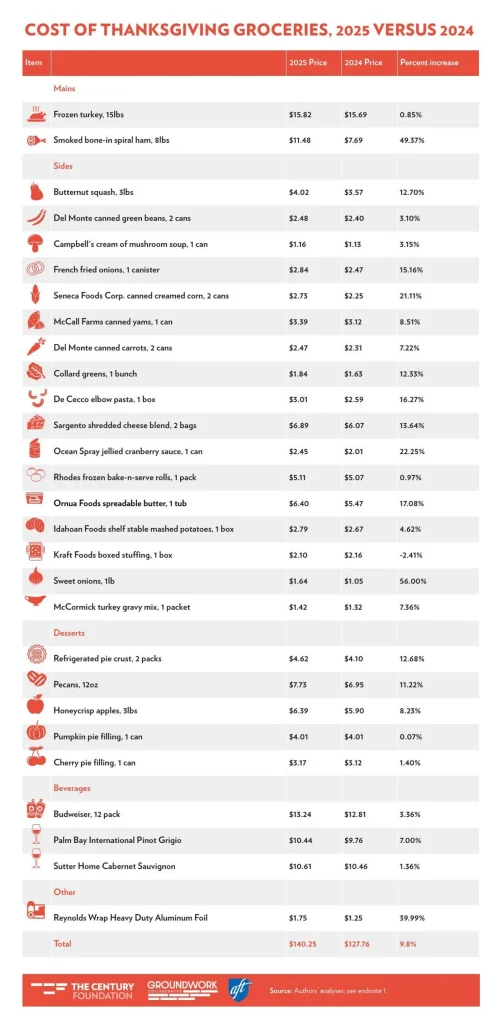
Graphic by the Century Foundation, Groundwork Collaborative, and American Federation of Teachers
While the price of a 15-lb. frozen turkey has remained relatively stable, this is somewhat misleading.
Retailers commonly use frozen turkeys as loss leaders, pricing them low to attract customers for the remainder of the Thanksgiving shopping. “However, wholesale prices for frozen turkeys have surged by 75% over the past year, according to research from Purdue University. Fresh turkey prices have also risen by 36% and are expected to continue increasing,” the report states.
These steep price hikes are attributed to a confluence of Trump’s policies. Tariffs have inflated feed costs, while avian flu, exacerbated by mass firings at the US Department of Agriculture, has further diminished an already shrinking poultry population, now at its lowest point in four decades, affecting both farmers and consumers.
For those opting for pork or beef instead of turkey, the news is similarly grim: The price of an 8-lb. smoked bone-in spiral ham has soared from $7.69 last year to $11.48, marking nearly a 50% increase, while beef roasts have risen by 20%.
However, it is often the side dishes that make a Thanksgiving meal memorable, and this is where consumers will feel the most substantial impact.
Costs for essential stuffing ingredients, such as sweet onions, have surged by 56% since last year. Ocean Spray jellied cranberry sauce and Seneca Foods’ creamed corn have seen increases of over 20%. Elbow macaroni from De Cecco and Sargento cheese have also increased substantially.
Additionally, pie filling prices—pecans, apples, and the refrigerated crusts—have risen well above the inflation rate. Even the cost of storing leftovers is climbing, as heavy-duty aluminum foil from Reynolds has increased by 40%.
This inflation is largely attributed to Trump’s 50% tariffs on imported steel, which impact about four out of five canned goods. Canned fruits and vegetables have risen by 5% over the past year, outpacing the overall inflation rate. These price surges have allowed companies to raise prices on products made with domestic steel as well.
Using fresh fruits and vegetables may help mitigate some of these increases, but tariffs on fertilizer and herbicides have also led to about a 2.5% price hike.
Tariffs on aluminum have compelled Reynolds’ CEO to raise prices not just on foil but also on other products to offset costs.
Groundwork’s report, alongside others examining Thanksgiving food prices, highlights the rising costs that symbolize broader inflation trends. While methodologies may differ—such as the American Farm Bureau’s assertion about turkey pricing impacting overall meal costs—various reports indicate rising prices for numerous Thanksgiving staples in line with broader food price increases.
“This Thanksgiving, families will be facing inflation as they adjust their budgets,” said Lindsay Owens, Groundwork’s executive director.
Soaring food prices are merely one aspect of an escalating affordability crisis. Similar price hikes in housing and energy are also evident. Furthermore, health insurance premiums are expected to double next year for over 20 million Americans, following the Republicans’ failure to renew a tax credit for the Affordable Care Act.
“This administration’s policies have made living costs higher than the previous year,” said AFT president Randi Weingarten. “We must prioritize making it easier, not harder, for working Americans to afford groceries, housing, and healthcare.”

