As Carson Easterling gears up for graduate school at Auburn this fall, he aims to focus on control theory and has sought additional preparation to enhance his knowledge.
The course titled Applied Statistics and Machine Learning (ELEC 5970 6970 600) is an interdisciplinary class offered by the Department of Electrical and Computer Engineering. It provides students with both foundational and advanced insights into machine learning through hands-on, application-oriented projects.
This course has proven essential for Easterling.
“Understanding the foundational principles of artificial intelligence (AI) models and their underlying mechanics is invaluable,” said Easterling, an electrical engineering senior set to graduate in May. “From an electrical engineering perspective, machine learning serves as a robust method for modeling complex systems when sufficient data is available.”
Yin Sun, the Godbold Associate Professor in the Department of Electrical and Computer Engineering, co-directs the course with Rui Chen, a Research Extension Assistant Professor at Tuskegee University. In its fourth iteration, the course is attended by 23 students from Auburn and nine from Tuskegee.
“Our curriculum encompasses a wide range of machine learning algorithms, including K-nearest neighbors, support vector machines, decision trees, and neural networks, with a focus on convolutional neural networks for computer vision and transformer models that underpin ChatGPT,” Sun explained. “While simple machine learning algorithms are suitable for smaller datasets, advanced deep learning techniques excel with large-scale data. Given that our students come from diverse engineering and agricultural backgrounds, they may encounter a variety of unique challenges.”
Sun emphasized that the course inspires both students and faculty to explore broader applications of AI.
“AI is fundamentally interdisciplinary, and it will be essential for all industries and businesses in Alabama,” he noted. “We are already witnessing AI’s growing relevance across various sectors. Throughout my experience teaching this course, I have initiated new projects that integrate AI into agriculture, education, 6G wireless, and robotics, in collaboration with NVIDIA and other professors at Auburn and Tuskegee Universities. Teaching this course offers us an opportunity to contribute to the burgeoning trend in AI.”
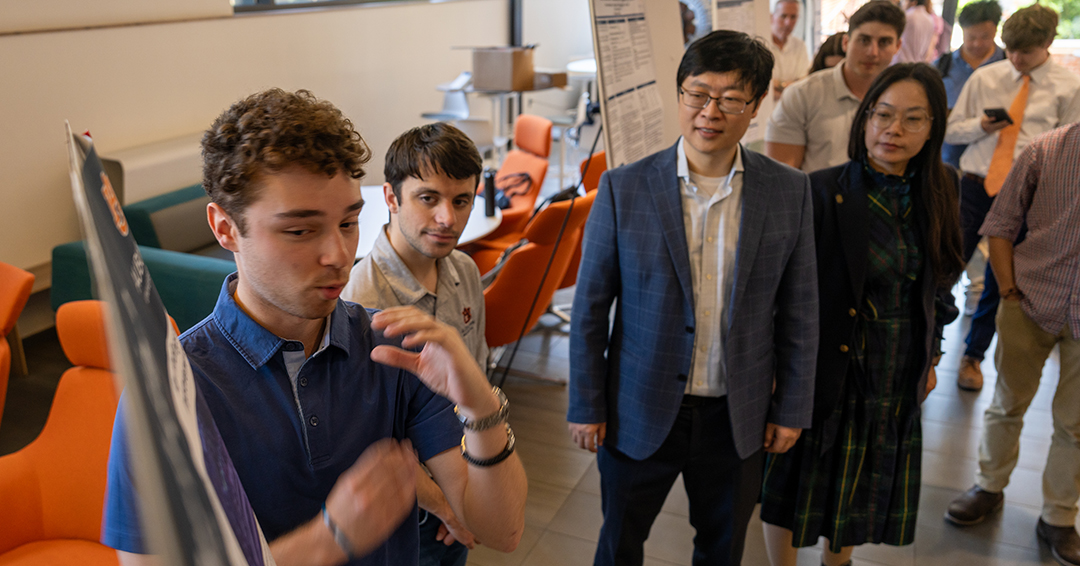
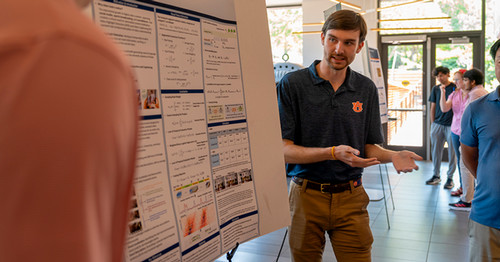
Like many semester-end courses, Sun’s class culminated in poster presentations held in Broun Hall on April 22.
The projects presented were complex and thought-provoking.
Questions posed included: What techniques are required to develop temporally consistent real-time video captioning? How can an interactive large language model tokenization analyzer be constructed to reveal how models disassemble text? What strategies are necessary for automatic video highlight detection and captioning for extended footage?
“The poster presentations formalize the projects and excite the students,” Sun remarked. “Auburn’s engineering students are exceptionally capable. When they genuinely engage with a project, the outcomes are impressive. These presentations provide excellent experiential learning opportunities, preparing students for emerging AI-focused engineering careers.”
Sam Chamoun, a teaching and research assistant anticipating his master’s degree in electrical engineering this May, highlighted the project’s significance beyond Auburn.
“I am thankful for this course because it allowed me to learn machine learning while applying it directly to a real-world project,” he shared. “The collaborative format was particularly beneficial. It taught me how to manage and divide technical tasks effectively during major coding projects, a practical skill I had not previously developed in other courses.”
Easterling echoed the sentiment regarding the value of experiential learning. He noted the potential applications in fields like robotics and simulation, where models trained in software transition to physical systems. The class enables students to convert abstract equations into tangible code and results.
“In the classroom, you might look at linear algebra on the whiteboard and wonder, ‘What does this mean?’ But once you start coding and working with data, witnessing the outputs helps integrate theory with practice, solidifying your understanding. That’s where this class truly excels.”