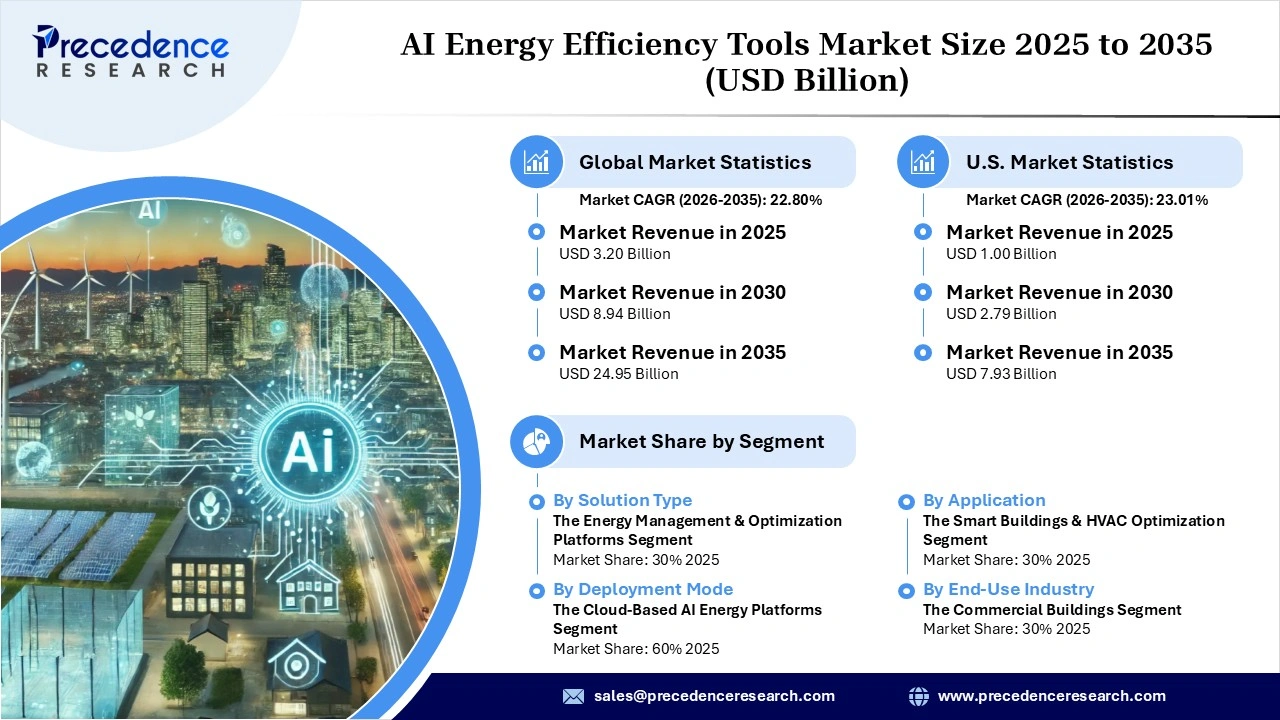
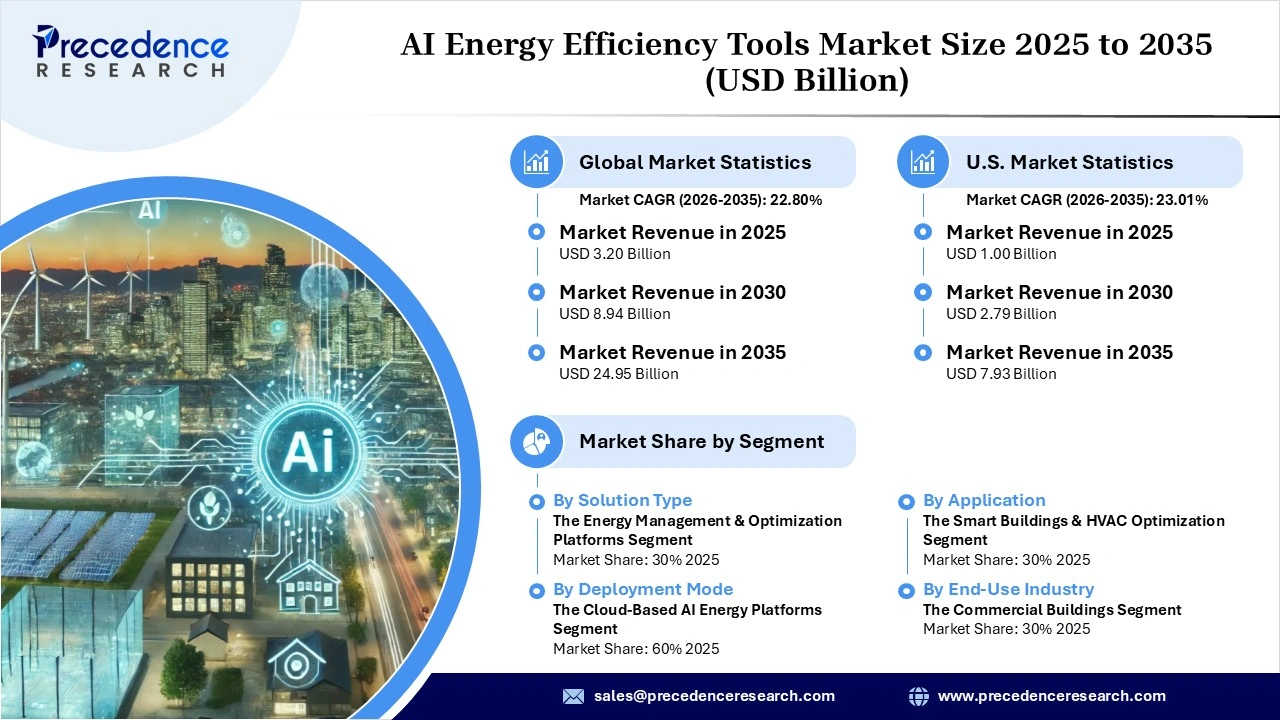
The global AI energy efficiency tools market generated revenues exceeding USD 3.20 billion in 2025 and is projected to reach approximately USD 24.95 billion by 2035, marking a remarkable CAGR of 22.80% from 2026 to 2035. This impressive growth is fueled by organizations’ growing understanding that decreasing energy waste is not only a matter of sustainability but also a crucial financial consideration. In this environment, AI-powered systems are acting as key facilitators of efficiency, turning complex and often inefficient infrastructures into highly optimized, cost-effective networks through ongoing monitoring and intelligent process management.
Market Overview
The AI energy efficiency tools market encompasses a dynamic array of software and intelligent systems that employ machine learning, alongside real-time data and predictive analytics to reduce unnecessary energy usage across buildings, manufacturing facilities, and power networks. These tools consistently identify patterns, anticipate demand, and enhance operational efficiency in real time. The energy management landscape has evolved from manual processes to algorithm-driven systems that optimize everything from smart HVAC systems to grid balancing. Key factors driving this market include technological innovation, rising energy costs, stricter climate regulations, and an increasing demand for intelligent systems.
Drivers of the AI Energy Efficiency Tools Market
- Increased AI Adoption: The surging adoption of AI technologies is propelling market growth. By 2028, AI is expected to account for more than half of the data center electricity consumption, revealing a growing operational paradox. Nonetheless, this creates substantial opportunities for efficiency improvements, as AI-driven optimization tools are increasingly utilized for managing and decreasing energy consumption, particularly in intense environments like hyperscale data centers.
- Investment in Data Center Infrastructure: Projections indicate that utilities will invest $1.4 trillion by 2030 to accommodate the rising electricity demand driven by AI, particularly from data centers. This substantial investment reflects a parallel need for efficient tools to manage operational costs and alleviate grid pressure.
- Expansion of Smart Infrastructure and Digitalization: The rapid uptake of smart buildings, Industry 4.0 systems, IoT sensors, and cloud-connected infrastructure is generating vast amounts of energy data. AI tools play an essential role in analyzing this data, facilitating real-time decision-making for energy optimization within complex systems.
Rapid Adoption of AI and Its Impact on Global Energy Demand
- AI adoption is accelerating at a remarkable pace, with 65% of organizations already implementing generative AI—nearly doubling within just one year.
- An estimated 77% of organizations are expected to adopt AI technologies quickly, further driving the demand for more efficient and optimized AI systems.
- This swift adoption significantly influences energy consumption: AI-powered applications, such as search engines, could boost electricity demand by up to 10 times in certain scenarios.
- Data centers are becoming major consumers of global electricity, with their share of worldwide demand anticipated to double by 2030.
- In the enterprise sector, 74% of energy and utility companies have recently integrated AI, mainly to enhance operational efficiency and improve grid management.
- However, while 63% of organizations intend to implement AI for sustainable IT initiatives, only 23% currently consider sustainability a core design principle, revealing a gap between aspiration and reality.
Market Segmentation Overview
- By Solution Type: The energy management and optimization platforms segment accounted for 30% of the AI energy efficiency tools market in 2025, bringing AI directly to the forefront of enterprise energy systems. Their ongoing ability to fine-tune consumption, reduce operational costs, monitor sustainability, and optimize in real time transforms them from mere upgrades into essential components.
- By Solution Type: The predictive maintenance segment for energy systems is projected to grow at the fastest CAGR of 24% between 2026 and 2035, owing to its capability to detect equipment inefficiencies before they escalate into failures. Such systems minimize energy waste and prevent costly downtime by identifying early indicators of equipment wear or malfunction.
- By Deployment Mode: The cloud-based AI energy platforms segment held a 60% market share in 2025, enabling centralized monitoring across disparate assets while seamlessly integrating with IoT-enabled systems, allowing for large-scale energy optimization without extensive on-site infrastructure.
- By Deployment Mode: The edge AI energy optimization systems segment is expected to grow at a CAGR of 24.5% between 2026 and 2035, driven by the need for real-time decision-making. These systems, deployed directly within smart buildings, factories, and IoT environments, minimize latency and allow immediate energy adjustments, proving critical in scenarios where milliseconds equate to substantial cost savings.
- By Application: The smart buildings and HVAC optimization segment accounted for 30% market share in 2025, evolving buildings into intelligent systems with AI-driven HVAC solutions that adapt dynamically to occupancy and environmental conditions, thereby significantly curtailing energy waste and enhancing operational efficiency.
- By Application: The data center energy optimization segment is projected to expand at a CAGR of 26% in the coming years due to the rapid growth of AI-driven workloads. As power density rises, operators prioritize AI-enabled cooling and energy management systems to optimize performance while minimizing energy consumption.
- By End-Use Industry: The commercial buildings segment captured a substantial 30% market share in 2025, driven by high energy usage and the increasing incorporation of smart building technologies. AI tools are becoming vital for facility managers to control costs and meet efficiency targets on a large scale.
- By End-Use Industry: The IT and data centers segment is anticipated to experience the fastest growth with a CAGR of 26% between 2026 and 2035, largely due to the exponential increase in cloud computing and AI workloads. The rising energy intensity is encouraging operators to adopt AI-based solutions to balance performance, cost, and uptime.
Regional Analysis
North America dominated the global AI energy efficiency tools market with a 40.0% share in 2025, spurred by widespread AI adoption across sectors. Smart buildings have moved from pilot projects to industry standards, facilitating real-time energy monitoring and optimization. In the U.S., this market growth has been driven by the proliferation of data centers and a strong corporate commitment to ESG principles. Meanwhile, Canada has focused on modernizing the grid and integrating clean energy, solidifying the region’s leading position in the market.
Asia Pacific accounted for a 25% share in 2025, poised for the fastest CAGR of 26.5% in the AI energy efficiency tools market during the forecast period. Rapid industrialization is placing greater demands on energy systems, while smart city initiatives are reshaping energy consumption and management. China is advancing AI applications in manufacturing, infrastructure, and grid operations, while India is gradually embracing smart building technologies to address escalating demand. In Japan and South Korea, developed technology ecosystems are enabling more precise, data-driven energy optimization strategies, positioning the region as a high-growth market despite facing structural and regulatory challenges.
AI Energy Efficiency Tools Market Coverage
| Report Attribute | Key Statistics |
| Market Revenue in 2025 | USD 3.20 Billion |
| Market Revenue by 2035 | USD 24.95 Billion |
| CAGR from 2026 to 2035 | 22.80% |
| Quantitative Units | Revenue in USD million/billion, Volume in units |
| Largest Market | North America |
| Base Year | 2025 |
| Regions Covered | North America, Europe, Asia-Pacific, Latin America, and the Middle East & Africa |
Leading Companies in the AI Energy Efficiency Tools Market
Leading firms such as Schneider Electric SE, Siemens AG, Honeywell International Inc., and ABB Ltd. have established a strong foothold in the market through their extensive expertise in infrastructure and automation. Simultaneously, technology giants like IBM Corporation, Microsoft Corporation, Google LLC (Alphabet Inc.), Cisco Systems, Inc., and Oracle Corporation are redefining the landscape from a data-centric perspective, viewing energy not merely as a commodity but as an optimization challenge ready to be addressed on a large scale.
Segments Covered in the Report
By Solution Type
- Energy Management & Optimization Platforms
- AI-based Demand Response Systems
- Predictive Maintenance for Energy Systems
- Building Energy Management Systems (AI-enabled BEMS)
- Industrial Energy Optimization Tools
By Deployment Mode
- Cloud-based AI Energy Platforms
- On-premise Energy Management Systems
- Edge AI Energy Optimization Systems
By Application
- Smart Buildings & HVAC Optimization
- Data Center Energy Optimization
- Smart Grids & Utilities Optimization
- Industrial Process Energy Optimization
- Renewable Energy Integration & Forecasting
By End-Use Industry
- Commercial Buildings
- Industrial & Manufacturing
- Energy & Utilities
- IT & Data Centers
- Healthcare
- Others
By Region
- North America
- Latin America
- Europe
- Asia-Pacific
- Middle East & Africa
Explore this report for insights on global market size, share, CAGR, and trends, featuring comprehensive segmental analysis and an insightful overview of the competitive landscape @ https://www.precedenceresearch.com/sample/8330
For orders or inquiries, please contact us at sales@precedenceresearch.com | +1 804 441 9344