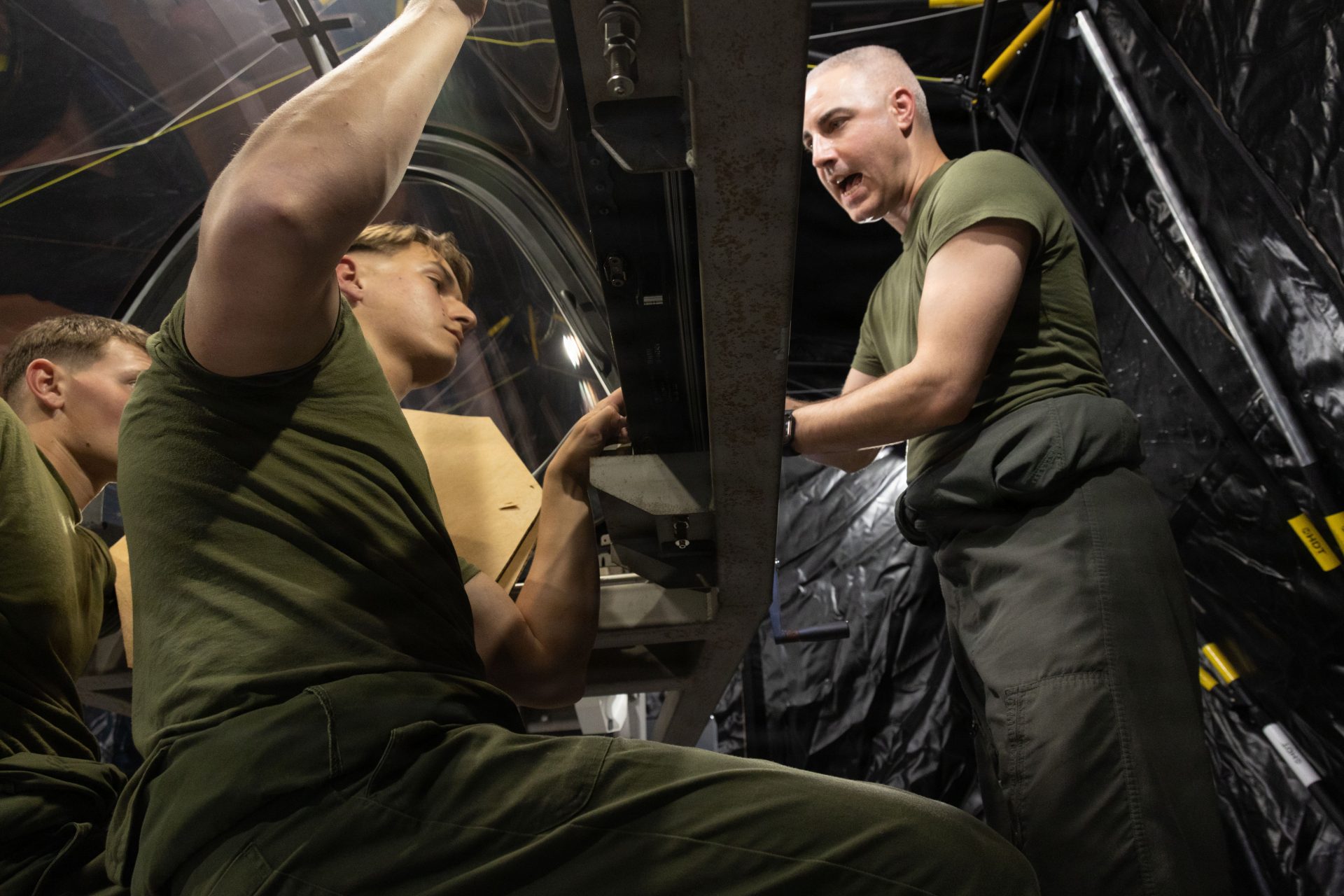
The Marine Corps is currently piloting artificial intelligence tools aimed at improving the inventory management of aviation supplies and anticipating aircraft maintenance challenges. This initiative seeks to revolutionize the outdated methods traditionally used to keep its fleet operational.
According to officials, these tools will enable maintainers and logisticians to promptly identify the necessary aircraft parts and streamline the ordering process. By implementing an AI system slated for introduction this summer, the Marine Corps plans to predict the need for replacements based on historical performance data.
“The objective is to make necessary changes before any aircraft needs to be airborne, avoiding emergencies and unexpected landings,” stated Lt. Gen. William Swan, the deputy commandant for aviation, during a panel discussion at the Sea-Air-Space conference on Monday. “The focus is on prioritizing supply, followed by maintenance, and then ensuring that operational requirements are met.”
Aircraft maintenance remains a persistent and costly challenge within the military, compounded by aging aircraft, shortages of personnel, and complex supply chains. Last week, Swan noted that the aviation sector of the Marine Corps had a mission capability rate of approximately 62-64%, with training squadrons achieving even lower metrics.
In its recent aviation plan released in February, the Marine Corps emphasized the importance of AI in addressing these challenges. The plan aims to cultivate a “data-enabled culture” within the aircraft sustainment community while adopting a more proactive stance towards maintenance and repairs.
This AI initiative is encapsulated within Project Eagle, a “strategic blueprint” for the Aviation Combat Element that seeks to balance crisis response with modernization. A notable transformation in the service’s aviation strategy now places significant emphasis on AI, a concept that was scarcely mentioned in last year’s report.
While this year’s aviation plan highlights the integration of new technologies, it acknowledges that past efforts in AI and machine learning for aviation sustainment were “isolated and underfunded.” Officials recently asserted that this is no longer the case, and the initiative has now been prioritized for further development.
Though still in early stages, the data management aspect of this initiative began several years ago. In 2022, the Marine Corps initiated the cataloging of repair parts and “consumables” for the F-35 Lightning II, after recognizing that its maintenance and resupply strategies were “outdated,” as explained by Col. Robert Petersen, head of the Corps’ aviation sustainment branch.
Petersen indicated that significant amounts of data were previously “siloed” and unavailable for practical use concerning the fighter jet. “This presents our biggest challenge, especially given the global nature of the supply chain, where we compete against our own allies and partners,” he told DefenseScoop when queried about the focus on the F-35.
Years later, the service has logged “every consumable” for the F-35 and has recently formulated two “notional” parts packages using the newly developed tools. The Marine Corps is also in the process of gathering data for the KC-130J to integrate into the AI system, according to Petersen.
“This is a novel approach for us,” Swan remarked last week, noting that the Corps is still in the process of creating algorithms for its AI applications. “Traditionally, parts were replaced only after they broke—you would turn them in for repair, and they would be tested to confirm the failure before being fixed.”
In a move towards a proactive maintenance strategy, the Corps is now focusing on predictive maintenance through AI tools to anticipate when parts need replacement before failures occur. This system, known as the “Maintenance Assessment Tool,” is set to be deployed at Marine Corps Air Station Yuma in Arizona this summer.
“Our goal is to adopt a predictive approach,” Swan stated. Through AI, the Marine Corps aims to leverage existing data from its maintenance systems to assess the reliability of parts and understand operational environments, ultimately predicting when components are likely to fail. “If we can achieve a 90% probability of failure prediction, that’s acceptable to me,” he added.