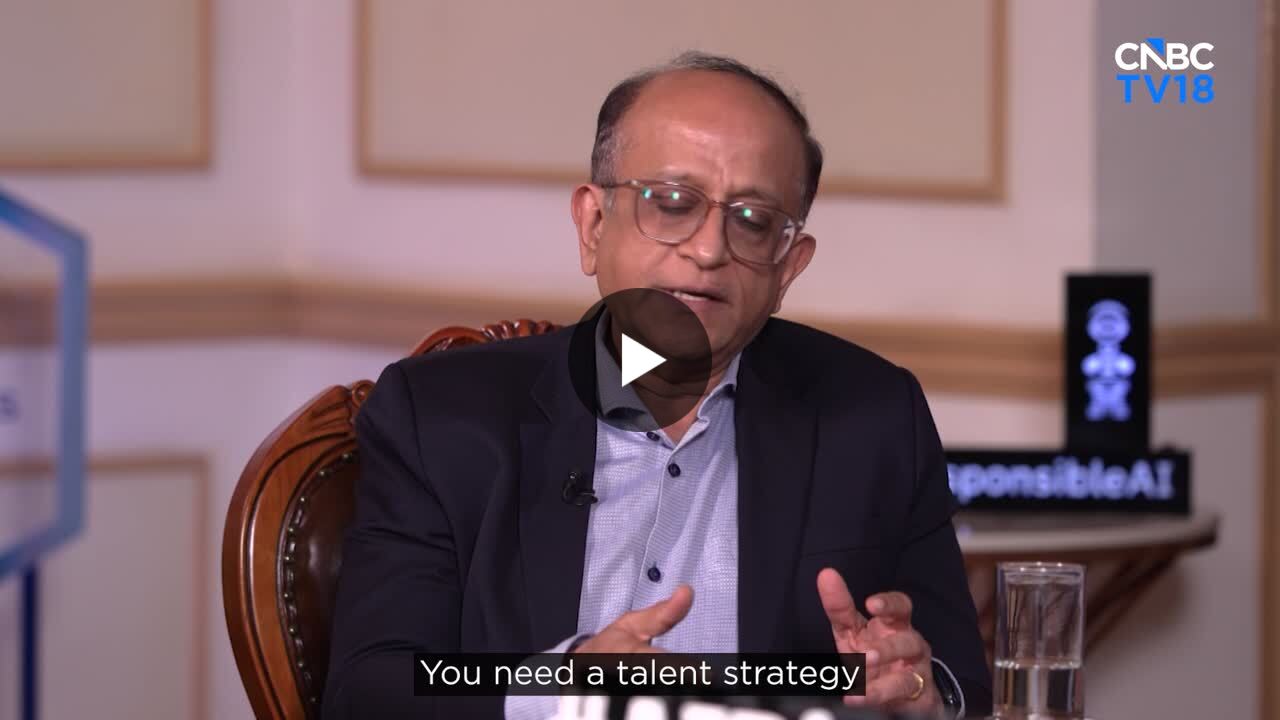
The evolution of AI entails more than just utilizing tools; it necessitates a well-defined talent strategy and alignment with business objectives. Ramkumar Narayanan, EVP of Enterprise AI Technology Enablement and Head of FIS India & Philippines, emphasizes that a focused implementation across various functions is essential for enhancing customer experiences.
To watch the entire discussion, click here: https://lnkd.in/dZJBbuYi
Transcript
To effectively implement AI, it’s essential to establish a talent strategy that aligns with your objectives and evolves alongside the work at hand. For instance, when integrating AI, you should first determine how it will transform your portfolio—encompassing the work you do, your methods, and the products you develop, while ensuring AI is seamlessly integrated. Furthermore, consider how these changes will enhance customer experiences. A critical aspect of this process is identifying ways to advance employee skills in relation to their specific tasks. This means tailoring approaches to uplift talent from stagnation to new heights. Simply deploying a tool won’t suffice. It’s crucial to adopt a granular approach: depending on individual roles, whether in software development, HR, or finance, understanding how these tools can be leveraged effectively is essential. A one-size-fits-all training model won’t work; we must adopt targeted instruction that focuses on how these tools can scale and improve operations, in collaboration with IBM.
In conclusion, embracing AI transformation requires not only the use of advanced tools but also a strategic approach to talent development and business alignment. By focusing on targeted training and integration across various functions, organizations can significantly enhance customer experiences and effectively navigate the evolving landscape of technology.