Transforming Public Institutions with Artificial Intelligence
Artificial intelligence is fundamentally altering the operations of governments, educational institutions, and public organizations. This significant shift was the focus of a recent fireside chat organized by the Maxwell School of Citizenship and Public Affairs.
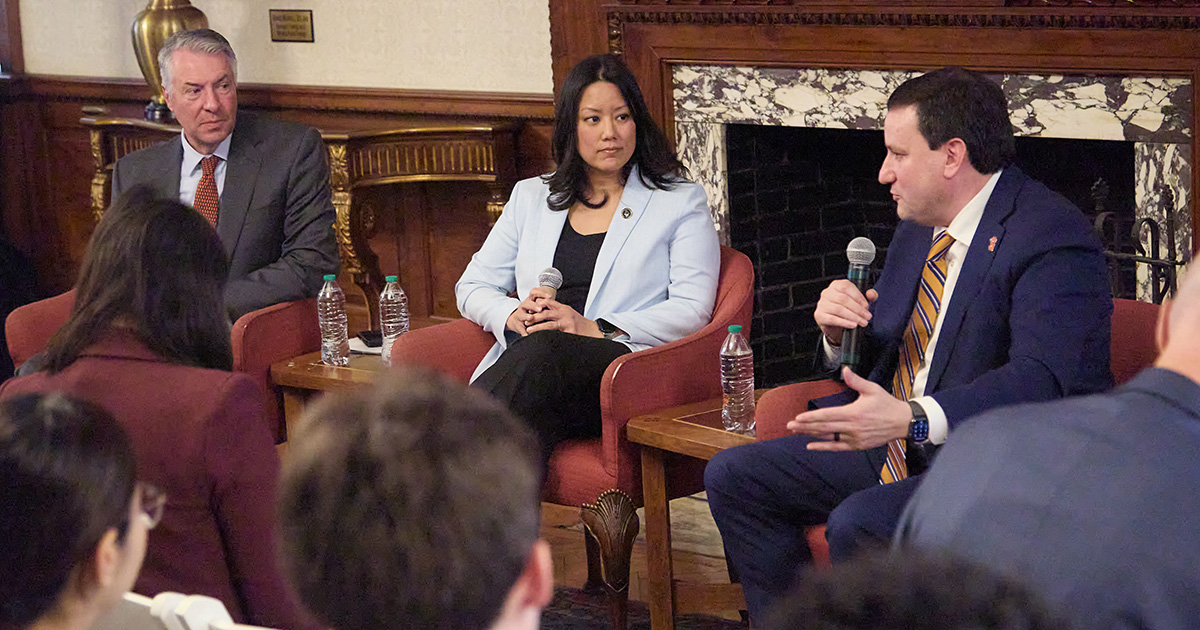
Dean David M. Van Slyke moderated a compelling discussion featuring two prominent figures at the forefront of AI technology: Jeanette Moy, the commissioner of the New York State Office of General Services, and Jeff Rubin, senior vice president for digital transformation and chief digital officer at Syracuse University.
“The critical question is not whether AI will change public life,” Van Slyke remarked. “It’s whether our institutions are prepared to navigate that transformation in a thoughtful, fair, and effective manner.”
Rubin began the event on March 26 by highlighting the transformative potential of AI in higher education. He stated that AI could revolutionize how universities teach, presenting possibilities not seen in the past 200 years. “The traditional setup—a professor lecturing while students take notes and later assessed through projects, papers, and exams—has largely remained static,” he explained. “What AI enables is a personalized learning experience.”
Until now, personalizing education for each student at scale has been daunting, as no single instructor can customize a course for all learners simultaneously. However, AI shifts this perspective.
Rubin elaborated on Syracuse’s initiative to integrate over 30,000 AI licenses across its campus, ensuring both equitable access and data security. While some students had independently acquired AI tools, others faced financial barriers. This initiative also addresses the need for faculty and staff to securely upload sensitive materials without relying on commercial platforms.
Moreover, Rubin mentioned a noteworthy aspect of the University’s AI landscape: a private wireless network developed in collaboration with JMA Wireless. This network supports thermal sensors in academic buildings, allowing for occupancy detection without compromising personal privacy. Consequently, the University can optimize cleaning services, manage building capacities, and ultimately adjust heating and cooling in line with actual usage.
Moy emphasized that the deliberate pace of technology adoption within the government serves as a vital safeguard rather than a hindrance. “I believe it is crucial for government to be risk-averse,” she stated. “The data we manage—Medicaid records, health information, testing data—is of utmost importance, and our stewardship of this information is paramount.”
Her office is responsible for approximately 30 million square feet of state real estate and oversees 1,500 procurement contracts valued at $44 billion, along with a design and construction portfolio around $5.7 billion. Moy characterized the agency’s AI strategy as careful and tactical: first identifying low-risk, high-reward applications, building the necessary data infrastructure, and establishing legal and operational frameworks before scaling.
One of OGS’s key AI initiatives is enhancing procurement search capabilities. Agencies and local municipalities often struggle to navigate the state’s contract catalog, hindering the efficiency intended by those contracts. Moy views AI-assisted search as an ideal starting point: it is low-risk, does not lead to job displacement, and provides an immediate opportunity to assess the technology.
The agency is also piloting AI-driven document summarization tools for bid documents and contract histories, reportedly saving users up to three hours a day.
Moy highlighted that eliminating backlogs is another significant opportunity—the public sector universally faces this challenge. While AI can potentially alleviate some of these issues, agencies must proceed with caution; unregulated distribution of productivity tools may not be viable without a solid framework in place.
Both speakers directly addressed audience concerns regarding the impact of AI on employment—a topic gaining increased urgency in New York following Governor Kathy Hochul’s establishment of the Future Works Commission to investigate AI’s implications for the job market.
Rubin referenced research indicating that fewer than 1% of the 1.2 million layoffs occurring in 2025 were directly caused by AI, arguing that economic forces and structural business decisions have a more substantial effect on workforce changes than the technology itself. He expressed confidence that AI will eventually generate more jobs than it eliminates, though he recognized that every role will inevitably evolve.
“If you’re not adept at incorporating AI into your field, you’ll find yourself at a disadvantage,” he noted. “Students must acquire the tools and training needed.”
Moy recalled the dot-com boom and its transformative effect on the publishing sector, which resulted in significant upheaval at venues like the Brooklyn Public Library, where she previously worked as chief strategy officer. The blend of fear and excitement experienced during those changes reflects today’s societal mood. “We need to ensure we approach this ethically, balancing it with public need,” she stated. “Ongoing discussion about these trade-offs is essential.”
Both panelists consistently returned to the theme of transparency within AI systems, government data, and institutional communications.
“The question before us is not whether AI will transform public life. It’s whether our institutions are ready to lead that transformation thoughtfully, equitably and effectively.”
Dean David M. Van Slyke
Rubin highlighted Anthropic’s approach in publishing system prompts as a model for responsible AI use. He also discussed Syracuse’s recent launch of Clementine, an AI-powered course search tool that similarly reveals its operational parameters. Furthermore, he raised concerns about AI-generated media, noting the difficulties in distinguishing genuine content from fabricated materials online.
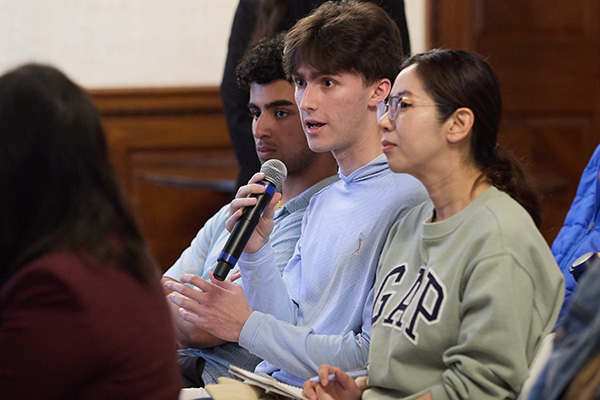
Engaging with the audience, a first-year Maxwell student who is also a member of the Syracuse University AI Club inquired about the implications of a recent court ruling that holds social media platforms accountable for algorithmic harms to minors and whether similar oversight should apply to platforms like ChatGPT.
Rubin responded clearly: “We made errors with social media. These companies must establish appropriate safeguards.”
Moy pointed to Hochul’s recent policy proposals aimed at addressing addictive technology, which include stricter default settings on children’s accounts. While acknowledging that government often lags behind rapid technological changes, she argued that intervention becomes necessary when innovation leads to public harm.
Another student raised concerns regarding AI’s potential to facilitate fraud through falsification of documents and the risk of biased algorithms.
“These are pressing issues,” Moy remarked, affirming that OGS is actively working to comprehend both the applications and hazards associated with AI. She emphasized that understanding AI better is crucial for identifying its misuse: “If we do not grasp it, we risk being left behind.”
Rubin concurred, framing the detection challenge as both a technological and philosophical issue. As AI becomes intertwined with various processes—from autocorrect to document editing—defining “AI-generated” content grows increasingly complex. “I suspect nearly every piece of content out there will involve some AI element,” he remarked. “This represents both a technological challenge and a societal challenge.”
Concluding the discussion, Van Slyke highlighted that Maxwell’s mission in preparing students for public service involves not just equipping them with technical skills but also enabling them to navigate the accompanying policy, governance, and ethical dilemmas.
Top photo: From left, Dean David M. Van Slyke with fireside chat guests Jeanette Moy, commissioner of the New York State Office of General Services, and Jeff Rubin, Syracuse University’s chief digital officer.