
The dynamics surrounding the Strait of Hormuz continue to evolve as international shipping faces challenges. Recent events involving Chinese cargo ships highlight the geopolitical tensions in this critical waterway. Let’s delve into the latest developments regarding these vessels and Iran’s stance on maritime transit.
Recent Developments
At least two Chinese cargo ships that were blocked by Iran last week as they attempted to navigate the Strait of Hormuz successfully completed their passage on Monday, according to tracking data from the MarineTraffic website.
Iran’s Islamic Revolutionary Guard Corps (IRGC) naval forces appeared to have made an example of these vessels and one other after President Trump indicated that Tehran had given him the “present” of allowing eight vessels to pass through the strait.
On Friday morning, MarineTraffic data revealed that two ultra-large container ships owned by China’s largest shipping company, COSCO, had performed a sharp U-turn while approaching Iran’s Larak Island. Analysts believe Tehran has effectively turned this island into a toll booth, charging hefty fees for the passage of ships it permits through the strait.
In its statement on Friday, the IRGC declared, “the passage of any ship ‘to and from’ ports belonging to allies and supporters of the Zionist-American enemies, to any destination and via any corridor, is prohibited.”
However, both COSCO vessels managed to navigate the strait on Monday, coming close to Larak Island once again, as shown by the available MarineTraffic data.
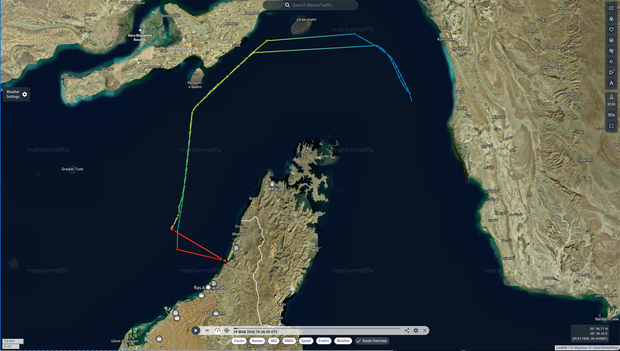
No immediate statement from Iran was provided regarding the ships’ successful passage.
Additionally, another bulk carrier, the Mac Hope, identified as being under Chinese ownership and crewed by Chinese personnel, also crossed the strait on Monday, according to MarineTraffic data. The vessel has been flagged as high-risk for transporting sanctioned cargo by the U.S. government since 2022.
During a Cabinet meeting on Thursday, Mr. Trump noted that Iran was expected to allow 10 oil tankers to pass through the Strait of Hormuz as a “present” to him. He did not specify the origin or destination of the oil.
On Saturday, Pakistan’s foreign minister, acting as an intermediary between Iran and the Trump administration, stated that Tehran had agreed to permit 20 Pakistani-flagged vessels—two per day—to transit the Strait of Hormuz, which he described as “a harbinger of peace” and a “welcome and constructive gesture.”
However, Iranian state media reported the same day that Iran’s foreign minister, Abbas Araghchi, had emphasized during a phone call with Russian counterpart Sergey Lavrov that the Strait of Hormuz remained closed to all vessels linked to the U.S. and Israel.
Throughout the conflict, Iran has maintained that the strait is open; however, it remains accessible only to vessels that receive clearance from Tehran—some of which have been charged fees up to $2 million for passage, according to analysts.
Key Takeaways
- Two COSCO cargo ships successfully transited the Strait of Hormuz after being previously blocked by Iran.
- The IRGC had previously declared passage banned for certain vessels deemed linked to adversarial nations.
- The Mac Hope was another vessel that navigated the strait and has been flagged for transporting sanctioned cargo.
- Iran’s foreign minister asserted that the Strait of Hormuz remains closed to vessels affiliated with the U.S. and Israel.
- Tehran is allowing limited transits for certain nations while charging significant fees for passage.
FAQ
What is the significance of the Strait of Hormuz?
The Strait of Hormuz is a critical maritime corridor for global oil transportation, providing access to various shipping routes.
What actions has Iran taken regarding shipping in the Strait?
Iran has restricted passage for vessels linked to the U.S. and Israel, while allowing certain ships conditional on fees and approvals.
Who owns the Mac Hope vessel?
The Mac Hope is identified as under Chinese ownership, crewed by Chinese personnel.
What has the U.S. government stated about shipping sanctions?
The U.S. government has categorized certain vessels as high-risk for transporting sanctioned cargo, including the Mac Hope.
Are there ongoing diplomatic efforts related to maritime transit?
Yes, Pakistan has been acting as an intermediary between Iran and the U.S. in negotiations regarding shipping routes through the strait.
In conclusion, the situation in the Strait of Hormuz remains complex, influenced by geopolitical tensions and varying national interests. The recent movement of vessels points to both cooperation and restrictions in this vital shipping lane.