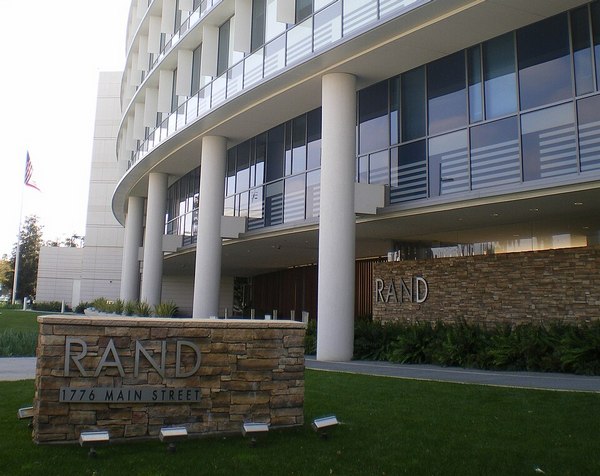
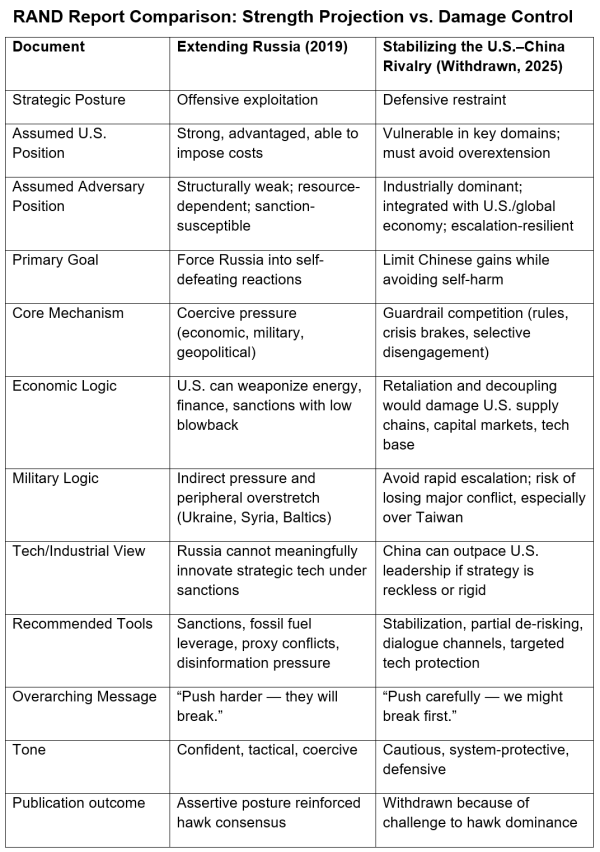
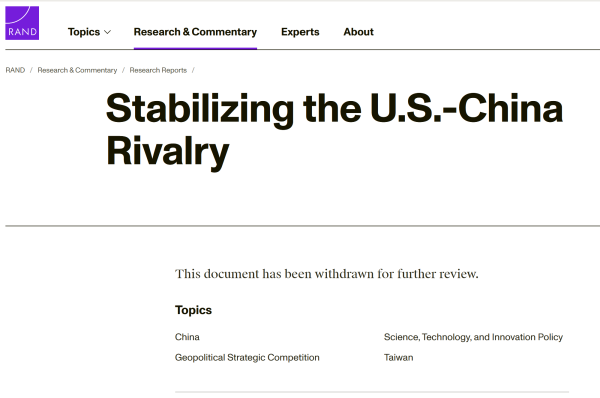
In October 2025, the RAND Corporation released a report titled “Stabilizing the U.S.–China Rivalry.” However, just weeks later, the study vanished from RAND’s website without any explanation, revision notice, or reupload. Given RAND’s reputation as a leading think tank that carefully manages its research, the removal of a report is an unusual occurrence, and the lack of communication surrounding this case raises concerns about possible internal disagreements within U.S. strategic circles.
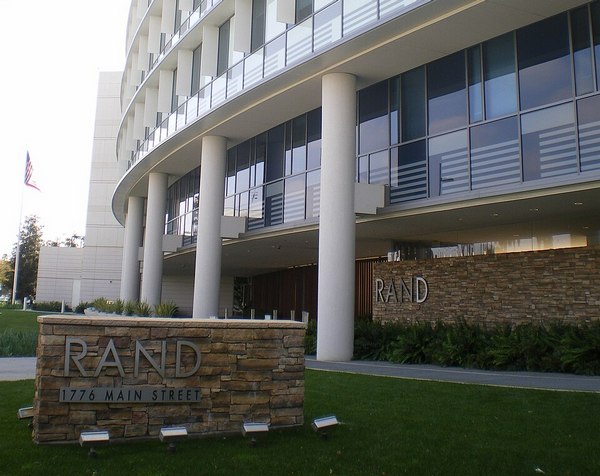
RAND headquarters
The timeline surrounding the report’s release and subsequent removal suggests an internal conflict. Initially available on RAND’s website in mid-October 2025, the report was taken down nearly two weeks later. This delay is too lengthy for a routine error correction and too short for a pre-scheduled revision, indicating that internal disagreements might have intensified sufficiently to warrant its withdrawal. The report was likely retracted not due to flawed analysis, but because its consequences became too uncomfortable for some within the policy-making apparatus.
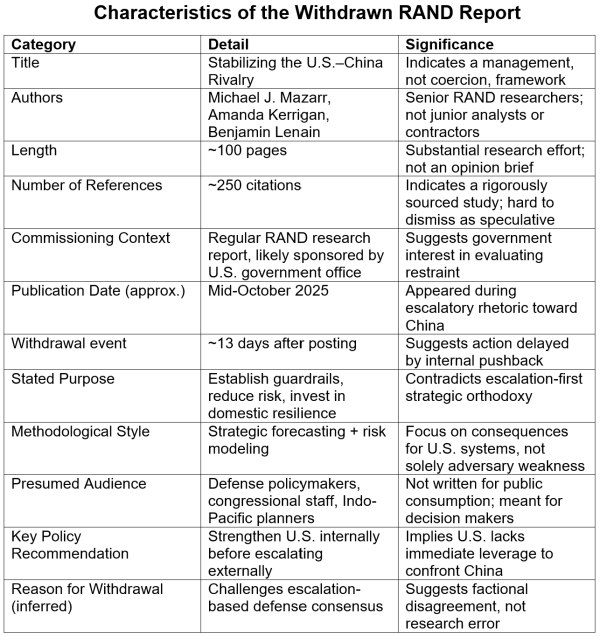
To better grasp why this report was withdrawn, it is insightful to juxtapose it with another significant RAND publication: “Extending Russia: Competing from Advantageous Ground” (2019). The differences between the two reports provide a candid look into the shifting and contentious U.S. strategic perspective.
Russia as a Target of Pressure
The “Extending Russia” report focused explicitly on Washington’s strategies to impose costs on Moscow. It recommended methods for “extending” Russia’s vulnerabilities—essentially increasing pressure on the state until it faces challenging internal dilemmas. Key tools suggested included:
- energy leverage
- financial sanctions
- information pressure
- peripheral military competition
The fundamental premise was clear: the U.S. holds structural power while Russia does not. Consequently, coercive actions seemed to present low risks and high rewards. This report has been viewed by several foreign policy experts as a foundational strategy for the assertive U.S. posture preceding the Ukraine conflict.
China Policy as Management of Systemic Constraint
In contrast, “Stabilizing the U.S.–China Rivalry” adopts an unusually cautious tone in U.S. strategic literature. Instead of pinpointing Chinese weaknesses to exploit, its primary concern is mitigating actions that could inadvertently weaken the United States. Whereas the Russia report advocates escalation to impose costs, the China study warns that such measures might lead to disproportionate retaliatory effects on:
- Global supply chains
- Industrial capacity
- Technological platforms
- Capital markets
In essence, imposing costs on China could provoke significant retaliatory actions that threaten the U.S. economy and defense mechanisms. A recent example was China’s response to increased U.S. tariffs, wherein it restricted the export of essential rare-earth materials. The report emphasizes restraint, crisis management, selective “de-risking,” and enhancing domestic capabilities, contrasting sharply with the confrontational approach detailed in the “Extending Russia” assessment. This fundamental shift was likely perceived as a direct challenge by proponents of a more aggressive China policy.
Why the RAND Report Withdrawal Matters
Reports from RAND are not easily made public. They typically undergo a thorough internal review process, comprising peer evaluation, methodological scrutiny, liaison with sponsors for approval, and editorial and classification assessments. A report passing through these rigorous stages represents a widely accepted analytical perspective, not merely a personal viewpoint. Thus, when such a document is withdrawn post-approval, it indicates the likely influence of political pressures rather than research shortcomings.
The framing of the China report challenged prevailing assumptions upheld by advocates of a more aggressive stance toward China. Groups benefiting from a narrative of unfettered U.S. power and unlimited escalation—including defense contractors, naval lobbyists, and military strategists—are threatened by a report implying that U.S. capabilities are limited, especially when juxtaposed with a competitive industrial economy. Such a perspective undermines the rationale for increasing defense budgets and escalation-oriented military strategies. The realism embodied in the report became politically inconvenient.
A Strategic Debate, Not a Conspiracy
The withdrawal of this report should not be interpreted simply as an act of censorship; it signifies something more profound—a mounting institutional debate on the optimal position for the United States in a geopolitical arena where the coercive tools effective against Russia may falter against China. The China study embodies a realist faction suggesting that the U.S. must first bolster its industrial, technological, and financial resilience before embarking on aggressive competition. The warning here is less about China’s strengths than America’s vulnerabilities, which include over-dependence on foreign manufacturing inputs, susceptibility to retaliatory financial controls, weakening technological monopolies, and fragile defense supply chains. The report stated the politically sensitive truth: policy must align with economic reality.
Report Withdrawal as a Setback for the China Hawks
The discreet removal of “Stabilizing the U.S.–China Rivalry” did more than preserve a consensus; it revealed its fragility. The hawkish stance on China—founded on the presumption that escalation can effectively impose coercive leverage—now confronts practical limitations that are increasingly undeniable. The realism conveyed in the RAND report was unwelcome not for its provocative nature, but for its evidence-based assertions at a time when the dominant narrative is ideological.
For hawks, escalation represents a means of reinstating deterrence through fear. However, “Stabilizing the Rivalry” introduced a scenario where escalation potentially undermines deterrence by exposing American vulnerabilities. This creates a situation reminiscent of a moral hazard in economics: an entity assumes greater risks based on the expectation that another party—here, the broader U.S. economy—will absorb the repercussions.
This conflict highlights why adopting a defensive strategy remains politically unappealing. It necessitates acknowledging that the U.S. cannot primarily manage China through military posturing, sanctions, export restrictions, or alliance pressures. While these tools are still relevant, in the RAND perspective, they complement industrial and technological renewal, rather than serving as substitutes. The hawkish model reverses this hierarchy, treating industrial shortcomings as minor issues rather than fundamental challenges to be addressed.
Ultimately, the withdrawal of the RAND report signifies a waning political standing for China hawks—not because their agenda lacks influence, but because its strategic rationale is becoming increasingly difficult to uphold without suppressing research that contradicts it. The inability to allow a vetted and approved study from a reputable think tank to remain public demonstrates a growing discord between hawkish attitudes toward China and the economic realities shaping policy decisions.
Conclusion
As the U.S. navigates its strategy regarding China, failing to confront its industrial dependencies will lead to disagreements not merely between hawks and realists but instead between narrative and economic realities. The withdrawn RAND report did not serve as an ideological challenge but rather as a forecasting tool that revealed an uncomfortable truth: the U.S. cannot engage in hegemonic competition without first revitalizing its economic capabilities. Ignoring this reality does not diminish the costs associated with escalation against China; it merely delays an inevitable confrontation.


