 Price inflation has spiraled out of control, a reality we all recognize—our pets probably do too.
Yet, President Joe Biden wants us to believe he’s managing the situation. Just last month, White House Press Secretary Jen Psaki claimed that inflation is on the decline. Such a statement feels disingenuous.
This was also around the time when White House chief of staff Ron Klain—an ill-prepared figure—supported Jason Furman’s assertion that the country’s inflation and supply chain issues affect only a small segment of the population. Furman, a former economist for the Obama administration and a Harvard professor, also tweeted that “most of the economic problems we’re facing… are high class problems.”
Such elitist attitudes have rendered Washington a realm of ignorance. The policymakers are profoundly disconnected from the struggles of ordinary Americans. While we may not be able to change this, we can take note of the implications it carries.
One of the more peculiar aspects of life in 21st century America is recognizing the precise moments when the truth cannot be hidden behind falsehoods. We witnessed it during the Iraq invasion when no weapons of mass destruction were found, or when Fed Chair Ben S. Bernanke assured that the repercussions from the subprime crisis would be contained, only to see Lehman Brothers collapse.
This week marked another such moment as the unrelenting price inflation status became undeniable. Reports generated by government officials could no longer obscure the facts.
On Tuesday, the Labor Department announced that the producer price index (PPI)—which tracks wholesale prices—rose by an alarming annual rate of 8.6 percent in October. The following day, it reported a 6.2 percent increase in the consumer price index (CPI) over the past year.
In reality, the CPI is climbing at more than double the officially stated rate. Nevertheless, the announcement of a 6.2 percent increase signifies a crucial moment when the truth could no longer be concealed. Make a note of this date.
Transitory for Longer
Is the Federal Reserve adjusting its narrative on inflation?
Not precisely. However, in an effort to preemptively address the recent dismal PPI and CPI reports, the Fed has tweaked its storyline. Federal Reserve Vice Chair Richard Clarida stated that inflation remains transitory… but it’s transitory for a longer period.
“The baseline outlook for inflation over the three-year projection window reflects the judgment, shared with many outside forecasters, that under appropriate monetary policy, most of the inflation overshoot relative to the longer-run goal of 2 percent will, in the end, prove to be transitory.”
This statement was made during a November 8 speech at the Symposium on Monetary Policy Frameworks. Clarida also presented his inflation forecast with the same certainty as a weather forecaster predicting next week’s temperature.
The Fed prefers to refer to something known as core personal consumption expenditures (PCE) inflation instead of the CPI. Clarida predicts core PCE inflation will reach 3.7 percent in 2021 before tapering to 2.3 percent in 2022, 2.2 percent in 2023, and 2.1 percent in 2024.
Consequently, by 2025, core PCE inflation is expected to align with the Fed’s target rate of 2 percent. Thus, the Fed’s viewpoint is that inflation will be transitory for roughly three years. Clarida also emphasized two clarifications:
“Let me be clear on two points. First, the realized PCE inflation so far this year represents, to me, much more than a ‘moderate’ overshoot of our 2 percent longer-run inflation objective, and I would not consider a repeat performance next year a policy success. Second, there are always risks to any outlook, and I and 12 of my colleagues believe that the risks to the outlook for inflation lean upwards.”
Indeed, the inflation coming our way will likely be far greater and more intense than the Fed anticipates. Here’s why…
Pre-2020 Prices are Gone Forever
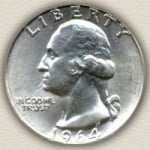
Before 1965, U.S. quarters were composed of 90 percent silver. However, by the mid-1960s, excessive spending had devalued the dollar to the extent that the silver content of a quarter was worth more than its face value. Faced with the choice of making sacrifices or taking the easy road, Washington opted for the latter.
On July 23, 1965, President Johnson approved the Coinage Act of 1965, which eliminated silver from circulating coins. The facts could no longer be obscured; the quarter had lost value well beyond that of its silver content.
Since 1964, quarters have been made from nickel and copper; these alloys can be devalued just like the dollar itself. They are worth $0.25, yet that quarter’s value diminishes continuously.
At the time of this writing, silver is priced at $25.23 per ounce. Based on its silver content—6.25 grams or almost 1/5 ounce—a pre-1965 quarter is currently valued at around $5. Thus, pre-1965 quarters are now worth 2,000 percent more than their current counterparts.
Similar to the pre-1965 quarter, most goods and services have also been revalued in relation to the declining dollar. Moreover, prices from before 2020 are irretrievably gone; they will never return.
Let there be no illusion: the ongoing price inflation is not fleeting. Instead, it is permanent. In fact, we believe a broad mass repricing of materials, goods, and services is now in progress.
Pre-2020 prices, much like those from before 1965, are lost forever. Budget deficits totaling $5.9 trillion over the two years ending on September 30, 2021, combined with a Federal Reserve balance sheet increase of nearly $5 trillion during the same timeframe, have irrevocably altered the pricing framework of our financial ecosystem and economy.
Price inflation is gaining momentum. The truth cannot be obscured by Washington’s fabrications any longer. We anticipate that this inflationary episode will be one for the history books.
Sincerely,
MN Gordon
for Economic Prism
Return from Pre-2020 Prices are Gone Forever to Economic Prism


