Israeli digital intelligence company Cellebrite is equipping law enforcement agencies with advanced artificial intelligence (AI) tools that significantly enhance the speed and efficiency of investigating call records, text messages, images, and videos stored on electronic devices.
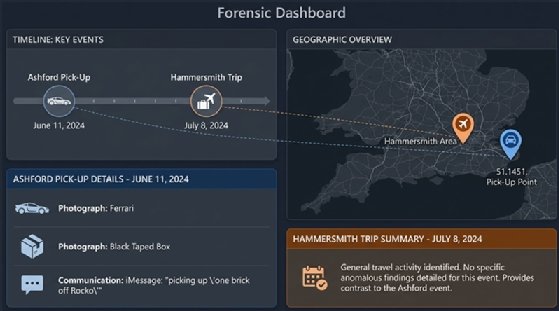
These innovative AI solutions empower police investigators to analyze data from a range of electronic devices, uncover connections between different data sets, track the movements of mobile devices over time, and create comprehensive timelines of events.
Cellebrite’s Guardian Investigate platform is specifically designed to assist law enforcement in tackling serious incidents, such as shootings, terrorist activities, and large-scale organized crime investigations, by providing swift insights from data as it is collected.
This platform enables investigators from various departments and agencies to collaborate on a unified dataset hosted on a centralized cloud platform. It allows for effective task allocation and identifies additional avenues for exploration.
Thanks to this technology, investigators can begin analyzing data the moment it is extracted from a mobile device and uploaded to Cellebrite’s Guardian cloud for decoding and examination, removing the need to wait for forensic experts to provide detailed reports on each individual device.
Mapping people’s movements
The platform can effectively utilize cell site data, which logs the mobile masts a device connects to, alongside Google Maps data, to track an individual’s movements over time.
Guardian Investigate serves as a modern alternative to the traditional whiteboards often used by police during investigations, enabling the mapping of locations, timelines, and communications, including social media activity and video content, with AI tools that can establish relationships among these data points.
Utilizing AI, the system is also capable of identifying unusual behavior. For example, it can detect when two individuals who typically communicate suddenly cease contact or when someone unexpectedly activates airplane mode on their device.
Cellebrite has integrated technology from its 2021 acquisition of the open-source intelligence company Digital Clues to create AI agents capable of identifying the owners of email addresses or phone numbers using publicly available information found online.
AI is able to identify owners of mobile devices
Matt Goeckel, formerly a law enforcement official and now the technical marketing director at Cellebrite, showcased how the tool autonomously identifies mobile phone owners by analyzing the email addresses linked to various applications and utilizing open-source research to establish connections.
“I can instruct Investigate AI to conduct an open-source search and determine what’s accessible regarding this individual,” he explained to Computer Weekly. “We can uncover profile pictures, other names, user handles, phone numbers, and addresses—all of which are public information.”
Goeckel highlighted one of the platform’s most impactful features: its ability to uncover inconsistencies within substantial amounts of evidence, such as conflicting witness statements. With a growing case load, the likelihood of missing crucial details increases, making this functionality invaluable.
The platform supports the aggregation of all data related to a specific investigation, thus eliminating the need for “swivel chairing,” where investigators toggle between screens to view different types of evidence, like surveillance footage and call records.
Rapid summaries of text messages
The Brazoria County Sheriff’s Office in Texas has piloted Guardian Investigate, noting that Cellebrite’s AI technology can condense the contents of a mobile device containing 200,000 text messages in a fraction of the time necessary for human investigators.
This AI software “instantly” identified relationships within the data that would have been “nearly impossible” to discern manually, enabling analysts to produce operational intelligence packages in mere hours instead of months, according to a testimonial provided for Cellebrite.
Cellebrite offers another tool, Cellebrite Genesis, a standalone AI analysis solution for organizations preferring to keep their data confidential. This tool features similar capabilities and operates via a ChatGPT-like interface.
According to Cellebrite, during a counter-terrorism investigation in Australia, Genesis was able to reveal evidence of a planned terrorist attack in just three minutes, a task that would typically demand two to three weeks of work from a human analyst.
Cellebrite reports that digital evidence is now integral to over 90% of criminal cases, including data derived from mobile devices, social media, and, more recently, drones.
Historically, investigators would collect a phone from a crime scene and dispatch it to a lab for analysis, where experts would sift through the data based on a warrant and return findings to investigators.
Ashley Hernandez, a product management executive at Cellebrite, indicated to Computer Weekly that the AI technology allows investigators to engage directly with the data from seized devices immediately, negating the need to await expert analysis and reports. “It operates as close to real time as possible,” she confirmed.
The human in the loop
Cellebrite asserts that its AI tools enable analysts to verify results by examining the source evidence used by the AI, ensuring a “human in the loop” approach to minimize errors and address potential AI inaccuracies.
Peter Sommer, a forensic expert familiar with Cellebrite’s technology, commented on the importance of manually verifying AI-generated results in forensic situations to ensure admissibility in court.
“Whenever AI is applied in forensic science, it is crucial to revisit the original data,” he explained. “While AI excels at processing large volumes of information, it is essential to manually check the findings to avoid errors, as too many complications can arise if one solely relies on immediate AI outputs.”