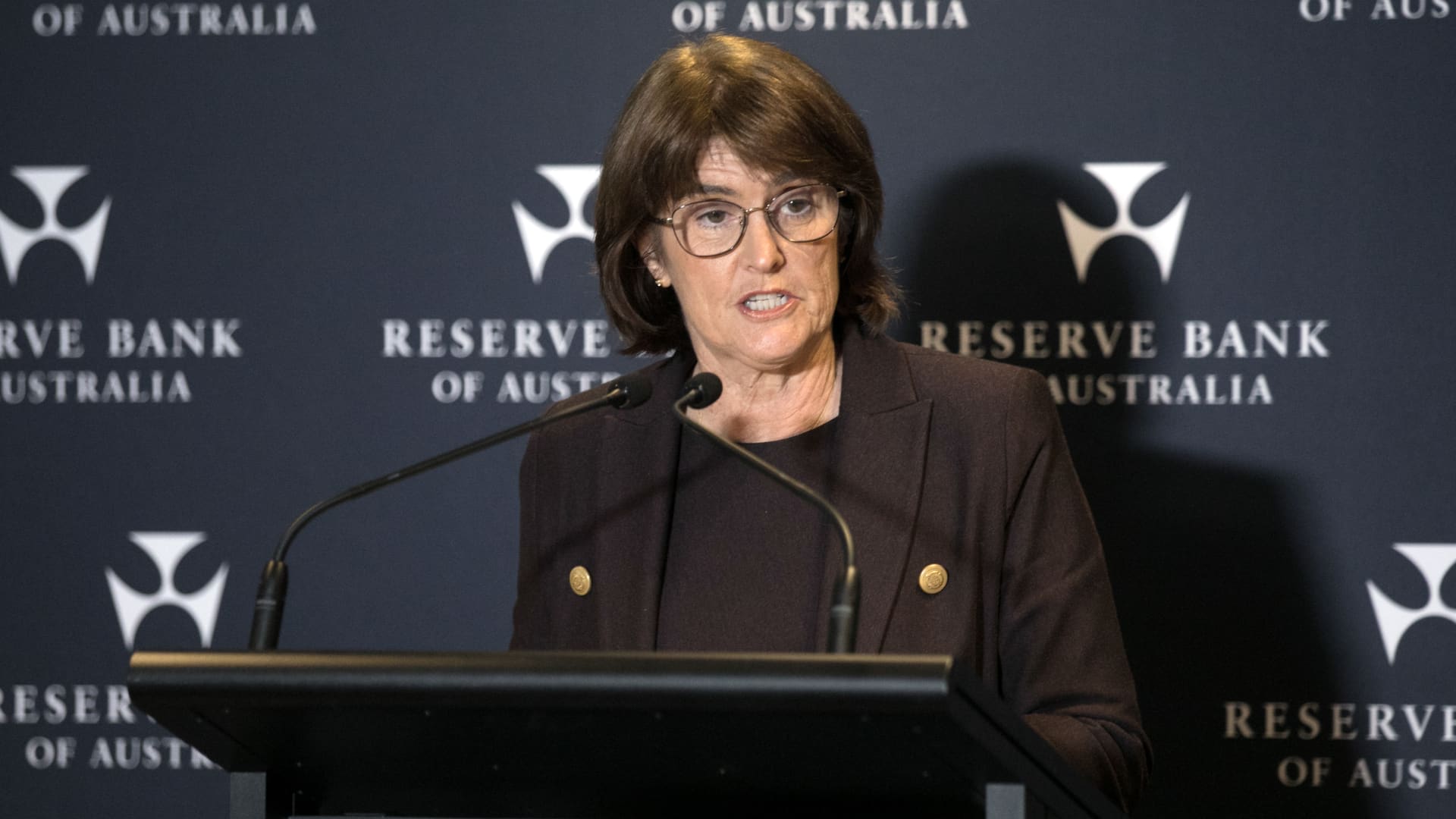
Michele Bullock, governor of the Reserve Bank of Australia (RBA), speaks during a press conference in Sydney, Australia, on Tuesday, July 8, 2025.
Bloomberg | Bloomberg | Getty Images
Australia’s central bank has made headlines once again by raising its benchmark policy rates for the second consecutive time, now set at 4.1%, the highest point since April 2025. This move comes in the wake of persistent inflationary pressures that show little sign of abating.
The recent hike of 25 basis points aligns with the predictions made by analysts surveyed by Reuters. Disquietingly, inflation in Australia remains above the Reserve Bank’s upper threshold of 3%, further exacerbated by geopolitical tensions in the Middle East that threaten to inflate prices further.
“While inflation has fallen substantially since its peak in 2022, it picked up materially in the second half of 2025,” the Reserve Bank of Australia stated in its announcement.
The Reserve Bank noted that while the situation in the Middle East is highly unpredictable, it is likely to exert additional pressure on both global and domestic inflation. They indicated that inflation is expected to remain above the target range for “some time,” which justified the recent rate hike.
In an interview with CNBC’s “Squawk Box Asia,” Paul Bloxham, chief economist for Australia, New Zealand, and global commodities at HSBC, emphasized that domestic factors played a crucial role in the decision-making process.
Bloxham remarked, “The output gap is positive, inflation is too high where it is right now, and the unemployment rate is still quite low.” He highlighted that Australia currently enjoys one of the tightest labor markets globally, with inflation that remains stubbornly elevated.
He further explained that due to the ongoing conflict in Iran, which is driving inflation, the RBA felt compelled to act decisively without waiting for global developments to unfold.
The decision to raise rates was narrowly approved, with five members voting in favor and four against. This nuanced sentiment mirrors concerns previously expressed by Deputy Governor Andrew Hauser who remarked in an interview that “we have a problem with inflation. It’s too high.”
Hauser reiterated the RBA’s expectation that inflation would eventually return to its target range of 2%-3% by late 2026 or early 2027, and to the midpoint of this range by 2028.
In February, the central bank projected that headline inflation would peak at approximately 4.2% around mid-2026, subsequently decreasing to “a little below 3%” by mid-2027.
However, these predictions might need to be adjusted upward due to the recent oil shock stemming from the Iran war. Inflation was recorded at 3.6% for the quarter ending in December, while January’s monthly inflation hit 3.8%, slightly above the anticipated 3.7%.
Meanwhile, economic growth in Australia appears robust, with the fourth-quarter GDP growth reaching 2.6%, providing the central bank with the flexibility to maintain higher interest rates.
In the wake of the announcement, Australia’s S&P/ASX200 index rose by 0.11% following the decision.
Key Takeaways
- The Reserve Bank of Australia has increased benchmark policy rates to 4.1%, the highest since April 2025.
- This marks the second consecutive rate hike amidst persistent inflation pressures.
- Domestic factors are primarily driving inflation, supported by strong economic growth.
- The RBA anticipates inflation will remain above target levels for an extended period.
- The decision to raise rates was narrowly voted on, reflecting concerns from multiple RBA members.
FAQ
Why did the RBA raise interest rates?
Raising interest rates helps combat high inflation, which has been a persistent issue in Australia.
What is the current inflation rate in Australia?
As of now, the inflation rate is recorded at 3.6% for the quarter ending in December, with January showing 3.8%.
When does the RBA expect inflation to return to target levels?
The RBA expects inflation to return to its target range of 2%-3% by late 2026 or early 2027.
How did the market respond to the rate hike?
After the rate hike announcement, the S&P/ASX200 index increased by 0.11%.
What role do global events play in Australia’s inflation?
Geopolitical tensions, such as those in the Middle East, are contributing to rising inflation and economic uncertainty in Australia.
In summary, the RBA’s decision to raise interest rates points to ongoing economic challenges as inflation continues to pose issues and geopolitical factors loom large. These developments will be closely monitored as they affect both the domestic economy and broader financial landscape.