Listen to the podcast and complete the accompanying quiz. If you encounter any difficulties with your answers, consult the provided script for clarification.
This week’s podcast is narrated by Graeme Acres, a production editor at SCMP’s Hong Kong office, and Cathy Hilborn Feng, the health and wellness editor at SCMP.
Script
Adapted from Agence France-Presse
Voice 1: Researchers in Japan have introduced a robot monk powered by artificial intelligence that offers spiritual guidance and may help address the shortage of human monks in the future. Developed by Kyoto University, this innovative machine has been trained using an extensive array of Buddhist scriptures, including some lesser-known texts. It is capable of responding to sensitive inquiries that individuals might hesitate to discuss with others.
Voice 2: Known as Buddharoid, this compact, two-legged humanoid not only provides voice interactions but also creates a tangible presence in religious settings. The university asserts that certain religious rituals traditionally performed by human monks might eventually be assisted by, or even replaced by, these robotic counterparts.
Voice 1: Buddharoid is the latest innovation from Seiji Kumagai, a professor at the university’s Institute for the Future of Human Society. Utilizing AI models from OpenAI and other sources, he has collaborated with engineering firms to design religious AI chatbots, including a Buddha Bot and a catechism bot. His new creation integrates the updated BuddhaBotPlus into a Chinese-made Unitree G1 humanoid robot, resulting in the AI robo-monk.
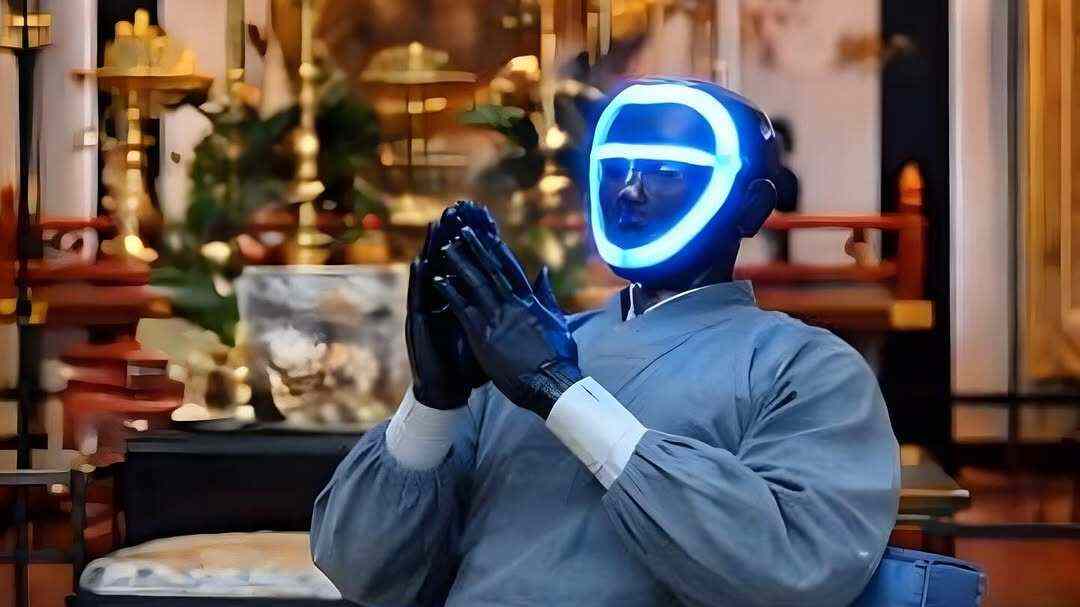
Voice 2: During a media event at a temple, Kumagai introduced the robot, which currently lacks a face and is dressed in a simple gray garment. It performed various tasks, holding its gloved hands together in prayer, walking around, and even offering advice to a young local journalist who expressed concerns about overthinking. The robot emphasized the Buddhist principle of not blindly following one’s thoughts and encouraged a calming of the mind and an acceptance of uncertainty.
Voice 1: AI-driven religious chatbots have gained popularity among millions across various faiths, though their use remains a topic of debate. Kyoto is already home to a non-AI android named Mindar, which delivers sermons. In Germany, a robot equipped with a touchscreen and glowing hands was unveiled in 2017, capable of bestowing blessings in five languages. However, Buddharoid uniquely combines AI and robotics, providing spiritual counsel while executing human-like physical movements.
Voice 2: Kyoto University has highlighted the need for ongoing ethical discussions regarding the proper integration of such technologies in religious practices. With Japan’s aging and shrinking population leading to workforce challenges, these humanoids may undertake specific tasks in the near future. The university suggests that AI robots could eventually participate in religious ceremonies, assisting with or even performing rituals traditionally conducted by human priests.
In conclusion, the emergence of AI-driven robots in religious contexts raises intriguing possibilities and ethical considerations. As technology continues to advance, the integration of AI tools like Buddharoid may reshape how spiritual guidance and practices are delivered in the modern world.