In recent weeks, the political landscape has shifted dramatically following U.S. and Israeli military actions against Iran. As President Donald Trump navigates the complexities of this conflict, his leadership and strategies are facing increasing scrutiny from various quarters. This article delves into the unfolding events and their implications for both domestic and international arenas.
Political Turmoil in the Wake of Strikes
WEST PALM BEACH, Fla. (AP) — In the two weeks since the U.S. and Israel launched strikes on Iran, President Donald Trump increasingly has been knocked on his political heels.
He’s grown more agitated with news coverage and has failed to find a way to explain why he started the war — or how he will end it — that resonates with a public concerned by American deaths in the conflict, surging oil prices and dropping financial markets. Even some of his supporters are questioning his plan, while his poll numbers are declining.
Meanwhile, Moscow is gaining from the war’s early days, thanks to Trump’s easing of sanctions on some Russian oil shipments. This, coupled with rising oil prices, undermines the ongoing effort to limit President Vladimir Putin’s ability to wage war in Ukraine.
Democrats, who were left reeling after Trump won the 2024 election, are regrouping and uniting against Trump’s Iran policy. With control of Congress at stake in November’s midterms, the party is highlighting the economic turmoil as evidence that Republicans have failed to deliver on their promises to lower everyday costs.
“I think Democrats are well-positioned for this November and the midterms,” said Kelly Dietrich, CEO of the National Democratic Training Committee, which trains party backers to run for office and staff campaigns.
Dietrich stated that the past two weeks reveal a lack of long-term planning by the Trump administration. “They’re flying by the seat of their pants, and the rest of us are paying the price,” he remarked.
Trump seeks help securing the Strait of Hormuz
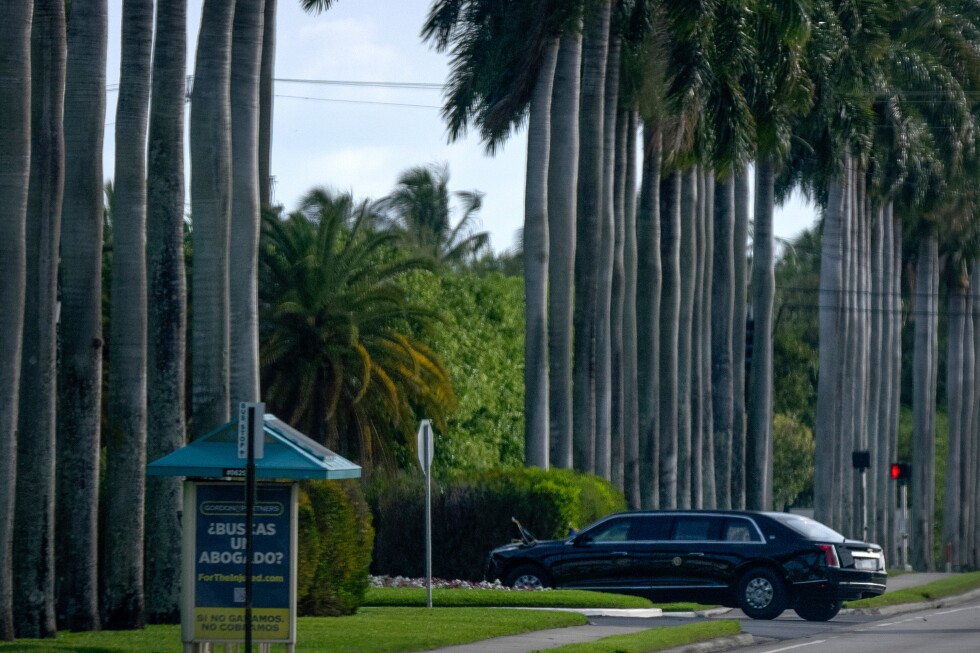
On Saturday, Trump spent hours at his golf club in West Palm Beach, Florida, before attending a closed-door fundraiser for his MAGA Inc. super PAC at his Mar-a-Lago estate.
Last weekend, he also golfed at another of his South Florida properties a day after witnessing the dignified transfer for six U.S. soldiers killed in the Iran war, a death toll that rose this past week.
Trump is increasingly complaining about media coverage of the conflict, stating, “Media actually want us to lose the War.” His broadcast regulator subsequently threatened to pull broadcast licenses unless they “correct course.”
The president — who kept allies other than Israel in the dark about his war plans for Iran — also for the first time suggested that the U.S. would need to seek assistance from the international community to facilitate the movement of oil tankers through the Strait of Hormuz, where transportation has been severely disrupted, impacting global energy markets.
Iran plans to continue its attacks on energy infrastructure while leveraging the effective closure of the strait against the U.S. and Israel. Notably, a fifth of the world’s traded oil passes through this vital waterway.
“Many Countries, especially those affected by Iran’s attempted closure of the Hormuz Strait, will be sending War Ships, in conjunction with the United States of America, to keep the Strait open and safe,” Trump wrote on Saturday, later adding, “this should have always been a team effort.”
It remains unclear if this multinational initiative is set to commence or if Trump is merely hopeful. He also mentioned, “Hopefully China, France, Japan, South Korea, the UK, and others, that are affected” will “send ships to the area so that the Hormuz Strait will no longer” be threatened by Iran.
The White House has not elaborated on Trump’s comments, but other nations are responding cautiously. South Korea plans to “closely coordinate and carefully review” Trump’s statements, while Japan is closely monitoring the situation. Britain’s defense ministry stated that it is “discussing with our allies and partners a range of options to ensure the security of shipping in the region.”
Trump had pledged at the onset of the conflict that U.S. naval ships would escort tankers through the strait, although this promise has yet to materialize. “It’ll happen soon. Very soon,” was his assertion before boarding Air Force One to fly to Florida.
Still, questions surrounding the strait continue to undermine Trump’s recent claim during a Kentucky rally that, “We’ve won.”
“You know, you never like to say too early you won. We won,” he stated. “We won. In the first hour, it was over.”
The war has far-reaching political implications
The U.S. Treasury Department announced this past week a 30-day waiver on Russian sanctions to facilitate the release of Russian oil cargoes stranded at sea, aiming to alleviate supply shortages caused by the Iran war.
Despite this, analysts argue that soaring oil prices due to Persian Gulf production disruptions are benefiting the Russian economy, which relies heavily on oil revenue to fund its military actions in Ukraine, making sanctions increasingly burdensome.
Key allies in Washington have expressed disapproval, arguing that this move empowers Putin. Ukrainian President Volodymyr Zelenskyy called the easing of sanctions “not the right decision” and “certainly does not help peace,” as it strengthens Russia’s position.
With midterm races heating up, Trump was asked Friday night about his message to voters concerned about high gas prices.
“You’re going to see a very big decrease in the prices of gasoline, gas, anything having to do with energy, as soon as this is ended,” Trump asserted.
However, Energy Secretary Chris Wright noted on NBC’s “Meet the Press” that higher energy prices are afflicting “Americans right now” and will continue to do so “for a few more weeks.”
The protraction of the conflict raises concerns about the midterm elections. Senator Rand Paul, a Kentucky Republican, suggested on Fox News Channel that if gas and oil prices remain elevated, “you’re going to see a disastrous election” for the GOP.
Iran has also further divided Trump’s “Make America Great Again” base, with some advocating for the military action and others asserting that Trump campaigned on a platform to end wars.
Prominent figures on the right, including Tucker Carlson and Megyn Kelly, have sharply criticized Trump. Nonetheless, Trump maintains that he created the MAGA movement and that it will follow him on any issue.
The ongoing political turbulence has led some Democrats to predict potential midterm gains that could rival the 2018 “blue wave” election during Trump’s first term.
“Democrats just have to keep reminding people that he made a promise to bring prices down, and they’re still going up,” stated Democratic strategist Brad Bannon. “Now they’re going to go up even more because prices in gasoline can increase prices of everything else, including in grocery stores.”
Key Takeaways
- The political implications of the conflict in Iran are proving significant for both parties.
- Trump’s popularity is being challenged amid rising oil prices and concerns about military action.
- Democrats are uniting against Trump’s Iran policy, hoping to capitalize on economic turmoil in the upcoming midterms.
- International cooperation concerning the Strait of Hormuz remains uncertain as various nations respond cautiously.
- Concerns over high gas prices pose a dilemma for the GOP as they approach midterm elections.
- The easing of sanctions on Russia could have unintended consequences for U.S. foreign policy.
FAQ
What actions has the U.S. taken against Iran?
The U.S., alongside Israel, has initiated military strikes aimed at Iran.
How has the situation affected oil prices?
The conflict has led to rising oil prices due to supply disruptions, significantly impacting global markets.
What is the response from other countries regarding the Strait of Hormuz?
Countries like South Korea and Japan are closely monitoring the situation and discussing security options for shipping in the region.
How are American voters reacting to Trump’s policy?
Concerns about rising gas prices and war-related casualties are causing voters to question Trump’s leadership and decision-making.
As the situation continues to evolve, the interplay between conflict and politics will likely shape the future landscape in both domestic and international arenas. Ongoing responses from political figures and nations will further determine the trajectory of these events.


