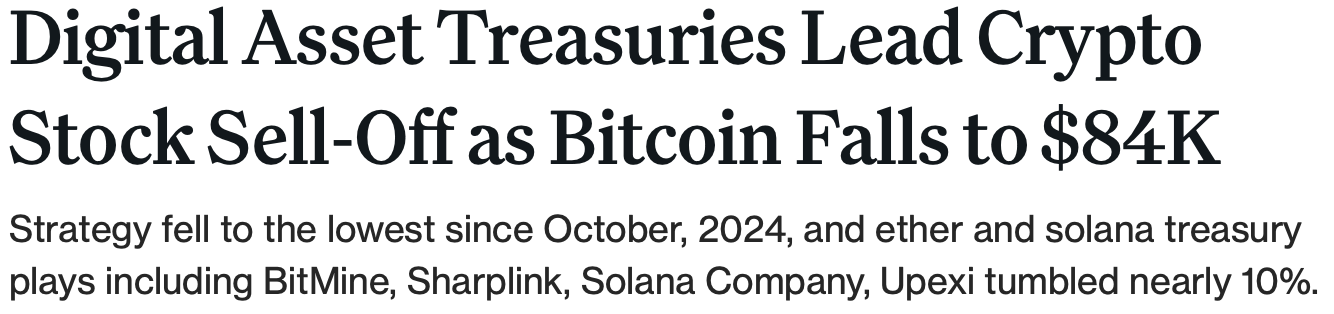
The world of cryptocurrency has recently faced significant turbulence, highlighting the risks associated with high leverage and the speculative nature of digital assets. As Warren Buffett aptly pointed out, the true financial state of investors is revealed in times of crisis. The decline in cryptocurrency values, particularly Bitcoin, raises concerns about the extent of debt fueling this boom. Let’s explore the factors contributing to this downturn and the implications for both retail and institutional investors.
Warren Buffett famously stated, “Only when the tide goes out do you discover who’s been swimming naked.” He did not, however, elaborate on how market losses, particularly with the involvement of substantial leverage, can exacerbate these situations. Currently, we’re witnessing the ramifications of borrowed money that contributed to the crypto surge, as experts caution that the downward spiral could turn severe. Due to the absence of regulation and centralized reporting, along with the vast number of cryptocurrencies involved, it’s challenging to assess the total debt tied to the crypto surge. Nonetheless, the ongoing decline of Bitcoin, once seen as a leader in the field, suggests that the leverage may be more substantial than anticipated.
Before delving into the concept of crypto “treasuries”—which misleadingly labels entities that purchased cryptocurrency, borrowed against it, and sold interests to investors through ETFs—let’s evaluate the fallout from the current downturn.

“Since October 2024” doesn’t sound too alarming, unless you were an investor who increased your Bitcoin or crypto holdings during that period.
LIKE, IF YOU ARE NOT SELLING #BITCOIN pic.twitter.com/uRb5F4kGMO
— Vivek Sen (@Vivek4real_) December 1, 2025
However, the focus is now shifting towards the strategy employed by crypto treasuries. Bloomberg Asia recently reported on:

Highlighted in the report:
- Retail investors who got involved in Michael Saylor’s Bitcoin venture are suffering as the value of shares in Strategy Inc. plummeted more than 60% from recent peaks.
- Popular exchange-traded funds connected to Strategy’s stock have seen declines exceeding 80% this year, with MSTX, MSTU, and MSTP collectively losing around $1.5 billion in assets since early October.
- In response, Strategy Inc. has built up a $1.4 billion reserve to support dividend and interest payments, hoping to alleviate fears of being forced to liquidate Bitcoin if prices continue to drop.
Strategy Inc., once celebrated for integrating crypto exposure into a public stock, now faces a crisis as its shares have dropped sharply over recent weeks. In an effort to stabilize the situation, the company has established a $1.4 billion reserve meant to secure dividend and interest commitments, hoping this will reassure investors and stave off potential mass sell-offs.
However, for many investors, the damage is already significant. The most recognized exchange-traded funds tracking Strategy’s volatile stock — MSTX and MSTU, which promise double the daily returns — have fallen more than 80% this year, ranking among the ten worst-performing funds in the US ETF landscape. A third fund, MSTP, introduced during the crypto frenzy in June, has suffered a similar fate, leading to a total loss of about $1.5 billion in assets since early October.
At the core of these concerns lies a valuation metric known as market net asset value (mNAV), which compares Strategy’s business valuation to its Bitcoin reserves. This premium has nearly vanished, with the ratio falling to approximately 1.15—an area flagged by executives as a potential warning sign. CEO Phong Le mentioned on a podcast that if this ratio were to drop below 1.0, the company might have to sell Bitcoin to cover payout responsibilities, albeit only as a last resort.
For five years, Strategy (NASDAQ:MSTR), still referred to as “MicroStrategy” by many traders, adhered to a fundamental principle: accumulate Bitcoin (CRYPTO:BTC), never divest. Executive chairman Michael Saylor transformed this unwavering policy into a well-recognized brand, and the company’s stock price surged faster than the asset it collected.
Saylor’s practice of sharing updates on Bitcoin purchases via social media became a ritual for crypto enthusiasts. Unlike his commitment to buying, he has never showcased any signs of selling. When questioned about potential losses during a market downturn, Saylor responded that he would simply buy more Bitcoin.
According to the Wall Street Journal in The Year’s Hottest Crypto Trade Is Crumbling:
Michael Saylor initiated a transformative strategy in 2020 when he turned MicroStrategy, then a modest software firm, into a major player in the Bitcoin market. However, as Bitcoin and Ethereum prices decline, shares of Strategy and its similar ventures are similarly faltering. At its peak in July, Strategy was valued at around $128 billion; now, it has shrunk to about $70 billion.
This selloff has impacted prominent investors, including venture capitalist Peter Thiel, who has supported numerous crypto-treasury companies, as well as those who followed aggressive investors into these stocks.
Brent Donnelly, president of Spectra Markets, remarked, “The entire concept is nonsensical. You end up paying $2 for a one-dollar bill,” indicating that such valuations may not hold up for long.
Initially, crypto-treasury companies provided a way for institutional investors who couldn’t easily access crypto to participate. However, recent crypto exchange-traded funds also offer similar opportunities.

Shares of Strategy fell after the Bitcoin advocate launched a dollar reserve to sustain its dividends and warned of a potential $5.5 billion loss if cryptocurrency prices fail to rebound this year…
The company has financed its Bitcoin acquisitions through a combination of debt and equity instruments, many of which have pledged dividend payments to investors.
However, with Bitcoin’s price slumping from record highs above $126,000 in early October to approximately $85,000 within just over a month, Saylor’s strategy is facing scrutiny.
On Monday, Strategy announced the establishment of a $1.44 billion US dollar reserve to maintain dividends. This reserve was financed through capital raised from share sales, with the goal of covering “at least 12 months of dividends” and potentially extending to “24 months or more” in the future.
While shares in Strategy initially dipped by over 12% before closing 3.3% lower, the stock has declined nearly 41% this year as investors have expressed doubts about the sustainability of its business model.
The company has been acquiring Bitcoin through share issuance, convertible debt, and new preferred equity products, indicating that it needs cash reserves to meet obligations to its $8.2 billion in convertible debt holders if stock prices do not improve.
As the decline intensifies, this downturn isn’t happening in a vacuum. Two weeks ago, The Economist reported in Crypto Got Everything It Wanted. Now It’s Sinking:
In recent years, the crypto sector has transitioned from being ridiculed by mainstream finance to gaining broad acceptance and support from regulators. Financial institutions are launching new products, and the current wave of American regulators shows a favorable attitude toward crypto. Bitcoin’s market value peaked at $2.5 trillion in October.
However, this newfound success has brought its own set of challenges as prices have plunged: Bitcoin fell from an all-time high of roughly $126,000 in early October to just over $92,000. For speculative assets like Bitcoin, which generate no income and depend solely on future capital gains, the absence of a new bullish narrative complicates matters. Additionally, the increasing integration of crypto with other market sectors means that any price dips will have broader repercussions than in the past.
During the lockdowns of 2020 and 2021, fiscal stimulus fueled interest in cryptocurrency, and mainstream brokers began offering crypto trading. Today, acquiring Bitcoin is relatively accessible, with various trading platforms available to consumers.
However, some significant investors remain cautious, and while recent purchases by central banks highlight interest, they are minuscule compared to overall reserves.
Further, developments in China have intensified the situation. Coinspeaker reported on November 29:
China is tightening its restrictions on crypto payments, as regulators warn that digital assets are once again posing risks to the country’s financial system. Officials noted that trading activity has resumed despite previous bans, leading to stronger enforcement measures against the use of crypto for payments and transfers.
Both the central bank and regulators acknowledged that while the 2021 ban pushed crypto trading underground, the market remains active, largely characterized by scams and unregulated transactions.
They reiterated that digital assets do not qualify as legal tender in China and cannot be used as currency, warning that financial activities involving these assets are illegal.
Particularly troublesome are stablecoins, which complicate user tracking due to their anonymous nature.
China’s relentless crackdown on scams also extends its reach to other countries, like Thailand, in a bid to stifle capital flight and money laundering.
Returning to the notion that Strategy will not liquidate Bitcoin seems overly optimistic. As Michael Shedlock mentioned:
Technical Failure
Bitcoin has plummeted from over $126,000 to $80,000.
After a slight recovery to about $93,000, it has since stalled.
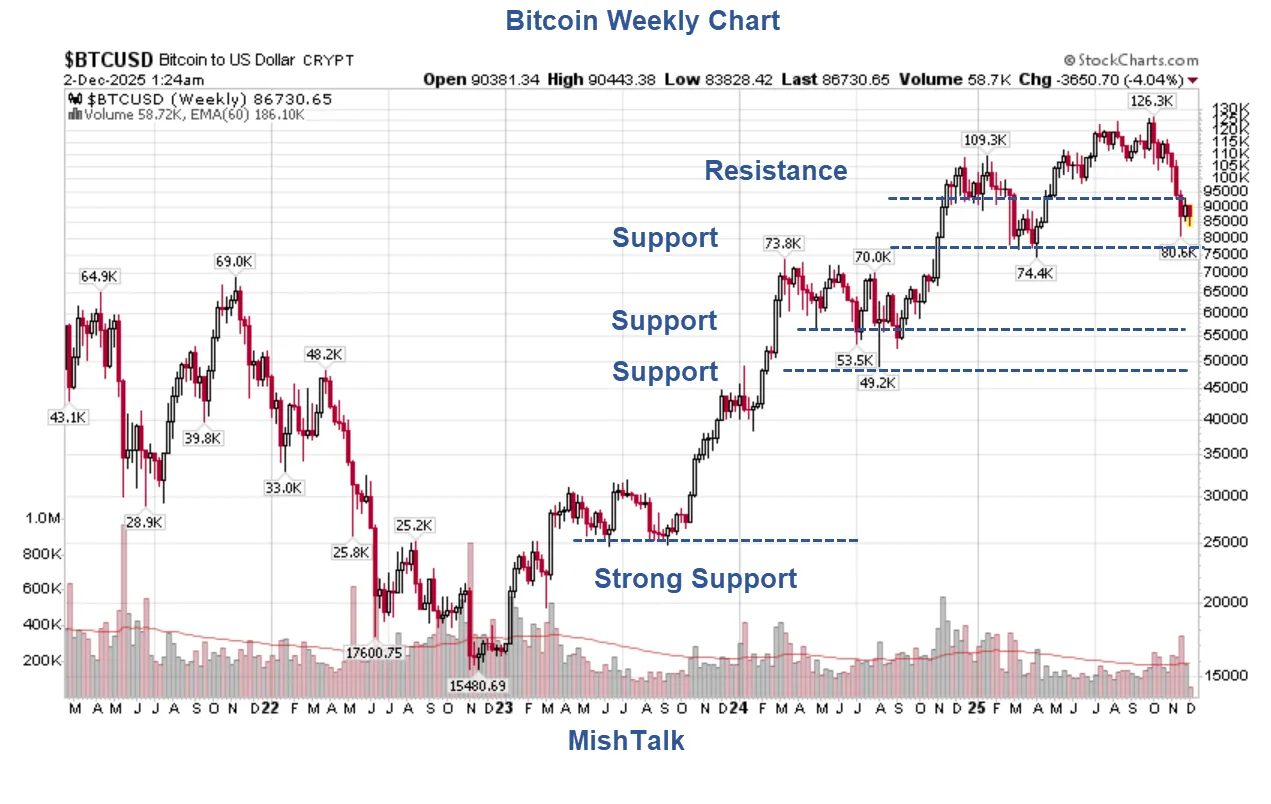
If Bitcoin fails to hold this level, potential support thresholds are at $75,000, then $55,000, followed by $49,000. Subsequent failures could see prices drop to $40,000 and even $25,000.
Others are more critical:
Remember what Michael Saylor said he would never sell Bitcoin?
-I warned from the outset that this individual poses a liability to the whole industry; $MSTR is essentially a Ponzi scheme. They had to sell shares to repay current investors & loans.
Now, they’ll eventually need to liquidate Bitcoin.
— Crypto Bitlord (@crypto_bitlord7) December 2, 2025
Twitter has seen outcries about alleged victimization:
JPMORGAN ACCUSED OF PARTICIPATING IN MARKET MANIPULATION🚨
🤔🩳 JP Morgan sells shares of MSTR, ramps up margin requirements from 50-95%, lobbies for Strategy’s exclusion from the MSCI index, has an established pattern of manipulating BTC prices, and waits for a -35% drawdown… pic.twitter.com/t6gP3yc5uz
— X Market News🚨 (@xMarketNews) December 2, 2025
There is an equal amount of hopeful speculation, suggesting that if and when MSTR reaches $1,000, supporters will undoubtedly celebrate:
Just a heads-up: I will be absolutely unbearable when MSTR is trading at $1,000.
— The ₿itcoin Therapist (@TheBTCTherapist) December 2, 2025
In contrast to Shedlock’s assessment, some are optimistic about Bitcoin’s resilience:
Bitcoin has NEVER dropped below its production cost
Current production costs ≈ $71,000 pic.twitter.com/E0lBK7TB15
— Coin Compass (@CoinCompassHQ) December 1, 2025
Finally, there is considerable chatter on Twitter about Vanguard recently allowing Bitcoin ETF purchases. Nonetheless, one might speculate that those most interested in Bitcoin assets would have already engaged elsewhere.
As this situation continues to unfold, the implications for investors remain vast and uncertain. Stay tuned for developments.